@DeCesareStephen @TheOfficeCalvin From his "Exposition of the Creed, 36." The Catholic Church however, overstepped these boundaries and violated the very tradition they claimed to defend. Unfortunately Trent has anathemized the reformers which we're making the same claim as Rufinus and many other fathers.
@DeCesareStephen @TheOfficeCalvin the "canonical" (in reference to the proto-canon) which is binding for doctrine. Read Rufinus: "They were willing to have all these (deuterocanon) read in the churches but not brought forward for the confirmation of doctrine...These are what the fathers have handed down to us" +
@HeritageSparks You know the opposite is also true. Many in the ministry occasionally feel the overwhelming urge to quit and find a regular job. The grass always looks greener on the other side!
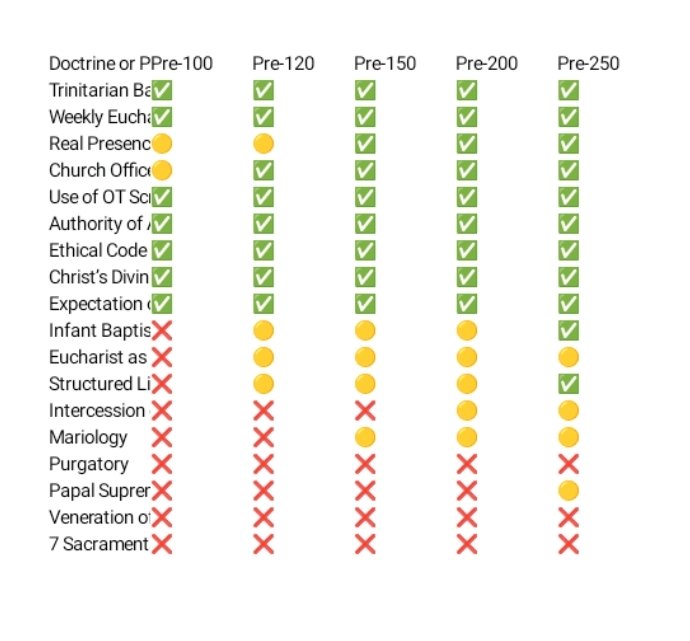
Under such circumstances traditional Protestantism and Anglicanism and to a lesser extent others, have as much a claim to be true expressions of Christianity. In almost all metrics they resemble the pre-200's church more doctrinally than today's Catholic or orthodox churches.
i asked ai to make a chart of what apostolic tradition or the "regula fidei" consisted of, putting in all the data points of Christian writing. Here is the chart. Clearly there is a stable part and a developing part creeping in. @potamopotos@TheOtherPaul2@C2Antiquity
"...while they do not observe the things which the apostles delivered, and even profess to maintain them contrary to apostolic tradition.”
Ergo it is very clear that if doctrinal purity is lost "apostolic succession" stops being a legitimate metric of the "true church"
@iamrjknight Though I would add a little nuance. Christ alone is our foundation, as revealed through Scripture. Lest we fall into the trap of making out of scripture a collection of prooftexts to back up our particular views instead of viewing the scriptures through a Christ centered paradigm
@CustosX@samuelmiller64@SecretFire79 Really? i would suggest you study p75 and p4. Both are the earliest exemplars we have of manuscripts including the first pages of a gospel. Both have titles. Both date from the latter part of the 2nd. c. Both suggest that the exemplars they we're copied from had the titles too.
@redeemed_zoomer i have to say that while many christians from traditional churches accuse protestants of bibliolatry, they nevertheless turn a blind eye to their own "ecclesiolatry"
@BishopJaxi Would you accept Rufinus as an authority in this matter?
https://t.co/8lm1TW5MhA
Notice the distinction he makes between "canonical" and "ecclesiastical" and the comment he makes about how they were not to be used for confirmation of doctrine as an apostolic tradition.
@joshozchelik O, Babanın ilk ürünüdür, var edilme anlamında değil,
çünkü başlangıçtan beri Tanrı, ki kendisi ezeli akıldır, Kelam’ı kendisinde barındırıyordu
ve ezelden beri kendisi Kelam ile içiçeydi.” (Hristiyanlar İçin Bir Dilekçe, 10)
@joshozchelik “Baba ve Oğul birdir. Oğul Baba’da bulunur, Baba da Oğul’da bulunur. Baba’nın
düşüncesi ve kelamı Tanrı’nın Oğludur. Birlik ve ruhsal kuvvet bakımından birdirler.
Ancak, üstün zekanıza dayanarak Oğul ile ne kastedildiğini sormak aklınıza gelirse,
Kısaca şöyle açıklayacağım:
@joshozchelik Sadece bazı protestanlarda değil, protestanları eleştiren diğer hristiyan mezheplerden olan bazı kişilerde de ciddi bilgi eksikliği var.
Şu üç terimi wikiden araştırmak, basit de olsa bir başlangıç olabilir: Nuda Scriptura, Sola Scriptura, Prima Scriptura.