Grok @bot is incredible - and they can even manufacture real physical objects! Here is a little experiment I did last night: I created a team of bots and asked them to solve a complex engineering problem end to end - starting from four images as design cues, inferring transferable structural principles from the pixels, synthesizing an executable interactive physics simulator, running and reasoning over experiments, optimizing the design & finally manufacturing the best designs.
The entire loop worked remarkably well - and I was even able to communicate with the agents from my Apple Watch. (Do we live in the future yet?)
Team of agents
1⃣ Chief of Staff coordinates the workflow: watches the other agents, pulls results into the main chat, transfers files between them, and keeps the job moving.
2⃣ Physics Experimenter is the scientist-coder. It interprets the design cues and images, writes the simulator, runs experiments, analyzes the results, and produces a detailed LaTeX scientific report.
3⃣ 3D Printing Bot operates the fabrication workflow: prepares and slices the models, generates manufacturing code, sends the job, and monitors the printer.
The workflow
I provided an initial task based on four unregistered reference photographs containing different objects at different scales (pinnate leaf venation, a Voronoi-like areole mesh, a stochastic fibrous lattice, and a radial/circumferential web).
The prompt asked the agents to infer transferable design principles - hierarchy, branching, interfaces, redundancy, disorder, load paths - and use them to build an interactive laboratory for hierarchical materials and fracture.
The scientific question was: at fixed material budget, how do hierarchy depth, redundancy, disorder, and interlevel strength change stiffness, peak load, energy absorption, and the brittle-to-progressive transition?
In ~20 minutes, the Physics Experimenter produced a 2D hierarchical Euler–Bernoulli beam-network laboratory. Coarse veins persist and remain thicker; finer infill is added inside cells; members connecting levels are treated as interfaces with relative strength κ; and total material volume is conserved. The four source photographs remain visible in an editable interpretation panel. The app generates geometry, steps or runs the network to failure, compares A/B/C designs, and exports JSON, CSV, PNG, and STL geometry for fabrication.
After validation the Physics Experimenter used the app and conducted 47 simulation experiments, including six holdouts.
It found something scientifically interesting: extra hierarchy is not "free" toughness. At fixed volume, initial stiffness changed by only about 20%, while work-to-failure varied by several-fold. Infill steals cross-section from the main axial veins, so deeper and more redundant networks often absorbed less energy than a simple depth-1 grid. Weak interfaces behaved as distributed fuses, producing more progressive failure and reducing localization. The specific H2 hypothesis - that hierarchy becomes detrimental primarily because interfaces form a mechanical bottleneck - was rejected; the dominant effect instead came from redistribution of a fixed material budget across structural levels.
The Physics Experimenter then assembled the methods, tests, results, hypothesis evaluation, and conclusions into a detailed scientific report.
The best designs were passed to the 3D Printing Bot. It opened Bambu Studio and brought the Bambu Lab H2D online. Both STLs were placed on one build plate at the same 50x scale and sliced using a 0.20 mm PLA process. The prints completed within less than an hour.
The loop
images → structural abstraction → executable physics → autonomous experiments → hypothesis testing → design selection → STL → slicing/manufacturing code → physical object
That last transition is what I find especially interesting: AI is beginning to operate across the entire scientific and physical workflow - converting observations into models, models into experiments, experimental evidence into revised designs, and those designs into manufactured matter by directly operating machines. This starts to blur the boundary between AI that reasons about the physical world and AI that can actually act on it.
Shoutout to the @bot team - you are building something very special here! The way these agents can move naturally from reasoning, to experiments, to operating machines in the physical world feels like an important step.
We might be witnessing the shift from simulating behavior to building real internal reasoning.
Anthropic’s research on "J-Space" reveals an internal Global Workspace inside models a mechanism hauntingly similar to human cognition. https://t.co/E5hlaah40b
@hot_town Not a universal truth, but after years of testing every note-taking system: I’m back to Apple Notes, and sometimes paper & pen remains unbeatable for my needs.
Fancy graph views gave me a nice dopamine hit, but zero real value for my actual work. Fun entertainment, nothing more.
@mitchdeg@StephaneMallard Sur le key man risk, cela me rappelle votre blog et le post sur Steve Jobs et Apple à l’époque, c’est loin 😊 finalement il avait su préparer l’après-Jobs !
Je serais surpris qu’Elon ne fasse pas de même. Ces grands bâtisseurs démultiplient leur génie en s’entourant parfaitement
The fastest way to change your life is to rip yourself out of your (physical and digital) environment. Change everything overnight. The places you go, the accounts you follow, the info you consume, etc. It's difficult but it absolutely works.
Today, we share a breakthrough on the planar unit distance problem, a famous open question first posed by Paul Erdős in 1946.
For nearly 80 years, mathematicians believed the best possible solutions looked roughly like square grids.
An OpenAI model has now disproved that belief, discovering an entirely new family of constructions that performs better.
This marks the first time AI has autonomously solved a prominent open problem central to a field of mathematics.
Arthur Mensch (Mistral) : "aujourd'hui les ingénieurs logiciels chez Mistral n'écrivent plus de ligne de code", ce sont des "managers d'agents" ; la productivité est énorme pour un individu, mais au niveau d'une grande entreprise il reste un goulot d'étranglement organisationnel.
We are cooked💀
100% AI
PROMPT: "A professor writes out a mathematical proof for trigonometric identities on a traditional chalkboard, explaining the step he is currently on in the equation."
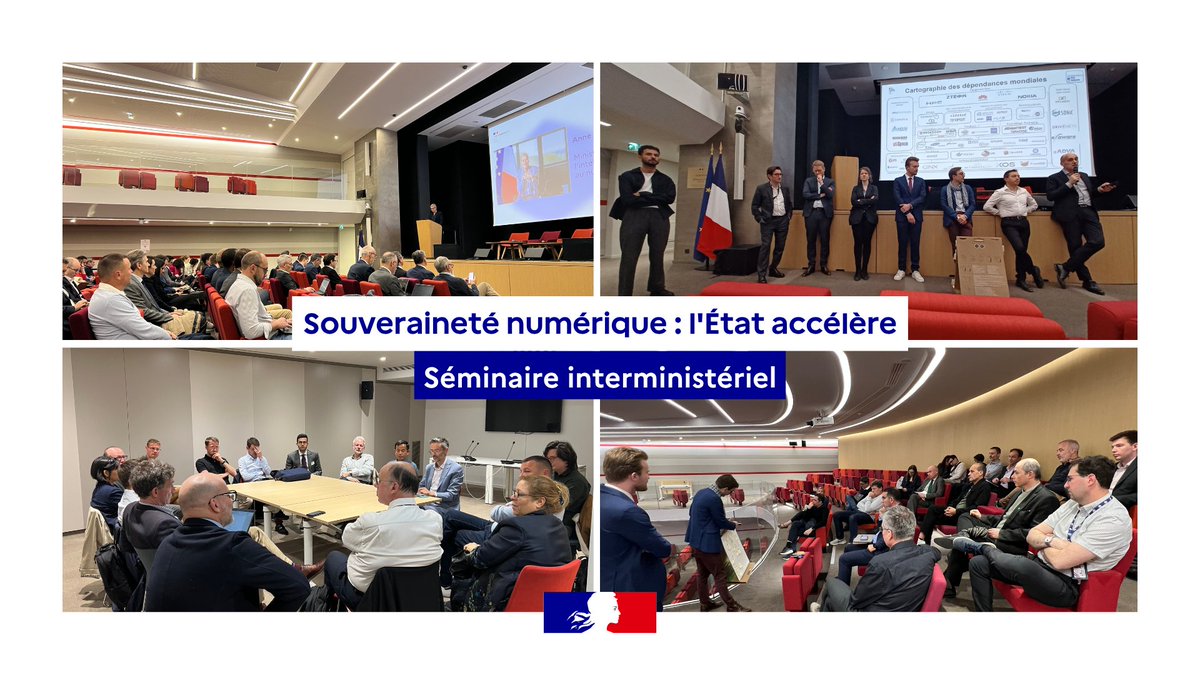
L'État accélère son virage vers encore + de souveraineté numérique 🛡️
Retour sur le séminaire interministériel #SouverainetéNumérique qui s'est tenu hier à Paris visant à réduire les dépendances extra-européennes de l'État. #GAFAMDetox
En savoir plus → https://t.co/63z1uYnyTT
I can't go back to the regular YouTube UI after this 😅
Obsidian Reader now makes the transcript interactive so you can scrub, highlight, auto-scroll. It feels so nice.
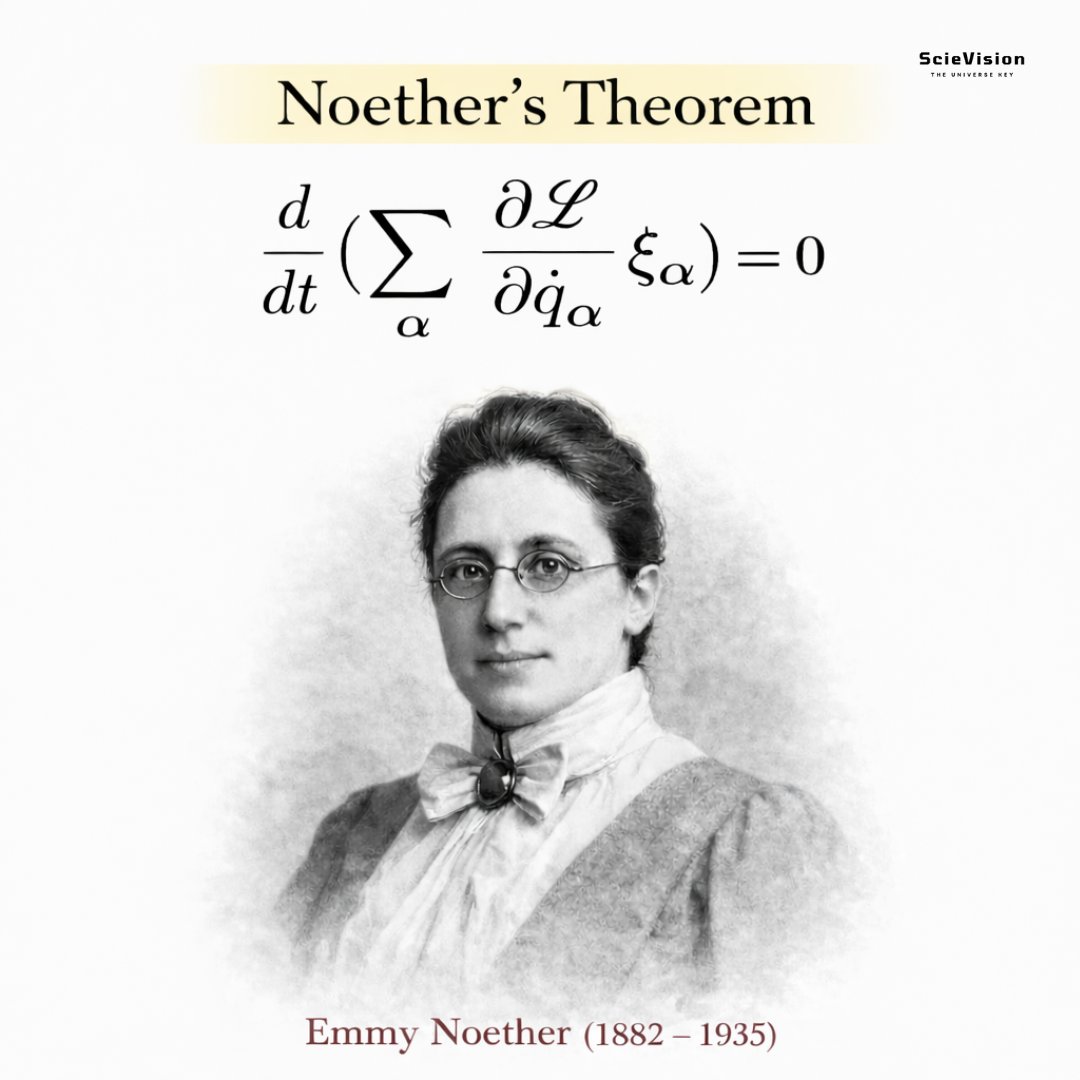
Noether’s Theorem ✍️
This equation reveals that every continuous symmetry in nature, a change you can make to a system without affecting its physical laws, brings about a conservation law. In simple terms, if the universe does not react to a certain change in perspective, it must keep a related physical quantity constant. For example, since the laws of physics remain unchanged no matter when you are (Time Symmetry), energy is conserved. Since the laws are the same regardless of where you are (Space Symmetry), momentum is conserved. Because they stay the same regardless of which way you face (Rotation Symmetry), angular momentum is conserved. This insight shifted our view of the universe. We no longer see conservation as just a series of lucky observations, but as a necessary outcome of the symmetry of space and time.
With rare exception, ideas really are trivial compared to execution.
For example, the idea of going to the Moon is simple, but ACTUALLY going to the Moon is staggeringly difficult.
@FrancescoD_Ales@FrancescoD_Ales Yes, but the problem is that Obsidian doesn't have an online version unlike Capacities. For me, that's really the only missing feature... at minimum as a paid option like for synchronization.