This is the most important piece of technology analysis published since the war began. Read every word. My good friend @veronken just connected a chain that nobody in Silicon Valley, Wall Street, or the Pentagon has connected in a single document.
The chain: a missile hits a gas facility in Qatar. The gas facility produces helium as a byproduct of LNG liquefaction. Qatar produces 33 percent of the world’s helium. All three Ras Laffan helium plants have been offline since March 2. QatarEnergy’s CEO confirmed the strikes reduced helium export capacity by 14 percent with repairs taking three to five years. One-third of the world’s supply of a gas that cannot be manufactured, only extracted from billion-year geological decay, removed from the market by the same missiles that took out 17 percent of global LNG.
Helium is not a balloon gas. It is the most critical process gas in chipmaking. Its thermal conductivity is six times nitrogen. In plasma etching, the step that carves nanoscale circuits into silicon, there is no deployed substitute at scale. The chips do not get made without helium. The AI does not train without the chips.
South Korea imports 64.7 percent of its helium from Qatar. South Korea is home to SK Hynix, which holds 62 percent of the global High Bandwidth Memory market, the single component NVIDIA cannot build an H100 or Blackwell without. NVIDIA accounts for 27 percent of SK Hynix’s total revenue. The $54.6 billion HBM market that Bank of America calls a 2026 supercycle depends on fabs that are now losing their helium, their oil, and their LNG from the same chokepoint simultaneously. Seoul imposed fuel rationing on March 25. QatarEnergy declared force majeure on South Korean LNG contracts on March 24.
Here is where Veron’s analysis goes beyond anything I have seen from Fortune, Bloomberg, Fitch, or any institutional research desk. South Korea does not just make the memory. South Korea builds the ships. Korean shipyards delivered 83.8 percent of global LNG carriers over the past five years. They hold two-thirds of the global orderbook. The world needs more LNG carriers to replace Qatar’s lost output. The country that builds those carriers is the same country being energy-starved by the loss of that output. The feedback loop is closed. The energy crisis hits the shipyards. The shipyard delays worsen the energy crisis. The energy crisis hits the fabs. The fab delays worsen the AI supply chain. One country. Three vulnerabilities. One chokepoint.
The buffers are real and Veron states them honestly. SK Hynix holds six months of stockpile. Samsung’s recycling system cuts consumption 18 percent. Over 70 percent of leading fabs recycle 80 to 95 percent of process helium. These buy time. Not immunity. If the strait reopens within 60 days, the supply chain exhales. If closure extends past six months, stockpiles thin and the structural deficit has no solution because the US cannot rapidly scale and Russia’s Amur plant faces sanctions.
This is the Nitrogen Trap applied to silicon. The same thesis this series demonstrated for diesel, sulfuric acid, and fertiliser now applies to the noble gas that makes AI physically possible. Jensen Huang’s roadmap runs on atoms before it runs on bits. The atoms are helium. The helium comes from Qatar. Qatar is offline. And the country that fabricates the memory and builds the replacement ships is being triple-starved by the same strait that Fink says determines whether we get $40 oil or $150 oil.
Read @veronken’s X Article. It is the best piece of supply chain analysis I have seen this year so far. The AI boom was built on an assumption so fundamental nobody stated it: that the physical world would cooperate. The physical world has stopped cooperating. The atoms are stuck. And the bits cannot move without them.
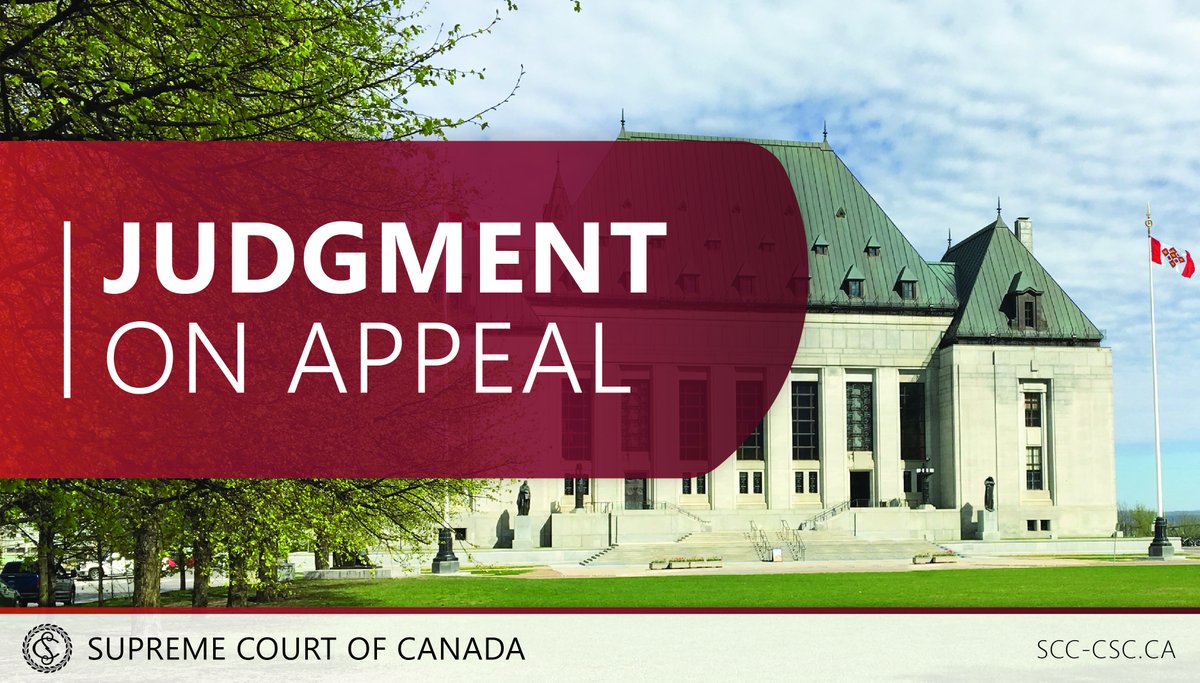
The Court has allowed the appeal in Yatar v. TD Insurance Meloche Monnex. It clarified the approach to judicial review where a right of appeal is limited by statute to questions of law. Read our plain-language summary here: https://t.co/GCIzH88qQC. #CdnLaw
Would you believe us if we told you over 70% of Canadian constitutional documents are NOT officially bilingual?
🎥If you want to know why many documents have yet to be adopted in French, watch this: https://t.co/pCnt0JxDuk #bilingual@Improteine
My family's thanks to @dandundas for such a lovely memorial of my mother's business career.
Obituary: Former Royal Connaught Hotel owner Joyce Mongeon was ‘a force of nature’ https://t.co/gfAyEIw3yU via @torontostar
This is a very unfortunate directive. Should there be required disclosure when an articling student was used? When CanLII was used (or not used?) to note up cases? Why is AI any more special that the lawyer whose name on the filing is any more or less responsible for it?
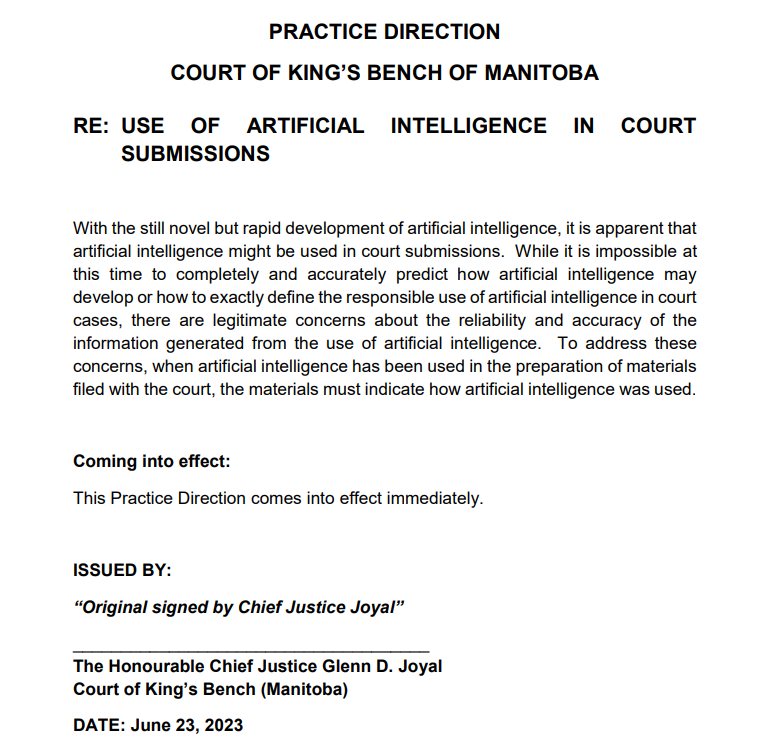
New AI practice directive - first of its kind in a Canadian Court?
"...when artificial intelligence has been used in the preparation of materials filed with the court, the materials must indicate how artificial intelligence was used"
https://t.co/Us90i2UU2P
Sometimes the "first of its kind" does not mean it is correct.
Consider: does this mean we should disclose when we use (or NOT use) CanLII to note up cases cited?
Or when an articling student or clerk prepare parts of our document?
This direction should be resisted.
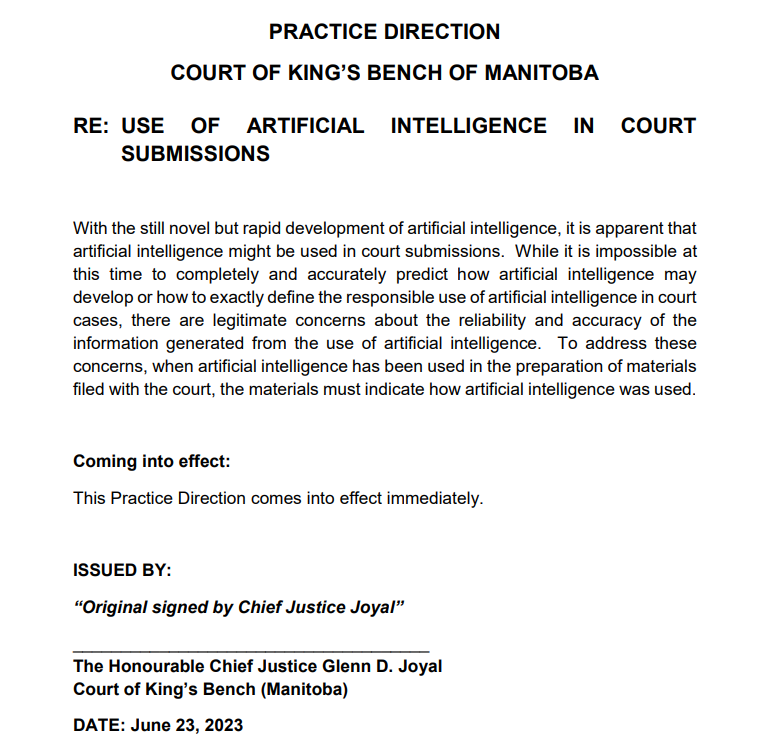
New AI practice directive - first of its kind in a Canadian Court?
"...when artificial intelligence has been used in the preparation of materials filed with the court, the materials must indicate how artificial intelligence was used"
https://t.co/aZgC3QRHwW
@JOpolsky Time to recall the difference between ss. 91, 92 and 96: even though the feds pay for the Superior Court judges, the province pays for clerks and other court staff.
Provincial governments are happy to call on Ottawa for the appointment of more judges without supporting them.
@pouchbaby 20 years ago it was very common to hear "where are you from?". Not sure it is appropriate in many contexts anymore.
However, are we allowed (say, in a social context) to ask "where are your people from?"
@MEKowalski Given that the much more diverse composition of the Good Governance coalition was exactly what the Bench needs for new appointments, I suspect we will end up over time with quite a number of Stop SOP candidates as benchers.
@MilosevicLawyer ../1
That was
Ontario courtrooms were in operation only 2.8 hours on an average business day, well below the Ministry’s optimal average of 4.5 hours
@MilosevicLawyer Pre-pandemic, the Provincial Auditor General tried to do a "value for money" audit of court operations. On the basis of judicial independence, the AG (the other one) was severely limited in what information would be provided. One statistic was telling ./2
https://t.co/wreyFw3BSF
@michaelsfirm@MilosevicLawyer@SCJOntario_en If I knew who Michel was I would look at his website too.
My friend's website https://t.co/k88hUycwVg has what I would call a "good start" but ...
A "good start" is also the punchline to "what do you call a bunch of lawyers chained together at the bottom of the lake?"
@SettleWithMitch Does the decision suggest that those using arbitrators (and maybe mediators?) should broaden the "stable" of people they are using?
And what can ADR professionals do in terms of marketing services?