Do psychiatrists have a spider-sense? Can your doctor really sense when something is not right? A fascinating new review published in Brainby Amad and colleagues explores something many experienced clinicians recognize but rarely discuss: the intuition that something is not quite right with a patient, even before we can identify a specific symptom. The authors call this phenomenon VIBE (Violation of Interpersonal Bayesian Expectation), proposing that our brains continuously predict how people should communicate and interact, detecting subtle mismatches in eye contact, facial expressions, voice, emotional responses, and conversational timing. When these expectations are violated, clinicians may experience a gut feeling that something is wrong. The concept builds on the historical praecox feeling, described in schizophrenia, but potentially extends to autism, mood disorders, and other neurological and psychiatric conditions. What resonates with me after decades of examining patients with Parkinson's disease and other neurological disorders is that clinical medicine is about much more than checking boxes, reviewing scans, or ordering laboratory tests. Sometimes the way a person walks into the room, speaks, moves, or interacts tells us something important before we can articulate precisely what it is. The caution is that intuition is not a diagnosis, and this proposed framework still requires scientific validation. Our impressions can also be wrong or biased. The art of medicine is learning to recognize these subtle signals, testing them against objective evidence, and never losing sight of the person sitting across from us. Perhaps the best physicians are not those with a supernatural spider-sense, but those who have learned how to listen, observe, question, and remain curious.
https://t.co/U4iorjXwkG
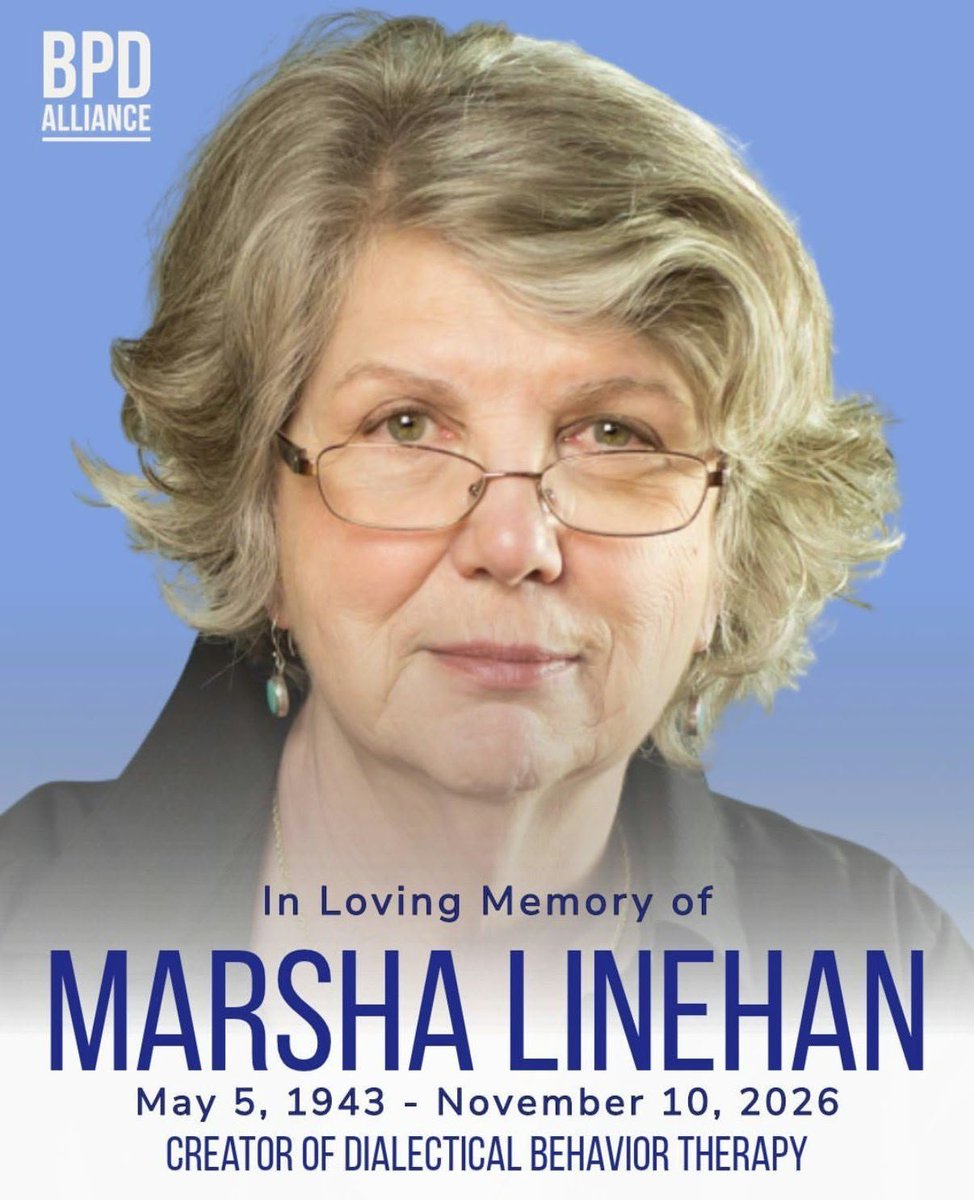
Murió Marsha Linehan. La considero una de las mejores referentes en el campo de psicoterapia, y le tengo mucho amor y respeto por su historia en vida: demostrar que existe la posibilidad del cambio y considerar que no solo somos nuestros diagnósticos.
El mundo 🌎 ha perdido a una de las mentes más brillantes, sensibles y trascendentes en la historia de la #Psicoterapia
Creadora de la #DBT#MarshaLinehan
QEPD
Despedimos con profunda tristeza y gratitud infinita a la Dra. Marsha Linehan, cuyo legado perdurará a través de la T Dialéctico Conductual y las vidas q transformó.
Marsha, tu partida deja una huella imborrable en todos los q ejercen la psicoterapia basada en la evidencia. DEP
I put together this PDF for our psychiatry R1s to prepare for their neurology rotation and to serve as a primer for neurology that's relevant for psychiatric practice
I figured that I share it here too, hopefully other psychiatry residents find it useful
https://t.co/A5TTlyxrfZ
1/ We discovered something totally unexpected about the neural structure of consciousness that overturns decades of thinking on its biological basis and brings us significantly closer to the recipe for generating conscious awareness.
New preprint: https://t.co/K8BwiHXvXg (led by @HesseJanis, with @FrankLanfranchi, @_conor_mcgrory, @Yuelin_Shi, and @EngelTatiana)
Could obesity be quietly aging our brains and increasing our risk of dementia? Obesity refers to excess body fat that can negatively affect health, including brain health. Cali McEntee, Eva Feldman and colleagues describe in a new review in Nature Reviews Neurology how obesity may affect memory, thinking and the biological pathways involved in dementia.
Key points:
- Midlife obesity is associated w/ cognitive decline and an increased risk of dementia, even when weight decreases later in life.
- Obesity may affect the hippocampus and prefrontal cortex, brain regions essential for memory, attention and decision-making, through inflammation, insulin resistance and vascular dysfunction.
- Exercise, healthier nutrition, weight-loss surgery and newer weight-management medications offer potential opportunities to improve metabolic health and possibly protect cognition, although more definitive trials are needed.
My take: What resonates w/ me is that obesity is not simply a number on a scale. It is a biological condition that can influence how our brains function and age. The brain and body are not separate universes. Inflammation, blood vessel health, insulin signaling and metabolism all matter. Perhaps most importantly, the timing of obesity matters. Carrying excess weight in midlife may have consequences that are not completely reversed by losing weight decades later.
Here are 5 points that resonated w/ me:
1- Midlife may represent an important window of opportunity for protecting long-term brain health.
2- Where fat accumulates may matter as much as how much we weigh, particularly when it collects around the abdomen.
3- Obesity can create a vicious cycle in which inflammation disrupts the brain circuits controlling appetite, potentially promoting further weight gain.
4- Exercise, nutrition and appropriate medical treatment should be viewed as investments in brain health, not simply strategies for changing appearance or body weight.
5- We still need randomized trials to establish whether treating obesity actually prevents dementia, but the opportunity to improve metabolic and vascular health is already in front of us.
https://t.co/rkzpiV2zWu