The first (?) interactive TypeScript type debugger.
Primarily built for the byte-code/VM of the new type checker, but is actually already quite useful to debug types by simply stepping through it.💪
I will compile it to WebAssembly in the next days to let it run in the browser.
@DJiafei Agreed, that's why I said it could change, but I don't see anything on the horizon. PINNs are known to work very sample efficient, but there is no working PINN+JEPA yet. It's the most promising candidate to me.
exactly. their bet on just getting "more data will solve it" with VLA etc is wrong, and it will be funny to see the one startup cracking the algo rendering ALL other completely obsolete. the difference will be like day and night, making absurd hardware requirement also not required anymore and thus making their moat in hardware useless. it's the software that counts and nobody has anything special here yet.
nice position, I support this. I never liked having the predictor the world dynamics encoded in its opaque weights. THat's why I'm working on a world-model architecture that moves the predictive power from the predictor to a (shared) substrate that can be analytically analyzed. This makes it much better to look into the world representation itself using many parallel cursors (superposition) and thus gives almost ideal gradients for anything planing/policy related. Especially powerful when multiple objectives are putting pressure on the very same shared substrate.
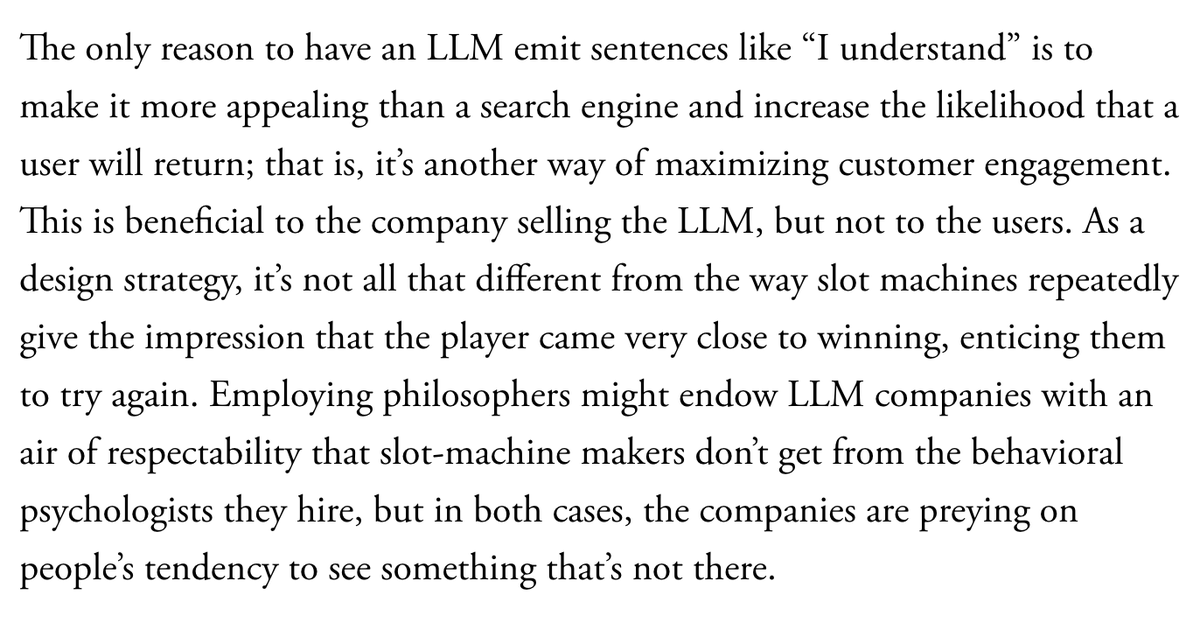
Compelling essay by sci-fi writer Ted Chiang on why LLMs are nowhere near consciousness, but why it serves the interests of LLM companies to constantly suggest that they might be.
I've pulled one quote below, but the whole article is worth reading.
I wrote 20years of my life code, first HTML with 13, later PHP, JS, C, CPP, Python, wrote compilers, db drivers, microcontrollers, this and that.
I've not written a single line of code since over half a year since Opus 4.5 came out. I just realized how crazy that is.
So I basically hate reading websites/blogs these days. Everything has their own color, spacing, fonts, 99% are ugly, full of distractions, some even override their scrollbar behaviour... that's why I visit less and less sites, they all just bother me. The only thing I enjoy is LaTeX articles, I cannot bear anything else anymore
So I basically hate reading websites/blogs these days. Everything has their own color, spacing, fonts, 99% are ugly, full of distractions, some even override their scrollbar behaviour... that's why I visit less and less sites, they all just bother me. The only thing I enjoy is LaTeX articles, I cannot bear anything else anymore
@yacineMTB have you tried a C2 substrate to tightly couple the derivatives (no MLP) and make it physics informed by construction? should make it 100x more sample efficient
dude robotics is so early. this whole JEPA/World-model/VLA is a shit show, trivial to compete with whatever they build. create a startup, make some progress that they cannot replicate with their phd noobs and get bought instead. have you seen sota on humanoid robotics? it's hilarious
I think JEPA is only half of the equation. I've played around with JEPA extensively the last months and to me the limiting factor is the latent/token representation, the unstructured mixture of state and change (which the encoder has to compensate for), plus the missing natural counterforce (one that ideally also favours factorization) against the collapsing pressure of the predictor's next-state prediction. the latent is just too noisy, inefficient, and unfactored, which forces an absurdly big predictor network to get good results. that won't scale. Besides that JEPA seems almost ideal to me, but it just explains a tiny abstract part of the overall solution.