@mvanhorn Thank you so much for the article!
It inspired me to add my first 2 contributions. one to your last30days skill: https://t.co/Ajo8wxhbAp
and one to Hermes directly
My Hermes agent was really struggling with last30days skills from @mvanhorn
Just opened a PR : cut the default SKILL.md prompt load from 130k chars to 10k by turning it into a lightweight dispatcher and lazy-loading the deep playbook.
Same engine, less context bloat.
https://t.co/5v2AUWn9vt
I was getting really frustrated with Playwright as the browser layer for my Hermes agents.
It kept breaking in weird ways, dumping too much DOM/context, and making simple toggle selection a true hustle..
Switched the default to Vercel’s Agent Browser path instead.
Much cleaner. Much more agent-native.
Trying to get better at contributing small things upstream.
Today’s version: I opened a tiny Hermes docs PR showing how to use `on_session_end` shell hooks for local completion sounds, instead of asking the project to own a new notification feature.
Small, but feels like the right muscle to build.
Thank you @NousResearch for all you've been doing!
https://t.co/voP8g8kCAN
$ZEC is now a probability trade.
The bug was patched, and prior exploitation is probably not the base case.
But with privacy comes a brutal problem: you may not be able to prove the negative.
@mert@rasmr_eth The chances that it has been already exploited are the same chances that we are in a virtual reality + that there are more forms of life alive in the universe.
When you start deploying specialised agents inside a company, one question matters more than people think:
Do we actually need another agent?
A new agent gives you:
+ Stronger isolation of memory, files, credentials, and persona
- More overhead, coordination, and maintenance
My default is to create agents per department, not per tiny task.
Depending on the size of the company, marketing might need one agent. Or two. Or three. Same for the dev team.
But you only need three if they are genuinely operating separately: different budgets, different teams, different workflows, different accountability.
If they are all doing variations of the same job, don’t create three agents. Create one better-scoped agent.
If you're an agency.. then this changes quite a bit.. see you on the next post
When you start deploying specialised agents inside a company, one question matters more than people think:
Do we actually need another agent?
A new agent gives you:
+ Stronger isolation of memory, files, credentials, and persona
- More overhead, coordination, and maintenance
My default is to create agents per department, not per tiny task.
Depending on the size of the company, marketing might need one agent. Or two. Or three. Same for the dev team.
But you only need three if they are genuinely operating separately: different budgets, different teams, different workflows, different accountability.
If they are all doing variations of the same job, don’t create three agents. Create one better-scoped agent.
If you're an agency.. then this changes quite a bit.. see you on the next post
Today, we’re excited to introduce Miso One, the most emotive voice model in the world.
Miso One is an 8-billion-parameter text-to-speech model for highly expressive speech generation. It emotes like a human and responds faster than a human, with just 110 milliseconds of latency.
We’ve open-sourced the model weights, with API access coming soon.
Hear how Miso One sounds in the thread below.
Getting stricter about agent workflows:
The output isn’t “done.”
The output is proof.
If an agent touches a workflow, I want the boring trail: what changed, what was fetched back, what was verified, what stayed open, and what actions were not taken.
The receipt is the work.
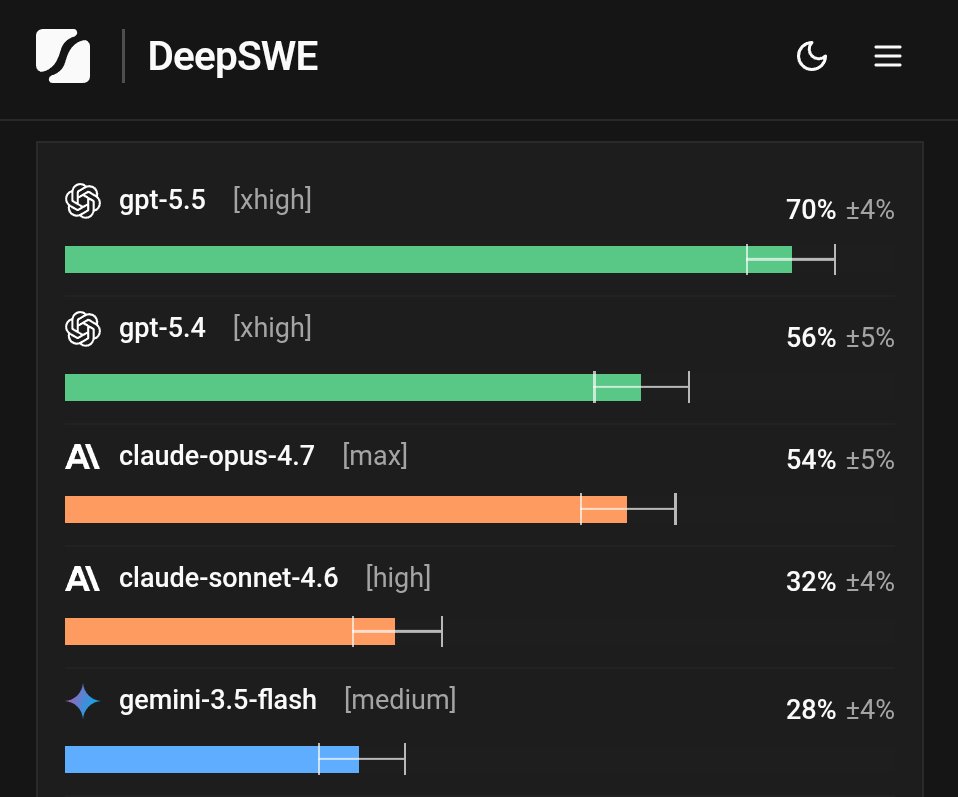
Many developers have suspected for months that GPT-5.5 outperforms Claude Sonnet for coding. But SWE-Bench reported near-parity, and it made people question what they’d been seeing in practice.
DeepSWE aligns more closely with that day-to-day experience: GPT-5.5 scores 70% versus Claude Sonnet at 32%. That difference is substantial.
DeepSWE focuses on what tends to matter in real workflows: whether an agent can take a short behavioral prompt, locate the correct area of the codebase, and implement the change cleanly - without needing you to enumerate files, modules, and functions. SWE-Bench often fails to capture that, due to dataset contamination and weaker verification.
https://t.co/C3s80xfDkk
Folks: when you write skills, ask your agent to be token efficient, relax grammer. I see too many skills that write books in the skill description, and all that crap is loaded into every context.
I wrote a skill that finds the worst offenders. https://t.co/kfaaJpxMXE