este domingo no se juega solo una final del mundial: se enfrentan dos formas opuestas de entender la vida
por un lado, Argentina representa la materialización una low trust society. la exaltación de la trampa, el marrullerismo con la excusa de la pasión
un equipo que ha llegado a la final arrastrándose entre ayudas arbitrales y juego sucio, porque en su modelo del mundo el que respeta las reglas es un pardillo
se aprecia en la estética: tíos hiper-tatuados que parecen sacados del patio de una carcel panameña, sin clase, sin saber estar y con un comportamiento visceral sin respeto por el rival
por el otro lado, España representa el orden, la estructura, la táctica. el respeto por el rival y por las normas del juego. La representación de una high trust society y de los valores europeos llevados al césped: un sistema donde cada individuo cumple su función sin hacer trampas, porque confía en que el sistema y el esfuerzo colectivo le van a recompensar
no es solo fútbol, este domingo se enfrenta la civilización contra la barbarie
Introducing PhoneFlow, the Open Source Voice Agent Platform 🚀
Lately Voice AI has been a very hot space:
In Spain alone there have been several major funding rounds recently, including HappyRobot ($44M), Prosper AI ($30M), Orbio ($21M), and Murphy AI ($15M).
If we take a broader look globally, there is an even more diverse set of players: Sierra (950M), Elevenlabs (500M), Parloa (350M), Decagon (250M), PolyAI (86M) Bland (50M), Vapi (50M), Synthflow (20M), Retell, etc
Although they have very different value propositions and GTM strategies (ranging from self-serve product led growth to FDE-driven enterprise sales motion or building for any use case to focusing on a single vertical) the core product behind most of them is actually quite similar: a platform to create voice agents by connecting nodes on a canvas with version control and deploy them to handle inbound and outbound phone calls.
Despite how crowded the space has become, I realized there wasn't an established open source alternative. So I decided to build one.
So far I had a lot of fun working on it. I got to solve some nerd sniping problems like:
- Transforming a mutable graph formed by different kinds of nodes connected through edges into a runtime state machine that dynamically updates the agent prompts depending on the current node and creates tools on the fly to transition through the outgoing edges when transition conditions are met
- A version control system with immutable snapshots of the agents to be able to iterate with confidence with full traceability of the changes
- A consumption based credit system that charges per call minute depending on the STT, LLM, TTS providers and models selected for each deployed agent version
- A basic templating engine to support dynamic variables in prompts
- Running and connecting the agents to handle real inbound and outbound phone calls
There are still a lot of features missing that I will continue to implement during my free time but I think this initial version is complete enough to put it out there.
Check out the GitHub repository, give it a star if you like it and join the waitlist to get notified when I release the platform generally available (link in comments).
Os voy a contar algo que me hace mucha ilusión. 💜
Hoy @elespanolcom ha contado mi historia. Pero más allá de la historia, hay algo que he construido yo misma y que de verdad quiero enseñaros.
Soy ingeniera y tengo un cáncer de mama muy raro. En vez de quedarme quieta, hice lo único que sé hacer: ponerme a construir. Con IA he creado una herramienta que dibuja en 3D mis metástasis y ayuda a decidir dónde biopsiar, qué lesión da el mejor material para acertar con el tratamiento que me puede dar más vida.
Y lo más fuerte: no es una idea guardada en un cajón. El equipo de oncólogos de Zúrich que lleva mi caso ya la está usando para tomar esa decisión.
Para mí esto es lo que debería ser la IA en medicina: no quitarle el sitio al médico, sino darle mejores ojos para decidir. Y si me sirve a mí, ojalá sirva a más personas con tumores raros a las que nadie da respuesta.
🔬 La herramienta: https://t.co/oLL6Nipxoc
🗞️ Mi historia en El Español: https://t.co/EmautZrHee
Si os toca algo, compartidlo. Cada persona que lo ve ayuda de verdad. Gracias por estar siempre ahí. 💜
1/ Empiezo este hilo a las 00:25
Había pensado tuitear «Con la IA se trabaja menos» y a cerrar el ordenador.
Hace cinco años habría parado a las 21:00 y puesto alguna serie.
Hilo sobre por qué la IA no nos deja trabajar menos: nos está cambiando qué entendemos por urgente.
this OpenClaw bot finds restaurants with ugly menus, rebuilds them as live web menus, and mails the owner a postcard...on autopilot.
here's how agencies can land recurring contracts with this system:
- scrapes every restaurant in a city in real time
- filters by review count + rating + last menu update + photo quality
- pulls the real menu items from the official site, PDF, or Google reviews
- samples the brand palette from the restaurant's own visual identity
- renders a 9:16 brand-matched menu, hosted live at a QR-accessible URL
- writes a personalized postcard referencing a real reviewer and a real dish
- mails it to the registered office addressed to the owner by first name
every step from discovery to brand-matching to outreach is automated.
reply "MENU" + RT and i'll send you a free guide so you can build this too
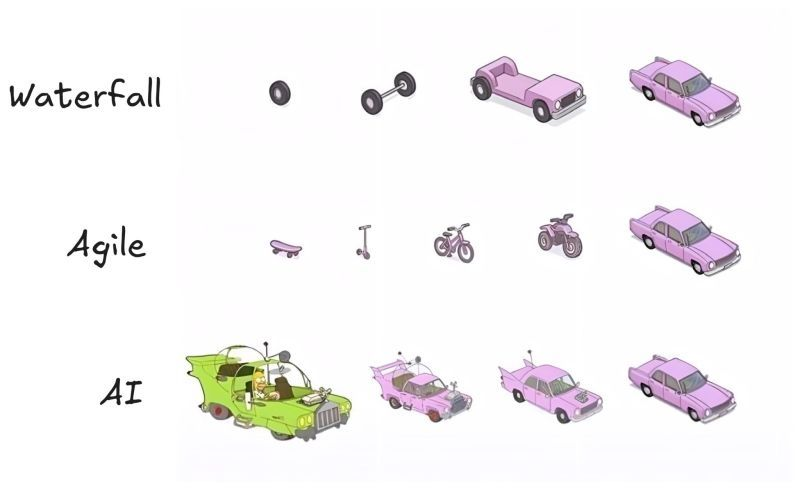
Honestly, this is the most accurate diagram I've seen.
Waterfall: You plan for 18 months and deliver exactly what nobody needs anymore.
Agile: You deliver something usable at every step, but the CEO keeps asking, "Where's the car?"
AI: You get the car on day one. It has six wheels, the doors are on backwards, and it has a rocket launcher. You spend more time making it yours than actually "building"; it's shaping. owning. verifying. That's what the best AI developers do now. They don't build. They shape and own.
Hot take: the moat in software isn't your code or how fast you ship anymore. Everyone can code and code fast now.
The moat is how well you wire up the loops and processes. Hooking up your entire stack (e.g. Datadog, AWS, Terraform, repos, Slack...) to agents that can monitor, find bugs, fix them, and deploy 24/7.
That's hard (at least for now).
Making those pipelines reliable and safe at scale is the actual engineering challenge now.
The companies that nail these end-to-end loops first will be genuinely impossible to compete with.
At @browser_use we are making bets.
Después de unos días de trabajo hago pública CONTRATACIÓN ABIERTA, una web donde se pueden revisar de forma fácil los contratos menores de las administraciones públicas de España.
Hay más de 7,3 millones de contratos y 11.700 organismos públicos.
👇👇
https://t.co/zBmiVJ6mTR
“It’s about understanding that software is about delivering solutions to actual problems, not an artisan job where you are crafting museum like pieces of code.” https://t.co/Zel94U41fE
Videazo sobre la vuelta de lo analógico y lo retro con muy buenas referencias para profundizar.
No va de nostalgia realmente.
Va de recuperar tu capacidad de decisión, curación, esencia, espera, propiedad...
Spain is censoring the internet by blocking @vercel CDN IPs, which is the front door of millions of applications and websites.
We’re working hard on mitigations to restore freedom of speech as we can, as they’re uncommunicative, secretive & undeterred by users’ complaints.
The classic software startup writes code to solve users' problems. If AI makes writing code more of a commodity, understanding users' problems will become the most important component of starting a startup. But it already is.