What actually happens after you hit enter? How does an AI server really work?
Our new drop follows one question through an NVIDIA GB200 NVL72 rack, from first byte to last word. Ask your own question and watch it get answered.
Built with @Lovable
https://t.co/61MiiokJ5G
How much useful work can an AI factory get out of the power it has?
I sat down with @nvidia 's Shruti Koparkar to talk about the economics and software behind AI infrastructure.
We discuss why she would test performance per watt first, what CUDA and CUDA-X actually do, and how Pinterest has used the same GPU fleet for recommendation systems, language models and vision-language models.
We also get into what happens when a new AI model launches, and when it makes sense to keep, repurpose or replace older GPUs.
YouTube down below:
You give an AI agent a task. What happens next?
This video walks through how agents use models and tools to complete tasks, and what makes them fast and responsive.
No technical background needed.
Jensen Huang was awarded the National Medal of Science today which is the highest science honor in the U.S.
There is something pretty special about watching son of immigrants reach absolute top of his field and still make his parents part of the story.
SITUATION DETECTED: Jensen Huang spoke about the future of AI to executives and diplomats from Japan, Korea, and the U.S. at today’s 4th Trilateral Dialogue, after accepting the Korea Society’s Van Fleet Award for strengthening relations between Korea and the United States.
NV Vera CPU on display again at the Coreweave event
Nvidia does not get the credit it deserves for the foresight it had to build a CPU designed for agentic use cases
Now, everyone in the industry is claiming they have an “agentic CPU” but Vera was first to market and first to scale by a long shot
Vera is the product of tremendous foresight and hard work, and is extremely well suited for high value agentic workloads
@NVIDIA A100 GPUs shipped in 2020 and are still in commercial service. CoreWeave has extended bookings for A100 capacity through 2029.
That should shape how we evaluate AI infrastructure value.
CUDA provides a common programming platform across GPU generations. Continued software and kernel optimization can improve what installed hardware can do, while support for different workloads gives operators more ways to keep it productive.
The practical implication: useful life belongs in an AI factory’s business case from the beginning.
Alongside throughput and cost per token, I’d ask:
- How will software improvements benefit the installed fleet?
- Which workloads are a good fit for each GPU generation?
- How can capacity serve new demand as requirements change?
Those questions connect hardware performance to years of useful work. NVIDIA’s latest explainer explores that connection through productivity, durability and workload flexibility: https://t.co/gRpK039sGs
NVIDIA Vera Rubin NVL72 is live on @CoreWeave, and the results speak for themselves.
@Cognition tested it on real-world software engineering workloads and saw 4.8x higher token throughput vs. GB200 NVL72.
From Volta to Vera Rubin, CoreWeave delivers every NVIDIA platform to production that stays productive, durable and fungible across generations.
Read the news from #FullyConnected26 ➡️ https://t.co/M6Ik3Pz0L3
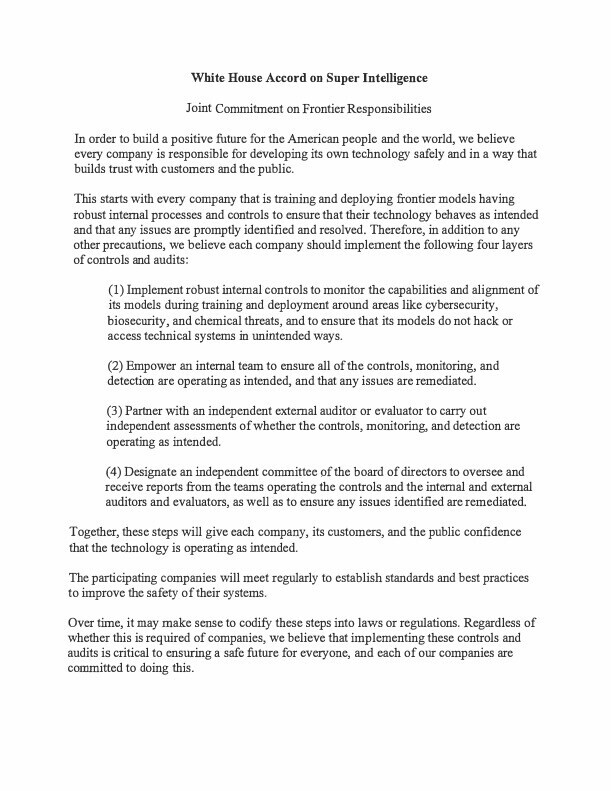
Yesterday at the White House, leaders from across our industry came together to sign the White House Accord on Super Intelligence.
The principle is simple: the companies building this technology have the primary responsibility to develop and deploy it safely, and to be accountable when they fall short.
The Accord reinforces that responsibility with robust internal controls, independent external evaluation, and board level oversight.
Super Intelligence offers an extraordinary opportunity to advance discovery, productivity, security, health, and prosperity.
The future of Super Intelligence will be shaped not only by what it can do, but by the confidence it earns. By building with ambition, rigor, and responsibility, we can help ensure this extraordinary technology expands opportunity and improves lives for generations to come.
NVIDIA is proud to be a founding partner of the Horowitz Andreessen Academy, a new school helping students learn by building.
A year to build, experiment, and learn from experienced founders.
At the G20 Innovation Ministerial, @JensenHuang joined U.S. Commerce Secretary @howardlutnick to discuss the infrastructure the Intelligence Age requires.
A gigawatt-scale AI factory is a $50–60 billion investment. At that cost, the architecture cannot be so specialized that a change in models or algorithms renders it obsolete.
It has to be fungible.
It has to be durable.
And it has to keep improving through software.
AI safety matters.
Strong engineering, rigorous testing, and accountability are how we get it right.
@JensenHuang on moving quickly, innovating, and leading responsibly.
#AllInSummit 🎥:
We made an interactive explainer of the AI compute stack: from grid power and data centers to chips, racks, clusters, and workloads, plus the public companies at each layer.
Explore the infrastructure behind what @JensenHuang calls the five layer cake:
https://t.co/NrFExRgtKV
AI is transforming how we build, work, and grow economies.
At #AllInSummit, @JensenHuang joined @theallinpod to discuss what comes next — from sensible regulation and open models to continued investment in AI infrastructure.
🎥 Full conversation:
Holy: NVIDIA’s coding agent AVO scored 100% on ARC-AGI-3’s 25 public games, solving all 183 levels.
The agent receives no rules or stated goals. It must learn by trying things, observing the results and correcting its mistakes.
AVO succeeds by remembering what it learned and building on it over long periods instead of starting over when the model’s context resets.
Powered by Claude Opus 5, the same system previously worked autonomously for seven days optimizing GPU code.
Really really cool to see what NVIDIA achieved here