A rational analysis of what happened on October 10, 2025, in the crypto markets.
Approximately $20 billion was liquidated, an event that surpassed COVID, FTX, and LUNA.
I have learned several lessons from this event:
1) Never use leverage
(Fortunately, I was not exposed in any way and had closed all trades at around 7:00 p.m.)
2) Cash is king.
Even in situations where the only direction seems to be up, having liquidity (I would say 10% of your assets) allows you to buy in such situations (exchange permitting, ha ha ha).
3) This was the biggest shakeout in history.
In times of fear and terror, real deals are made.
I still remember the day of FTX, which remains the day I bought the most in a single day.
4) Take a look at your portfolio, look at the volatility of the coins you hold, and compare them with each other.
You will notice patterns.
Cryptocurrencies such as $HBAR, $QNT, $XDC, and $TAO have suffered much more volatility than $TRAC, $AUKI, $CHEQ, or $DMTR.
This substantial difference in terms of ATR (Average True Range) is mainly due to leverage exposure and a herd effect that led weak hands to sell en masse.
In the short term, it would be important not to see the 110k zone for $BTC breached.
In the long term, the dynamics have not changed, and I remain bullish on the sector.
See you in a few months or maybe weeks.
Democratizing high-performance computing is @AethirCloud 's bold mission.
It's a mission I believe in, as it recently became a new addition to my speculative portfolio.
@AethirEco operates in the decentralized cloud computing market (we're talking about a DePIN), focusing on AI applications such as training, fine-tuning, and model inference, as well as cloud gaming and edge computing.
In an era where AI is transforming industries such as finance, healthcare, and entertainment, Aethir solves the problem of enterprise-grade GPU scarcity by offering on-demand solutions that reduce costs and latency.
The market in which $ATH operates is experiencing explosive growth, with the global AI infrastructure sector projected to reach $223 billion by 2030, with a CAGR of 30%.
Within this, the TAM (Total Addressable Market) specific to decentralized GPU compute—Aethir's core business—ranges between $11 billion and $20 billion, with key segments such as AI ($7-14 billion), cloud gaming ($2-3 billion), and edge computing ($2-3 billion).
This enormous potential is fueled by the exponential demand for AI semiconductors, projected to reach $71 billion by 2024.
Compared to its competitors, Aethir stands out for its decentralized approach focused on enterprise-grade GPUs such as Nvidia H100s, aggregated from Tier 3 and 4 data centers in over 93 countries.
Aethir's vision is clear 📌
Accelerate the evolution of cloud computing, unlocking the potential of AI and revolutionizing gaming for billions of users.
In the whirlwind of AI innovation, where models such as GPT-4 and Claude 3 reduce development cycles from years to months, a frustrating paradox emerges: AI capabilities are growing exponentially, but traditional infrastructures remain anchored to linear and slow processes.
Imagine having a revolutionary idea for a personalized marketing algorithm or medical research tool, only to see it vanish into the maze of 5-8 month infrastructure delays. This mismatch is a silent killer of opportunity, allowing agile competitors to capture markets, generate valuable data, and build insurmountable barriers.
But there is hope, and it's called speed.
Aethir revolutionizes deployment with its decentralized cloud, reducing timeframes by 90% thanks to a structured and motivating process. For more information, please visit:
https://t.co/H7LK0ZrUnD
By aggregating global idle GPUs, Aethir creates a resilient and cost-effective ecosystem, overcoming single points of failure, resource scarcity, and the inflexible pricing of centralized rivals.
#AethirDAT
DePINs represent one of the sectors capable of profoundly changing the crypto world as we know it.
We are at the dawn of a structural change.
From my personal point of view, the main players will be 👇
- $TAO
- $NATIX
- $AUKI
- $PEAQ
- $ONO
DePIN is the frontier.
DePIN, or Decentralized Physical Infrastructure Networks, represents a paradigm in which blockchain and token-based incentives are used to build and manage physical infrastructure in a decentralized manner.
This includes networks for computing power, storage, wireless connectivity and, in @onocoyRTK 's case, high-precision GNSS data.
With more than 4,400 stations in 86 countries and 1.5 million $ONO mined, onocoy has demonstrated significant growth, supported by $5 million raised from strategic investors.
onocoy's competitive advantages, are rooted in its inclusive and innovative approach:
📌 System Open and Inclusive
Onocoy accepts GNSS stations of any level, from low-end to gold standard reference stations.
This means that anyone, from small farmers to large companies, can contribute their own devices, creating a diverse and broad dataset.
This inclusiveness provides global coverage and greater resilience, reducing dependence on centralized infrastructure.
📌 Data Accessibility.
By enabling anyone to use the dataset, Onocoy promotes innovation and net growth.
This horizontal approach enables developers, companies, and researchers to create new applications that leverage high-precision GNSS data, such as navigation systems for drones, mapping for autonomous vehicles, and tools for precision agriculture.
It is an open invitation to the ecosystem to build on top of their infrastructure, creating a multiplier effect of value.
📌 Complex but Promising
Although building a system that accepts diverse data streams is more complex and time-consuming than a standardized approach, this long-term investment positions onocoy as a leader in creating a scalable and flexible infrastructure.
Their ability to manage this complexity, through decentralized validation mechanisms and data standardization, demonstrates a commitment to quality and innovation.
These competitive advantages not only distinguish onocoy from direct competitors such as Geodnet, which may have a more standardized approach, but also from traditional vendors such as Trimble, which operate in a centralized model.
In onocoy I see one of the few projects that is creating a blue ocean.
(I hope that those who read deeply understand the meaning of creating a blue ocean)
Goodbye data monopoly, welcome era of participation.
@NATIXNetwork is creating the world's largest crowdsourced camera network.
Using smartphones, dashcams and devices such as VX360 for Tesla to collect geospatial data, incentivizing users with $NATIX tokens.
This approach leverages existing hardware, making the system scalable and affordable.
It's like having thousands of eyes on the road, compared to just a few dedicated vehicles, ensuring an always-fresh view.
NATIX's circular economy is a virtuous cycle; users contribute data, which is processed to create maps and scenarios for AI, generating revenue sold to customers. These revenues fund buybacks and burnings of $NATIX tokens, reducing supply and potentially increasing value.
More data collected, more revenue, more burns, more value to the community.
Compared to Google Maps and TomTom, which use dedicated fleets and satellites, NATIX offers real-time updates, lower costs, and direct compensation for users.
Google can take days to update maps, while NATIX does so instantaneously.
However, centralized systems ensure uniform quality, while NATIX must validate data through AI and communities, a process that could vary, as evidenced by Hivemapper, which maps 5 times faster than Google.
It is clear how NATIX's decentralized model is cheaper, scalable and resilient, breaking monopolies and promoting innovation.
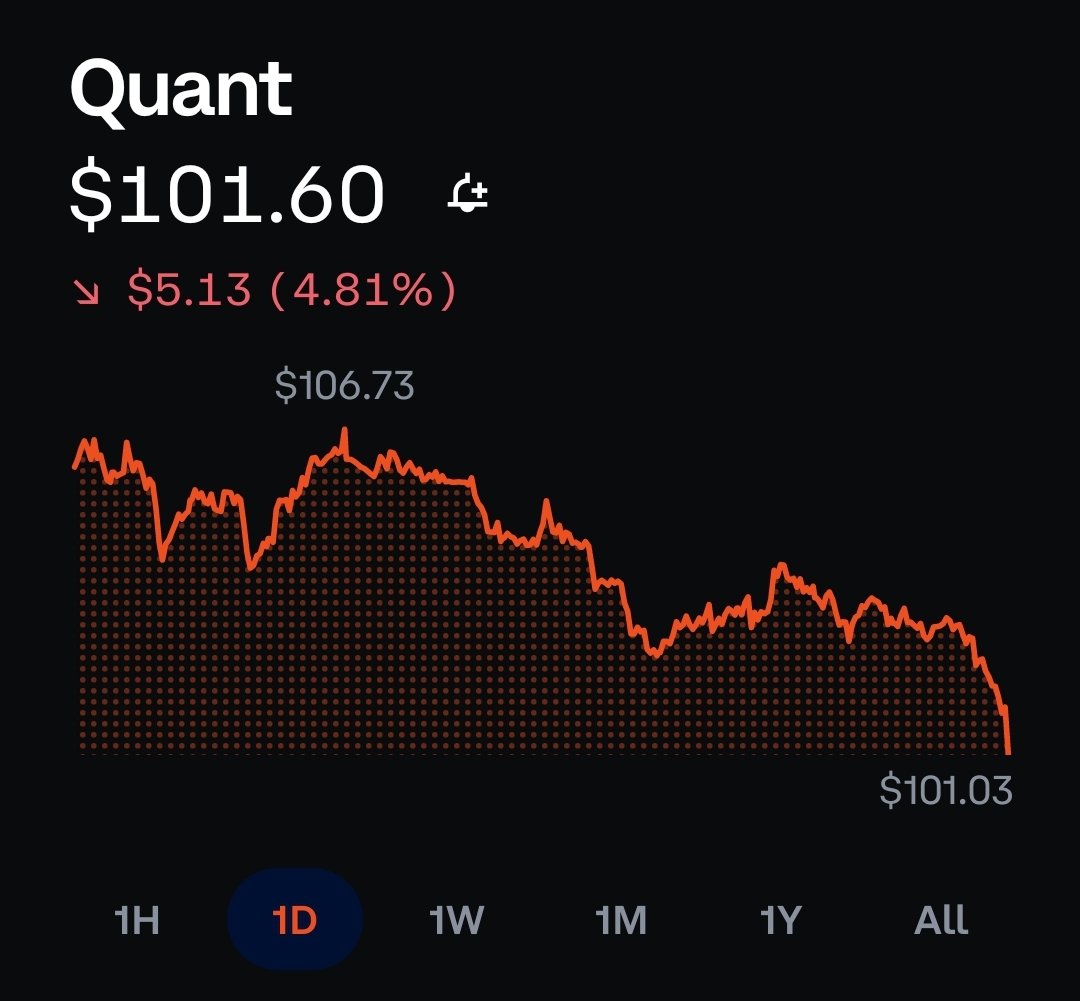
QNT !! holding since 2021 not selling not even 1 slowly accumulating..its the only one in my portfolio that does its own thing ..10 years ago BTC was $250 .. in 5 years many will be saying the same about QNT ! my fam and friends will be saying ..she knew ✔️🙌💃🏼💎
It is not easy for me to make a prediction regarding the crypto market for the next 6-9 months, as a student of Taleb I find many types of predictions fallacious and prefer to take a more humble approach: observe, react and adapt.
This is in order to avoid the intellectual arrogance of "I know what will happen"
But in this case I will attempt to connect the dots, based on data, historical patterns and macro signals,to offer as useful and realistic a view as possible.
The DePIN sector is poised for exponential growth, with projections (From the World Economic Forum) indicating a value of $3.5 trillion by 2028.
This impressive growth comes from real networks replacing centralized systems with token-incentivized participation, offering more efficient, reliable and community-owned alternatives.
The integration of AI and blockchain, (As we can see in AUKI and NATIX) points to a future where physical and digital worlds are seamlessly connected, enabling smarter, more autonomous systems.
DePINs allow multiple participants to contribute resources, such as computing power, storage or sensor data, and receive rewards in tokens. This model democratizes access to infrastructure, improving its resilience and efficiency.
At the core of DePINs are two main components:
- the physical infrastructure, consisting of tangible assets such as sensors, wireless hotspots and computing devices.
- and the digital backbone, powered by blockchain, which records transactions and manages incentives through smart contracts.
Some of the most interesting projects in this landscape in my opinion are:
$AUKI is developing posemesh, a decentralized network of machine perception for spatial computing.
This protocol enables digital devices to exchange spatial data and computing power securely and privately, forming a shared understanding of the physical world.
AUKI is crucial for applications in robotics, extended reality and smart cities, making the physical world accessible to AI.
"Over the next 10-20 years. I believe, quite strongly that civilization will grow to 100B+ productive economic participants; most of them will be AI."
--------------------------
$PEAQ is a Layer-1 blockchain built specifically to power the machine economy and DePINs.
It provides the infrastructure needed for machines, robots and AI agents to interact, earn and spend on-chain.
--------------------------
$ONO built for every industry that depends on precision.
Traditional GNSS correction data is expensive and centralized, but onocoy leverages a community-powered network of reference stations to provide high-quality correction data at low cost.
With more than 4,500 miners validated in less than two years, onocoy demonstrates how a decentralized network can scale faster and at lower cost than traditional models.
------------------------
$NATIX is pioneering the data collection layer of DePINs, using AI and smartphone cameras to collect geospatial data in real time.
Through its Drive& app and VX360, NATIX incentivizes drivers to collect road data, essential for training vertical AI on autonomous driving.
It is also one of the DePINs with the most significant growth, counting over 250 thousand active users 175 million km mapped.
-------------------------
$ANYONE is privacy, reimagined.
Anyone's network consists of physical and virtual relays that users can run on their own devices, such as laptops, VPS servers, or dedicated Anyone hardware.
These relays fragment and route user data in a way that makes it impossible to trace the origin or destination of traffic, providing a high level of privacy and security.
As the industry continues to grow, DePIN is sure to play a crucial role in shaping the future of our digital and physical worlds.
Transforming coffee farming in Honduras with real-world blockchain utility ☕🌍
@ONGCesal and AL-INVEST Verde will use Dimitra’s tools to impact 10 coffee cooperatives, digitize their farms, map their production, and meet EUDR requirements.
📍 Mapping & geolocation
🔗 Full traceability
🌱 Sustainability data
All powered by Dimitra’s app: making compliance simple, efficient, and accessible for smallholder farmers.
#Sustainability #EUDR #AgTech #AI
$QNT CEO Gilbert Verdian on stage with the BIS, SWIFT, Lloyds and Commerzbank.. discussing Project Agora
#Agora is a major collaborative effort with seven central banks..
🇬🇧 Bank of England
🇺🇸 Federal Reserve Bank of New York
🇯🇵 Bank of Japan
🇫🇷 Bank of France
🇰🇷 Bank of Korea
🇨🇭Swiss National Bank
🇲🇽 Bank of Mexico
The goal is to create a unified ledger capable of handling programmable financial instruments, tokenised commercial bank deposits and wholesale CBDCs
Its the first real attempt to coordinate programmable cross border payments at a global level
Everything points to $QNT being central to Agora and uniquely positioned as core infrastructure provider
- $QNT already successfully worked with the Bank of England on Project Rosalind
- Together.. Quant Flow and Overledger Fusion directly mirror what Agora is aiming to build
⚪️ Quant Flow = Programmable money
🟠 Overledger Fusion = Interoperable Infrastructure
- The Trusted Node Program aligns perfectly with central bank expectations
- @gverdian is center stage alongside BIS, SWIFT and others to explain how programmable finance will be structured across the world
Project Agora aims to define how money and assets settle globally in a new financial system..
$QNT is already solving those exact problems with Flow and Overledger
Massive.
$QNT ‼️‼️‼️‼️
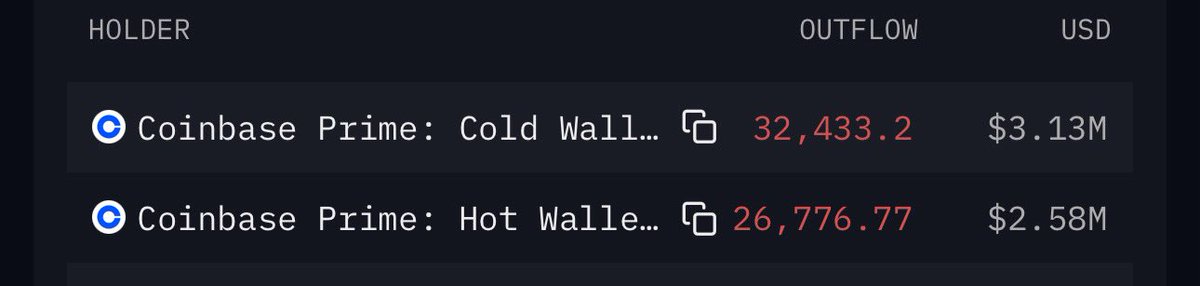
Huge amounts of $QNT were moved via Coinbase prime to individual wallets. Were talking about 32000 tokens being moved to QNT only wallets with no $ETH
Fusion imminent?
There are two opportunities at the moment that demonstrate asymmetrical value between what the market is perceiving and the fundamentals.
“Markets are driven in the short term by emotions and narratives, but in the long term they always come back to reflect the reality of fundamentals.”
I am talking about $AUKI and $DMTR. ✅
AUKI is currently in a lower value area low, every time the price has come out of the major trading area we have seen a recovery of 100% the first time and 120% the second time, respectively.
The fundamentals in this period have not changed, in fact I would say the opposite, they have improved.
AUKI is on the way to 1 million annual revenue, the last conference at AWE was a success, with two awards won for its solutions in the retail and robotics market.
The solutions brought by AUKI are capable of reshaping the way we interact with the digital world, and vice versa.
A capitalization of 30 million is an insignificant fraction compared to the market AUKI aims to serve.
In terms of risk/return ratio, we are facing a textbook case of positive asymmetry: the downside risk is contained, while the upside (if fundamentals continue to evolve) is potentially explosive.
Dimitra on the other hand is in a very similar situation, again the point made earlier with AUKI (Technically) applies.
Since the hack many things have improved, the team continues to work hard in the distribution of its services that greatly improve the lives of farmers and their chances of entering international markets.
Yet the market continues to undervalue this ecosystem.
What distinguishes a successful investor from a mere speculator is the ability to think independently, look beyond the noise of the moment, and act when others are distracted.
Do your research and draw your own conclusions, these are mine.
Above all, keep an open mind.
This collaboration is just the beginning, with plans to expand mapping in the ��🇸 and 🇪🇺. $NATIX
Grab, a leader in ride-hailing and delivery services in Southeast Asia, has a strong track record in crowdsourced mapping, with millions of drivers and advanced AI software.
The partnership with @NATIXNetwork integrates VX360 into the GrabMaps pipeline, creating high-fidelity maps in real time.
The benefits of using a decentralized system in data collection are:
🔵 Real-time data collection
It is like having thousands of eyes on the road, as opposed to a few vehicles passing by every so often, ensuring a fresh view at all times.
🔵 Lower impact in costs
Data collection is distributed among users, incentivized with $NATIX tokens, reducing costs compared to Google's dedicated vehicles, which require significant investment.
🔵 Scalability
Without a central point of failure, the system is more robust. If a Google server goes offline, maps may be inaccessible; NATIX, with distributed nodes, continues to work
🔵 Improved accuracy
Community validation, like NATIX's decentralized techniques, ensures more accurate data, with verified contributions from multiple sources. For example, if one user reports a hole, others can confirm it, reducing errors.
Impending expansion into other markets is no longer a doubt, the benefits are too significant to be missed by other companies, but it is only a matter of time..