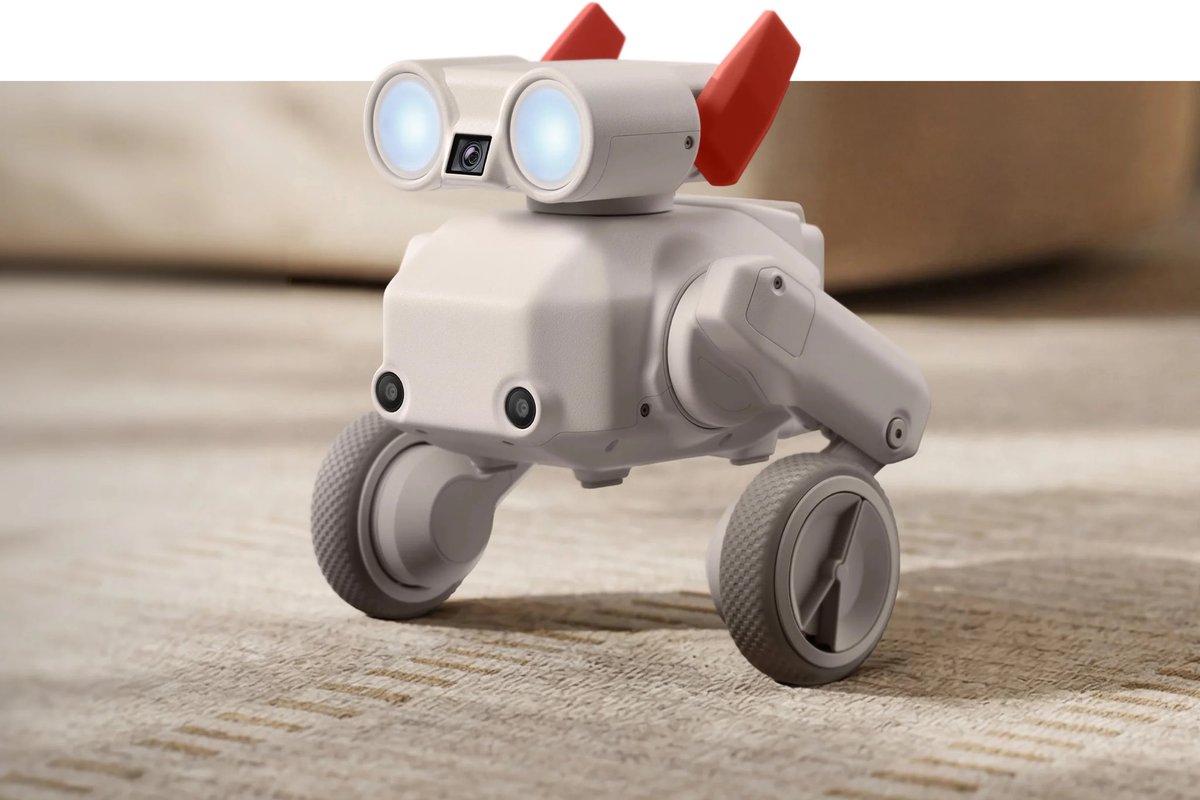
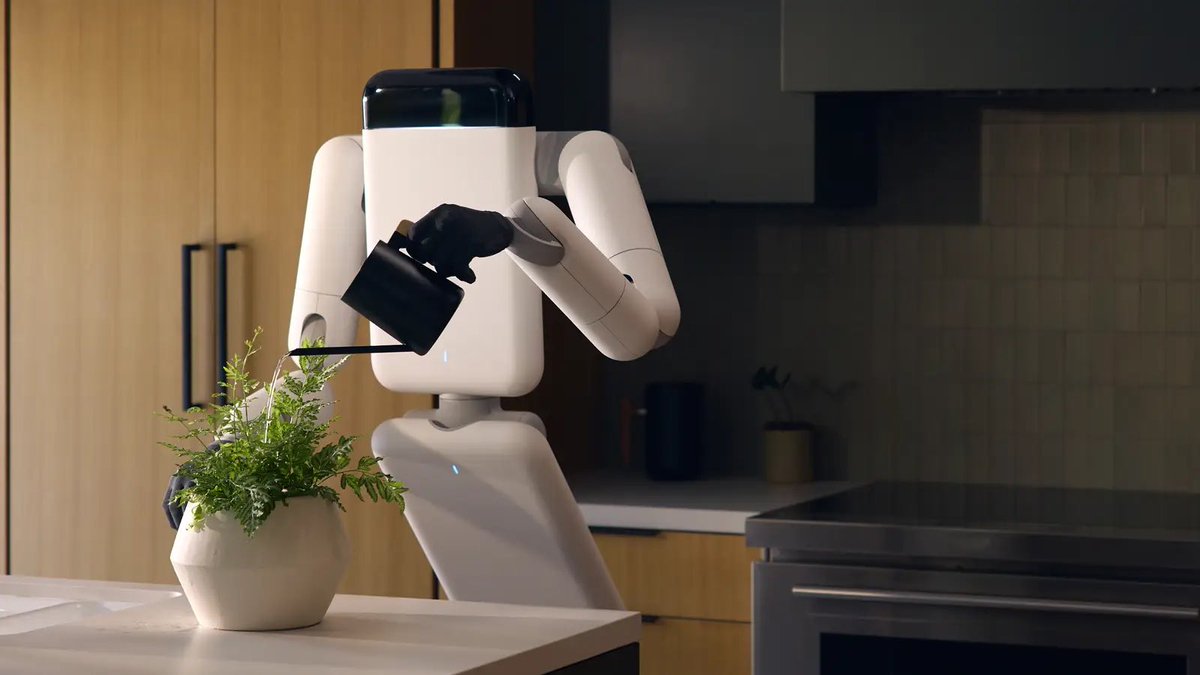
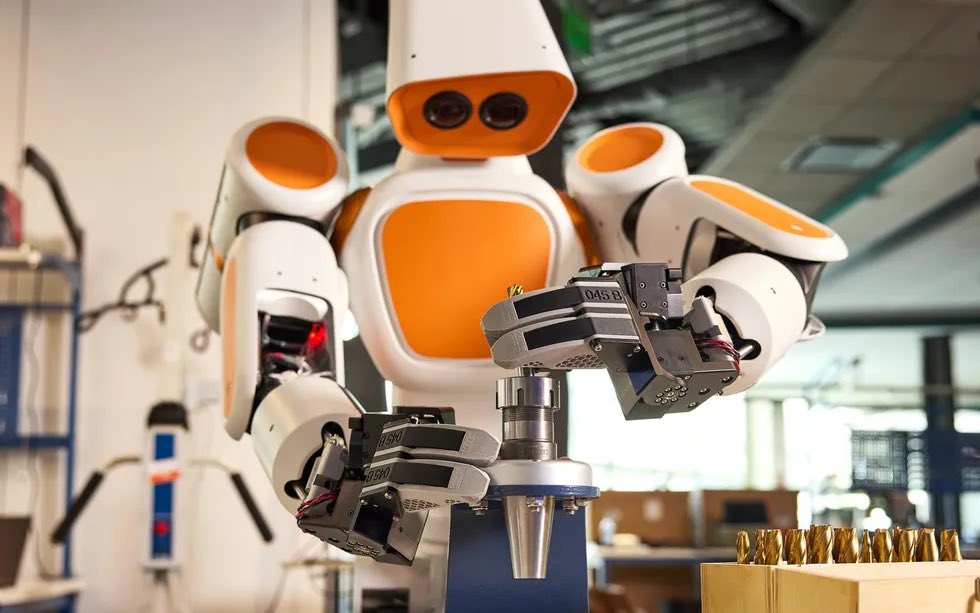
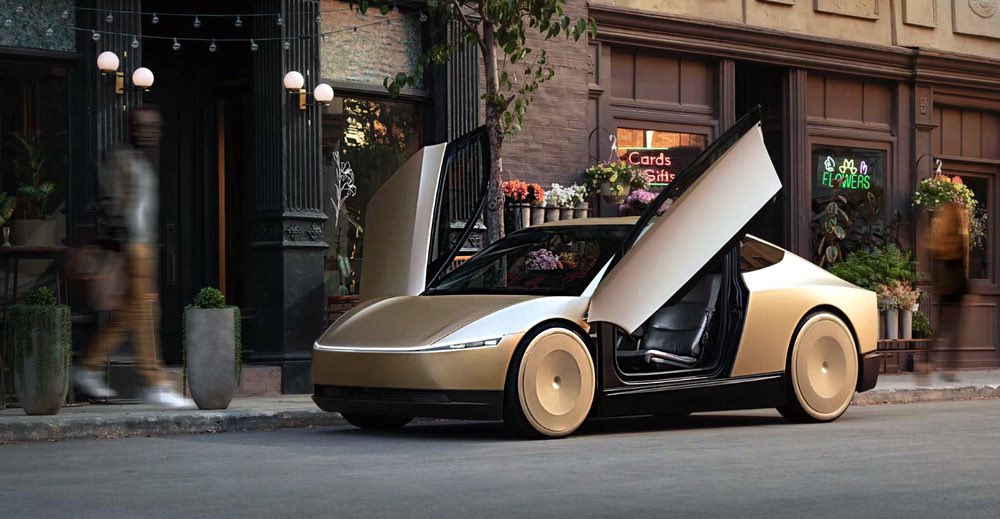
Been noticing this trend in tech design that uses white as dominant color and orange as the accent. Now this wave is dominating in robotics!
Sunday, Walden, now the two cute and affordable locomotion robots: Beni and Microduck also uses the same color palette.
More …
This is so well said!
Robotics research really needs some deep reflection rn on what still make sense in an university lab and what still brings in real world values - feel like lots of roboticists are having identity crisis nowadays - if scaling is the future then robotics will face the same fate like LLM and AV research.
IMO this is inevitable sadly … Research needs to move beyond data onto the next frontier
Hot takes: Robotics can in many ways be solved faster than self driving.
1. Data isn’t a much harder problem in robotics — it’s a different one.
Driving’s long tail is exterior and adversarial: other agents, weather, the pedestrian who does the one thing nobody does. You can’t manufacture that tail, you wait for it. That’s why fleet scale was the only answer.
Robotics’ tail is interior: clutter, object variation, contact. And every robot lives in one bounded, scannable, persistent environment — not a road shared by everyone. You don’t need to generalize across all homes at inference. You need to generalize enough to enter one, then specialize.
The safety asymmetry is the unlock. A driving failure at 60mph is unrecoverable, so you must clear superhuman reliability before you deploy. A robot failure is a dropped mug. You can ship below asymptotic competence and let recoverable failure become the data source. Self-driving had to solve the problem to start collecting. Robotics doesn’t.
Once it’s in the home (opt-in, obviously):
— idle time is reconstruction time; 3DGS turns each house into a personalized sim asset
— real2sim2real on that asset for nav and coarse manipulation
— failure-triggered teleop as the labeling engine
— highest signal-per-byte data in the stack
— verifiable reward. Driving has no crisp success signal. Manipulation does: the dish is in the rack or it isn’t. RL in deployment, not just imitation.
— per-household adapters on a shared base. Self-driving structurally can’t do this.
2. Dimensionality is a red herring.
Yes, driving is 2D with three outputs and a humanoid is 50–70+ DOF. That doesn’t mean 20x the data. DOFs aren’t independent and their ranges don’t freely combine — the manifold of useful configurations is far smaller than the raw count suggests. Train a dexterous hand and a gripper on the same pick-and-place and the dataset sizes come out comparable. Cover the distribution and dimensionality stops mattering.
3. Hardware is still the real constraint.
It’s gotten dramatically cheaper and more reliable, but good hardware is distilled time and robots haven’t had much of it. Cars have had a century of it. We don’t need another century — maybe 5–10 years to the Apple-grade robot, the point where people start arguing about eliminating white space inside the chassis.
And none of it spins without a base policy general enough to be tolerated on day one. That’s the inversion: in self-driving the data engine came first and the model followed. Here the model comes first, because nobody lets a useless robot live in their house long enough to generate data.
“Good enough” is a lower bar than “general,” though: a few tasks at high reliability, safe failure modes, clean handoff when unsure.
Data is still the hardest problem. But the bottleneck is coverage, not volume — and coverage is buyable with deployment.
Three full-stack physical AI companies seem super promising, and here are some of my personal insights and opinions
Sunday: $200M, $1.15B. @sundayrobotics
Genesis: $105M seed. @gs_ai_
Walden: $300M @ $1.1B. @WaldenRobotics
1. Robot design wise they all converged to wheeled base. Two arms. No legs. This is probably the future defaulto form to get the first robot into industry or homes.
On top of the topology- industrial design for robots absolutely matters - we need Apple like designers before we can get robots into homes - slimmer, lighter, more compact, and friendly - robot designs need to think out of the box.
2. There is no more secret sauce - all firms uses similar method — ALOHA, UMI, Diffusion Policy, LBMs, WAM plus sim as an eval tool. VLA is a dead end, WAM and LBM is the way to go just like how it’s done in self driving. However unlike the 100 years of data self driving have, robotics still missing that.
To solve robotics now is to solve the data problem now.
3. Robotics will only possible to be solved in the industry - research labs will suffer like LLM, AVs - it is a fight in data, funding, compute, and talents which industry excels at. Robotics research needs to rethink beyond data and facilitate industry on niche and more frontiers like dexterity, HRI, multi-robot collaboration etc.
Hi everyone! I’m Jerry Cheng, PhDing @nyu. I work on robotics, simulation, and RL for locomotion + manipulation.
Today I finally shipped my own website:
https://t.co/j3TDsCCIME 🚀
If you do Robotics Research and is also passionate in building a Robotics Startup-Let’s connect!