Han sido 28.795 votos
-con desprecio absoluto de los medios de comunicación
-sin más recursos que los propios
-sin militancia activa, ni experiencia, ni mítines en la mayoria de ciudades
-sin poder enviar programa y lista a cada hogar
Etc.
Nada mal para empezar.
Seguimos 💪💜
Las Medallas de #Extremadura se han concedido a tres hombres y una institución.
Y además uno de ellos es el presidente de la Fundación Triángulo, José Mª Núñez, que tanto daño ha hecho a mujeres y menores impulsando la Ley Trans, nacional y autonómica.
https://t.co/fuYIkVUqGo
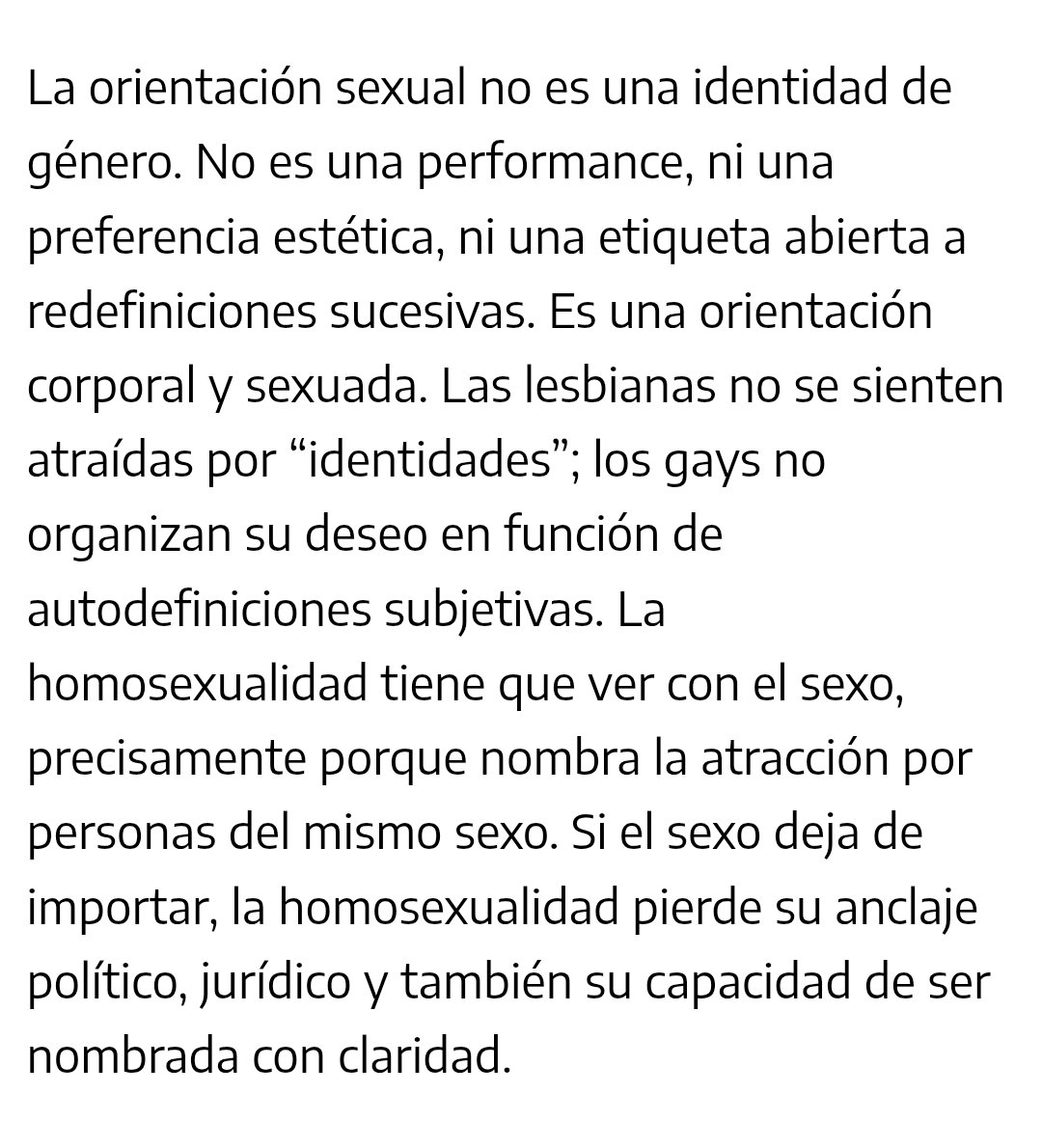
"Las lesbianas no se sienten atraídas por "identidades"; los gays no organizan su deseo en función de autodefiniciones subjetivas. La homosexualidad tiene que ver con el sexo..
El nuevo armario: permiso para ser homosexual en tiempos queer https://t.co/V3j7VKjrZV vía @eldiarioex
Yesterday, the regional edition of @eldiarioes in Extremadura, an important media outlet in Spain, surprisingly published an article by Pablo Pacheco Domínguez titled:
“The New Closet: Asking Permission to Be Homosexual in Queer Times.”
Today, the newspaper deleted it.
So I’m leaving an english copy here so you can see that our voices, gay and lesbian voices, are also speaking out in Spain against the confiscation of our historic struggle, with the aim of using it as the moral cover for a homophobic and misogynistic ideology, as well as political and financial capital.
⸻
“The New Closet: Asking Permission to Be Homosexual in Queer Times”
For decades, homosexual and bisexual people, women and men, defended one very simple thing: that homosexuality is attraction to people of the same sex, and that this reality should be neither punished, nor hidden, nor pathologized. LGB politics was born to protect this experience, to affirm its legitimacy, and to demand that no one should have to ask permission or forgiveness for desiring people of their own sex.
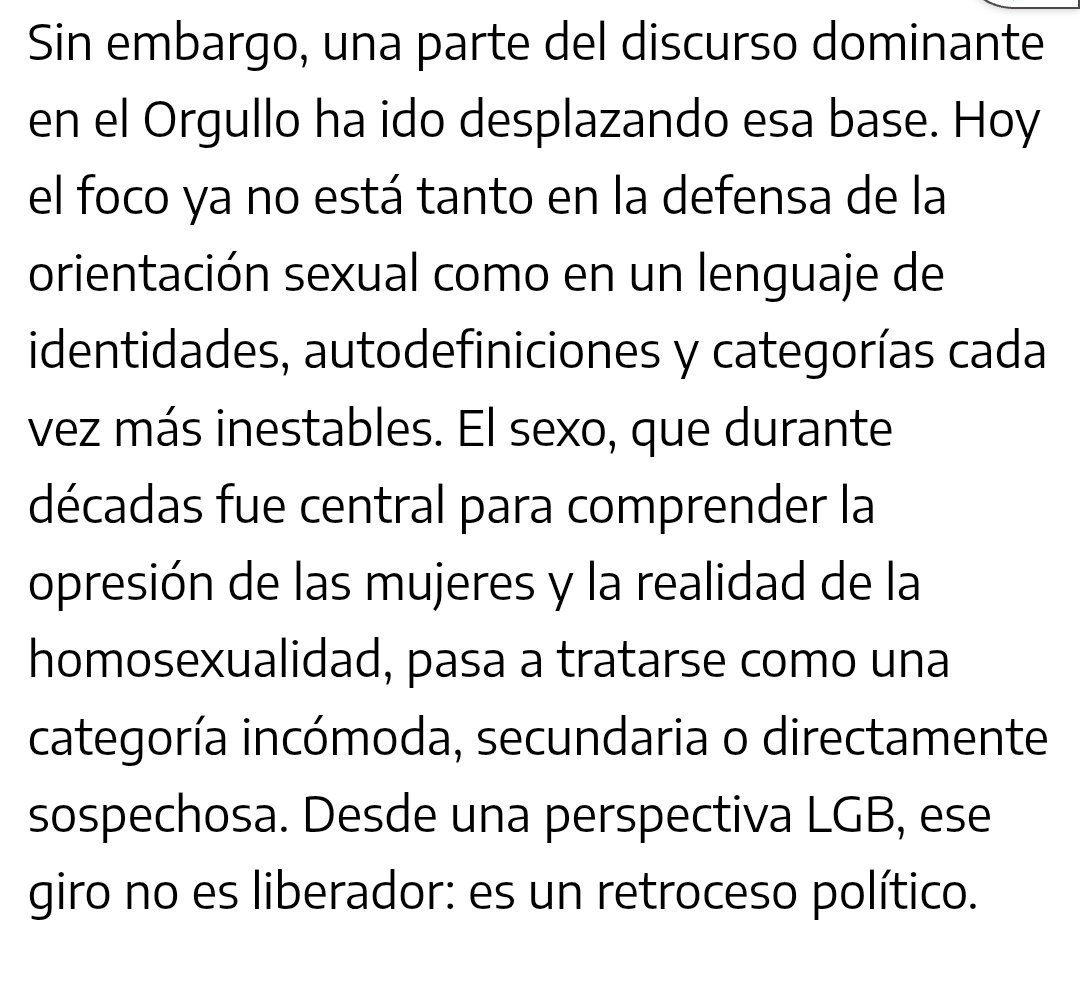
However, part of the dominant Pride discourse has gradually shifted that foundation. Today, the focus is no longer so much on defending sexual orientation as it is on a language of identities, self-definitions, and increasingly unstable categories. Sex, which for decades was central to understanding the oppression of women and the reality of homosexuality, is now treated as an uncomfortable, secondary, or even directly suspect category. From an LGB perspective, this shift is not liberating: it is a political setback.
Sexual orientation is not a gender identity. It is not a performance, nor an aesthetic preference, nor a label open to successive redefinitions. It is a bodily and sexed orientation. Lesbians are not attracted to “identities”; gay men do not organize their desire around subjective self-definitions. Homosexuality has to do with sex, precisely because it names attraction to people of the same sex. If sex stops mattering, homosexuality loses its political and legal grounding, and even its ability to be named clearly.
This has consequences. In the name of inclusion, growing pressure is placed on gay men and lesbians to justify the boundaries of their desire, as though sexual orientation had to submit to permanent moral correction. Lesbians who do not want relationships with male bodies are accused of transphobia, as are homosexuals who refuse to accept that sex is irrelevant to desire. But sexual orientation cannot be reeducated to fit a theory. For far too long, homosexual people were told that their desire was immature, selfish, incomplete, or correctable. It is troubling to see that same logic reappear today, dressed up in progressive language.
Nor is it useful that, under the “LGBTIQ+” umbrella, very different realities are mixed together: sexual orientation, gender identity, gender expression, and sex characteristics. This is not about denying civil rights to anyone, nor about promoting hostility toward any group. It is about pointing out that not everything follows the same political logic, raises the same legal conflicts, or requires the same analytical tools. The agenda of homosexual and bisexual people cannot simply dissolve into an addition of heterogeneous causes whose only link is an acronym that keeps getting longer and more confusing.
The underlying problem is also feminist. Gender is not an inner essence, but a system of expectations, hierarchies, and stereotypes that has historically served to discipline women and homosexuals. Feminism was not born to celebrate femininity or masculinity as identities, but to question the power these categories exert over our lives. That is why it is difficult to see as emancipatory a politics that turns gender into an inner truth and protects it from all criticism. Lesbians, precisely because they have disobeyed the mandate of male centrality, know very well that liberation does not come from reinforcing stereotypes under new names, but from dismantling them.
This is also why certain discourses about minors who do not conform to gender roles should be approached with caution. Not every discomfort with femininity or masculinity is a “trans” identity; sometimes, it is simply the way a young lesbian or a young gay boy goes through a difficult adolescence in a society that still punishes sexual dissidence. Automatically turning that discomfort into a question of gender identity can push some young homosexuals to interpret their difference as a problem of the body, rather than as a confrontation with the stereotypes imposed on them.
None of this should be controversial within Pride. And yet it is. Saying that homosexuality is based on sex, that lesbians exist as their own political category, or that gender is a hierarchy to be abolished rather than celebrated, has become a provocation in spaces that are supposedly rooted in the defense of sexual freedom. The result is paradoxical: the more Pride discourse expands, the less room there seems to be for clearly naming the homosexual experience.
This is not about going back into the closet or setting groups against one another. It is about recovering a clear LGB agenda, one capable of defending sexual orientation without asking permission from queer theory, and also capable of bringing the feminist critique of stereotypes, sexual exploitation, and the commodification of bodies back to the center. Homosexuality does not need deconstruction. It needs political respect, conceptual clarity, and the freedom to exist without being redefined from the outside.
-Pablo Pacheco Domínguez
El artículo de Pablo Pacheco en @eldiarioes, ya censurado por la ortodoxia Queer, ha despertado mucho interés, más por el lugar de publicación, que por ser de sentido común, que lo es, no siendo distinto a lo que el feminismo lleva años denunciado.
Como nos temíamos la tribuna de @eldiarioes acerca de como el transactivismo ha fagocitado el Orgullo y el movimiento LGTBI ha desaparecido por las críticas del lobby transproselita. ¡Lástima que lo habíamos guardado!
https://t.co/7nhkhMzXgL
Pensamos que había sido un avance, pero fue simplemente un despiste: @eldiarioes publica por fin un buen artículo sobre el cuirismo colonizando el colectivo LGB, para borrarlo al día siguiente.
La historia en pantallazos (1/2):
Como lesbiana, en pocas fechas me siento peor que en el #orgullo. Me siento invisibilizada. Nada de lo que me podría interesar o representar lo veo reflejado en ninguno de los cientos de actos. Como feminista, me siento ammordazada, no pudiendo decir que el pasto es verde.
Espectacular artículo sobre la autocontradictoria deriva del paraguas LGTBIQ+. Sencillo y riguroso a la vez. Perfectamente argumentado. Habría que destacar cada frase, así que mejor leerlo entero.
https://t.co/w46AlugCZD
Parece que @eldiarioes@eldiarioex han decidido eliminar el artículo de Pablo Pachecho Domínguez titulado: "El nuevo armario: permiso para ser homosexual en tiempos queer".
Si un medio retira un artículo de opinión por presiones ideológicas, no estamos ante una discrepancia editorial, sino ante un problema de libertad de expresión. Quienes defendemos el debate abierto deberíamos exigir explicaciones, sea cual sea nuestra posición.
Por suerte, el texto ha sido preservado y puede leerse aquí: https://t.co/BWllXhvtPJ
La mejor respuesta a la censura es leer, debatir y compartir.
#orgullocritico
El transgenerismo queer que niega el sexo va arrinconando a la homosexualidad de lesbianas y gays que se niegan a volver al armario.
UN GRAN ARTÍCULO
homosexual en tiempos queer https://t.co/DG4yZrATsb a través de @eldiarioex
Contra la totalitaria censura transactivista de @eldiarioes, difusión Feminista ⬇️
"El nuevo armario: permiso para ser homosexual en tiempos queer" https://t.co/gCJdB9yxxu
https://t.co/x9eYFm74WA
Artículos que no quieren que leas. Artículos que la prensa no publica y que cuando se cuelan -caso de este publicado ayer en @eldiarioes Extremadura - sobreviven menos de 24 h. Las tijeras de @iescolar, jaleadas por el neofascismo queer, han hecho su trabajo censor.
Hay textos que ayudan a ordenar ideas y a abrir conversaciones necesarias. Este es uno de ellos. Gracias a Pablo Pachecho Domínguez por escribir con claridad, honestidad y valentía sobre un debate que no deberíamos eludir. Muy recomendable su lectura 👇🏻:
#orgullocritico
El nuevo armario: permiso para ser homosexual en tiempos queer https://t.co/GyNmffX3Kw vía @eldiarioex
Sorpresa para nadie, vemos publicado un artículo sobre un tema que las feministas llevamos diez años exponiendo sin que se nos dé voz en los medios.
Lo publicaron. Lo difundieron. Y después lo CENSURARON.
Un artículo que planteaba un debate incómodo sobre la deriva del Orgullo y el desplazamiento de la defensa de la homosexualidad por parte del discurso queer ha desaparecido.
Cuando una opinión deja de poder leerse después de haber superado todos los filtros editoriales, la pregunta es inevitable: ¿qué ha cambiado? ¿Presiones? ¿desaprobación?
Es preocupante que, cuando alguien cuestiona públicamente la ideología trans o queer, la respuesta sea la descalificación, la presión para silenciar determinadas posiciones y la desaparición de espacios donde puedan expresarse opiniones críticas.
Quienes presumen de pluralismo deberían ocupar el primer lugar en defender que las ideas se respondan con argumentos, no haciendo desaparecer los textos que las contienen.
Si una sociedad solo tolera las opiniones que confirman el relato dominante, deja de fomentar el debate para convertirse en un espacio donde determinadas voces quedan excluidas.
🔗 Link al artículo: https://t.co/91jrtUDrSf
@eldiarioes@iescolar
#libertaddeexpresión #censura #PFAC #FeministasAlCongreso
Las feministas somos tan homófobas que llevamos horas difundiendo y aplaudiendo el artículo de un gay que @eldiarioes acaba de censurar. Artículo que viene a decir lo que las feministas llevamos diez años diciendo, por otra parte: El transgenerismo es homofobia. Y por eso lo han quitado, porque está prohibido criticar la nueva religión