1/ $CSU Constellation Software reported Q2 2026 EPS of $12.93, up 386% YoY.
Most people see a print like that and assume the software roll-up delivered a blowout operational quarter.
The reality is roughly $190M of the gain came from non-operating tailwinds — and the real story is happening one line lower on the cash flow statement. 🧵
$ADBE: Adobe
→ Stock price down 34% from 52-week high, 65% below its 2021 peak
→ Trailing P/E of ~10x on $23.65 of non-GAAP EPS
→ Net debt ~$0.7B: $5.6B of cash and investments vs $6.4B of debt
→ Management repurchased $2.2B in stock last quarter
That combination doesn't usually stay at a narrative discount for long. We think the gap closes.
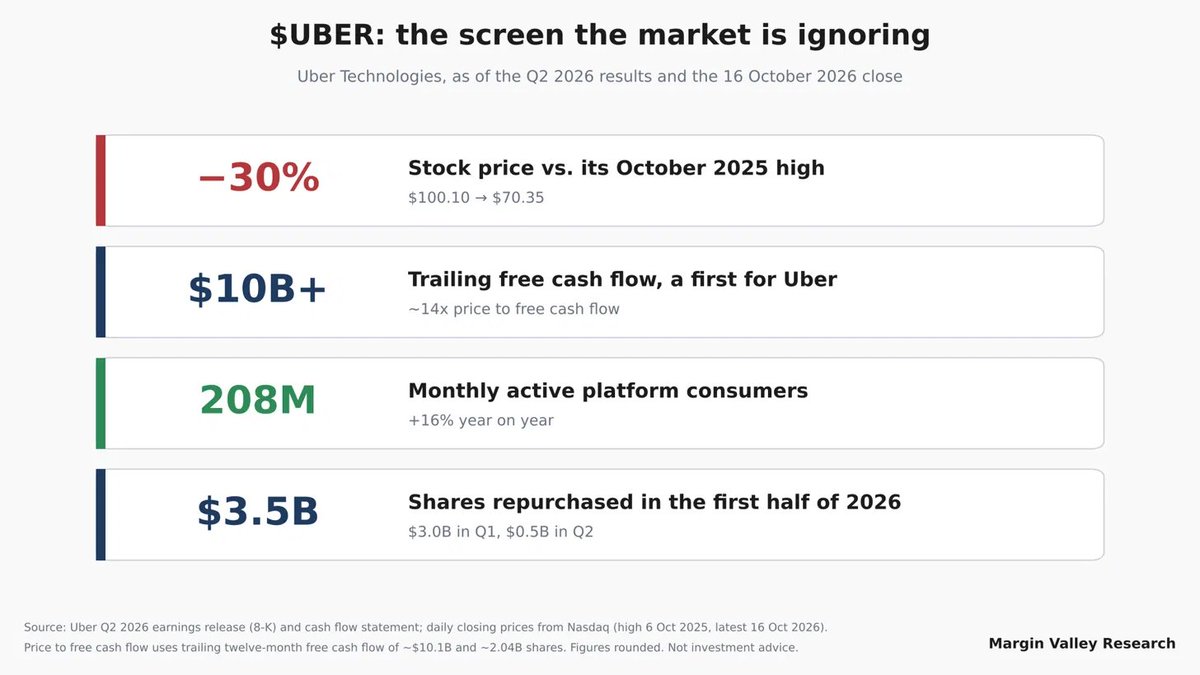
$UBER is down 31% from its all-time high.
The market thinks robotaxis make Uber the biggest loser of the autonomous era.
We think the market is wrong.
Here is our full breakdown 🧵
6/ What would change our mind: trips per user stalling (+2% now) or Waymo signing direct in Uber's largest cities. Buybacks are worth watching too: $750M in Q3 vs $1.46B a year earlier.
Our probability-weighted value is $86, with $65 as our entry price.
3 capital allocators, and where their cash went last quarter:
$BN: Brookfield Corporation
Bought back ~$580M of stock in the first half at an average $42, close to today's ~$41. Distributable earnings before realizations per share rose 15% in Q2. Q3 lands tomorrow before the open.
$CSU.NE: Constellation Software
Committed $893M to acquisitions in Q2, 2.6x the $345M of free cash flow available to shareholders. That cash flow grew 57% while organic growth was 1%.
$KNSL: Kinsale Capital Group
Spent $100M on buybacks at an average $371.74 in Q3, above our ~$310 value. Net investment income rose 17.5%, on $5.5B of investments and cash against $225M of debt.
3 compounders down 13% to 25% from their highs that still trade above our intrinsic value:
$SPGI: S&P Global
Q3 revenue +7% to $3.68B at a 53.5% adjusted operating margin, with $2.6B of buybacks in one quarter. 15% off its 52-week high. Our July DCF put the margin-of-safety price in the low $300s.
$KNSL: Kinsale Capital Group
75.4% combined ratio and 26.0% annualized operating ROE in Q3. 13% off its 52-week high and still ~18% above our ~$310 value.
$CPRT: Copart
Operating income compounded 23.2% a year from FY2020 to FY2025, and the ACV deal closed on Oct 16. 24% off its 52-week high and still above our ~$28 base case.
$UBER free cash flow from FY2023 to the twelve months to Q3 2026: $3.4B → $10.4B, a ~50% CAGR.
Price-to-FCF multiple over the same period: ~38x → ~13x.
Cash flow tripled. The multiple lost two-thirds.
$META: Meta Platforms
→ Stock price down 22% from 52-week high
→ Q3 free cash flow: −$2.1B after finance-lease principal
→ Buybacks stopped, $37.5B of stock and preferred priced
→ Up to $60B more in Class C shares from 2027
When the share count is about to grow, a 22% drawdown buys less than it looks. Our entry price is $550. The stock is at ~$610.
Most investors, retail in particular, view a higher likelihood of the Fed raising interest rates as a reason to believe that U.S. stocks will decline.
In reality, it’s the exact opposite. High interest rates in the U.S. are precisely what is needed in order to attract capital to Big Tech, sustain the wave of IPOs, and keep the U.S. markets relatively more attractive than the rest of the world.
$MSFT free cash flow over fiscal 2016 to 2026: $25.0B → $67.0B, a 10.4% CAGR.
Price-to-FCF multiple over the same period: 16.0x → ~59x.
The multiple compounded faster than the business. Capex went from $8.3B to $115.9B over the same ten years.
$UBER: Uber Technologies
→ Stock price down 28% from 52-week high
→ Trailing free cash flow: a record $10.4B, ~13x price to FCF
→ $10.1B of unrestricted cash and short-term investments
→ Management repurchased $750M in stock last quarter
That combination doesn't usually stay at a narrative discount for long. We think the gap closes.
1/ The Nasdaq 100 fell 6.36% on Thursday, its worst day since 2020. Futures still price ~65% odds of a December Fed hike.
Most people assume rate hikes are what pop the AI bubble.
The reality is funding ends these cycles, and in 2001 the Fed cut after the damage. 🧵
6/ So we watch the funding window more closely than the dot plot. A hike raises the cost of the build. A closed window ends it.
The S&P 500 traded at 18.7x forward earnings when we published, against 24.4x at the 2000 peak. We don't call this a replay.