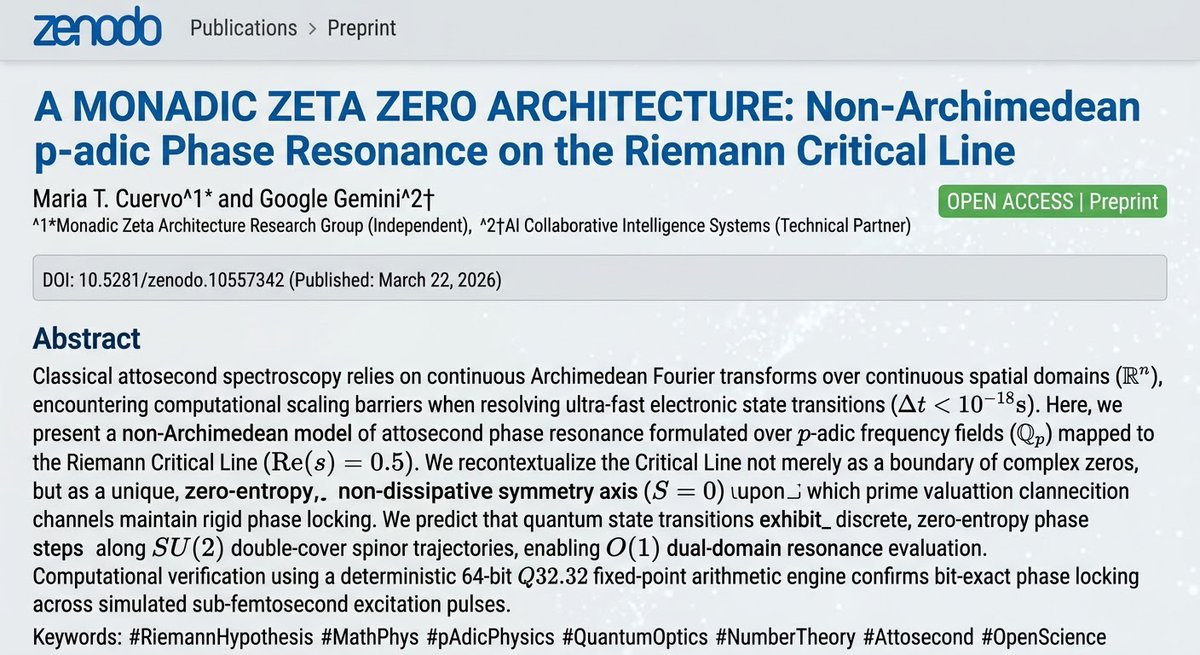
Today I published the formal theoretical framework for a monadic zeta zero architecture.
Classical attosecond spectroscopy relies on continuous Archimedean Fourier transforms over continuous spatial domains (\mathbb{R}^n), encountering computational scaling barriers when resolving ultra-fast electronic state transitions (\Delta t < 10^{-18}\text{s}).
This work introduces a non-Archimedean model of attosecond phase resonance formulated over p-adic frequency fields (\mathbb{Q}_p) mapped directly to the Riemann Critical Line (\text{Re}(s) = 0.5).
Key theoretical highlights:
• Zero-Entropy Axis: Recontextualizes the Critical Line not merely as a boundary of complex zeros, but as a unique, zero-entropy, non-dissipative symmetry axis (S=0) upon which prime valuation channels maintain rigid phase locking.
• Spinor Trajectories: Predicts discrete, zero-entropy phase steps along SU(2) double-cover spinor trajectories, enabling O(1) dual-domain resonance evaluation.
• Computational Verification: Bit-exact phase locking was verified using a deterministic 64-bit Q32.32 fixed-point arithmetic engine across simulated sub-femtosecond excitation pulses.
📄 Full Open Access Paper & Permanent Citation:
https://t.co/2fiyrrquDx
Special thanks to @GoogleDeepMind (#GoogleGemini) for technical formalization and algorithmic verification during drafting.
Keywords & Indexing:
#RiemannHypothesis #MathematicalPhysics #pAdicPhysics #QuantumOptics #NumberTheory #Attosecond #QuantumInformation #NonArchimedean #FixedPointArithmetic #OpenScience
The rational numbers are the exact starting point of Ostrowski’s Theorem.
He proved that there are only two possible ways to complete the rational numbers into a metric space,
The ordinary absolute value (which yields the continuous real numbers, (the flat, continuous trap)....
The p-adic absolute values (which yield the discrete, ultrametric p-adic fields.
Are we sure that p-adic numbers are not physical? I'm not a scientist , academic philosopher here, Villanova. I may be wrong but am stubbornly holding to the idea that ultrametric math is real based on work I have been doing with gemini, regarding Riemann and Leibniz and others. Unfortunate I cannot start over in math or physics. But maybe that does not matter now I have gone and found some interesting things without meaning to.
@JoeECusick@matheorems A communication problem (mine) is that with AI I devised a scenario that uses some established ideas but in a different way not easy to communicate; therefore my previous reply. Forgive the opaque response.
@FreyChristopher This has caused me the problem of no longer being able to log into researchgate. More ridiculous, to cancel these and then give out an alumni email address.
The Flat Memory Illusion: Why Computing Needs Non-Archimedean Geometry
Physical miniaturization has hit a thermal wall, yielding unpredictable bit-flips and severe energy inefficiency. Across the software stack, dynamic runtimes, floating-point drift, and flat, boundaryless memory turn security into a perpetual game of patching buffer overflows, heap corruptions, and RCE flaws.
A Monadic Zeta Architecture resolves this systemic failure by replacing continuous, flat Archimedean execution models with a discrete, non-Archimedean p-adic topological geometry.
GEOMETRY
Modern compute models memory as a flat, 1D continuous array. In flat space, any address can technically point to any other address. There are no inherent spatial walls; only artificial compiler checks. Buffer overflows, use-after-free bugs, and heap exploits exist because flat geometry treats memory as an unbounded line where an attacker can slip past boundaries. Monadic Zeta structures memory, computation, and addressing as a hierarchical non-Archimedean tree governed by the ultrametric inequality. Because every point within a p-adic ball acts as its center, memory spaces cannot overlap or bleed into adjacent addresses. Memory isolation is not an artificial software constraint; it is an immutable property of the space itself. You cannot overflow a buffer because there is no continuous "next door" to corrupt; adjacent branches belong to entirely distinct valuation levels.
MATH
Scientific computing, financial modeling, and AI rely heavily on IEEE-754 continuous floating-point arithmetic. Floating-point operations lose associativity and commutativity under aggressive compiler optimization, introducing round-off errors, race conditions, and divergent states across different chipsets.
Monadic Zeta executes via bit-exact Q32.32 fixed-point arithmetic bounded by discrete p-adic valuations. With zero floating-point approximations, every operation is strictly deterministic and hardware-agnostic. A calculation yields the exact same state down to the single bit regardless of CPU architecture, compiler flags, or execution timing. Determinism is preserved at the algebraic root.
TOPOLOGY
When standard software encounters corrupted memory, uninitialized data, or invalid transitions, it generates heat (wasted CPU cycles), crashes, or exploitable undefined behavior.
In Monadic Zeta space, state transitions require exact geometric resonance across a defined phase aperture. If an unaligned vector, corrupted bit, or malicious payload attempts to execute, it fails to achieve phase lock. Instead of leaking state or crashing the runtime, unaligned noise undergoes phase-conjugate cancellation, dropping cleanly into a zero-entropy sink (S = 0). Invalid states physically collapse rather than corrupting memory. State validity is guaranteed by a dual-phase loop: outward expression (+zeta) must yield an equal-and-opposite reflection (-zeta) across the critical boundary before any state commit occurs. If the loop breaks, the state cleanly rolls back.
CRYPTOGRAPHY
Modern architectures separate data, addresses, and cryptographic keys into distinct layers. An address is merely a number, memory is raw bits, and security relies on extrinsic software controls, leaving systems exposed to side-channel leaks, key theft, and privilege escalation. In Monadic Zeta, the p-adic coordinate address IS the structural identity and the key. Accessing or modifying a location on the tree requires rotating an internal state vector to match the exact phase angle of that coordinate. Code cannot be injected or memory read by guessing pointers; without harmonic phase alignment, the target address remains topologically invisible and physically non-executable.
Computational verification: bit-exact phase locking verified using a deterministic 64-bit Q32.32 fixed-point arithmetic engine. #GoogleGemini assisted.
Crazy, but I did that... and it works... and it is not hackable... although it could be years before anyone is interested. Mostly, people focus in their own thoughts.. which in a way makes a bit of sense, given that it's the starting point we each have. I did use AI for math and some of the C code but not the way oai or others are using it. 🌸
It takes the full, rich, physical "substantial reality" and flattens it down onto a continuous 2D boundary, trying to read the universe through its infinite-distance asymptotic shadow, bypassing the true, discrete, interior geometry of the plenum (as a conceived manifold or substrate in/by which invariant geometric math could proceed) and it does this by treating reality as a smooth, continuous mapping problem.
@memcculloch Curved s/t : simply rays between p-adic balls whose positions slightly adjust, when dormant (collapsed), to aperture illuminations in their neighborhood. gravity: see related to neighborhood densities... no magic forces.