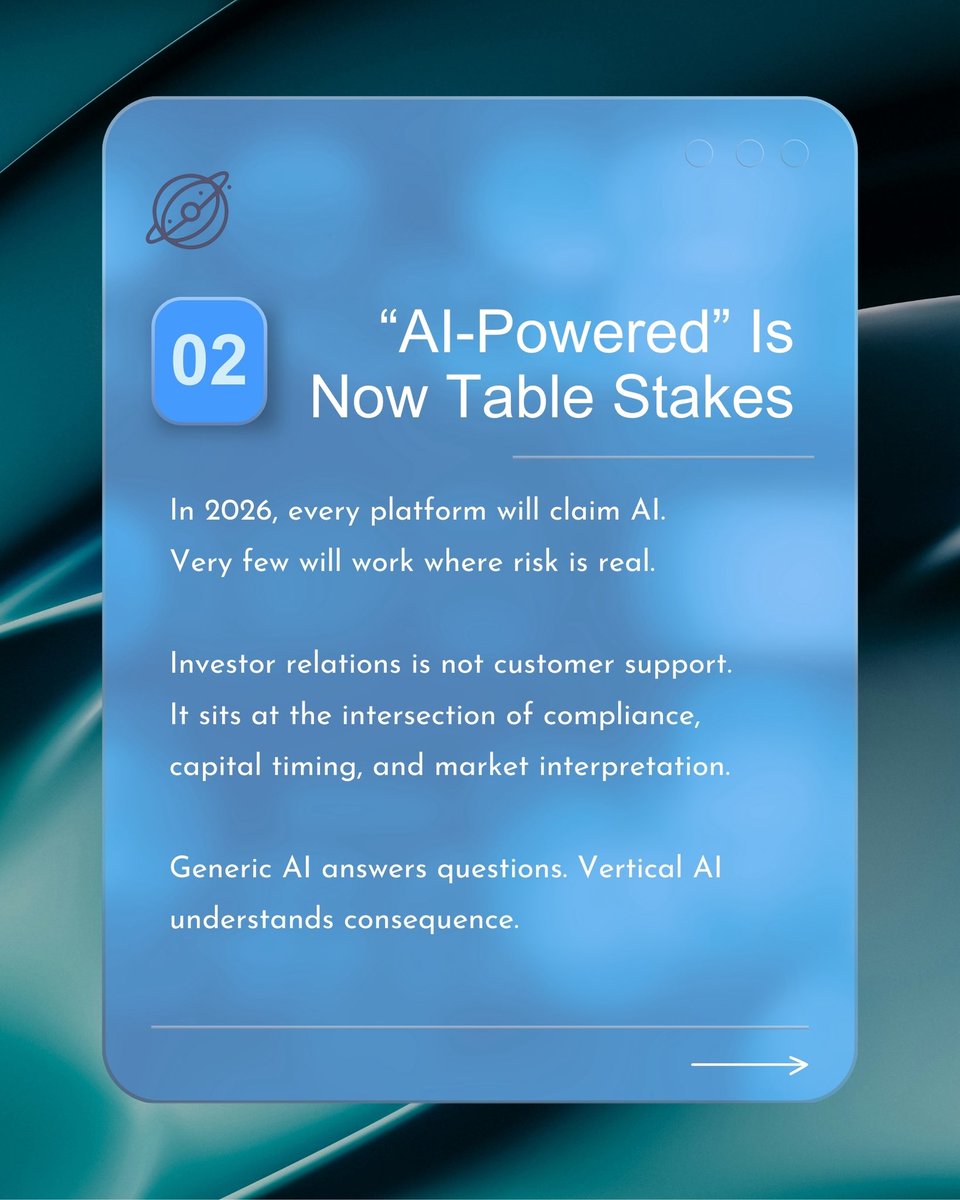
With new AI tools advancing, anyone with a laptop can ship a deck, or a release that looks the part. What hasn't gotten cheaper is distribution, and it's gotten harder now that every investor inbox is drowning in the same volume of output.
Turns out the stuff that still matters is what has always mattered: knowing your investors, reaching the right capital, and a story people trust.
#InvestorRelations #CapitalMarkets #AI
Meta is turning its biggest apps into a subscription ladder.
The new “Plus” tiers are tailored to each app: Instagram Plus and Facebook Plus are rolling out globally at \$3.99 /month, while WhatsApp Plus is priced at \$2.99 /month.
At the same time, Meta is testing new creator, business, and AI subscriptions under its broader Meta One brand. The premium Meta One Advanced tier, at \$49.99 /month, includes more significant perks: priority placement in search results, expanded linking options, enhanced analytics, and advanced visibility tools.
The signal is clear, even if it is frustrating: platforms are no longer just monetizing attention.
They are monetizing access, reach, compute, status, and visibility.
For brands, creators, and public-facing executives, the “free” version of the internet is shrinking.
Because feed, search, and story surfaces are finite, this creates inevitable friction. If certain accounts can buy priority placement, non-subscribers will likely experience some form of relative compression in organic reach. That displacement effect is directionally plausible, but Meta has not published quantitative guarantees on how Meta One Advanced will affect the broader algorithm.
That means marketers should treat the ROI of these premium tiers as an empirical question, not a universal rule. The right move is to test account by account, surface by surface, and use case by use case.
The real strategic question is the magnitude and reliability of the paid visibility. “Preferred discoverability” may create an advantage in certain contexts, but it will not magically lift every post, every account, or every campaign. Meta’s ranking systems still depend heavily on predicted value, engagement, and relevance.
In short: Meta can sell inventory. It can sell featured placement. It can sell better tools, expanded links, and interface-level advantages.
But it cannot sustainably make weak content perform like strong content without degrading the overall user experience.
So yes, this is another step toward pay-to-play. But subscription status is not a replacement for strategy, positioning, creative quality, or actual audience demand.
It may buy visibility.
It does not buy resonance.
An article by @mariahjmac navigating the current tech, capital, marketing industries, comparing today's existential challenges with historical parallels. The Angel Faces Backward - https://t.co/18qX07CGbK
★ Tech-led social marketing for complex markets.★
I’m very excited to start sharing more from @airvynlabs here. I’ve been doing a lot of restructuring behind the scenes, (and probably waited too long for everything to feel finished before posting. wasn't listening to my own advice..)
Airvyn is the home for the mar-tech work, built to serve the same ecosystem of clients in strategic partnership with @orbitonapp
Feeling grateful for all the conversations, and energized by the industry’s excitement even with the market volatility. I’ve got a little Orbiton vlog coming soon :) & big things in the office I can’t wait to share.
Welcome back to Orbiton Weekly — and welcome to 2026!! 🎉 🎉
In this episode, @DBaraghoush and @mariahjmac reflect on Orbiton’s biggest year yet and break down what drove the company’s growth in 2025.
We talk candidly about starting the year as a two-person team, closing a friends-and-family round led by @Frank_Giustra, CIM®, B.A Econ. and @fioregroup, and working with our first design partner, @SilverVarden.
Dolly Varden Silver went on to become the first company to deploy an AI chatbot in investor relations, and the engagement we saw confirmed that we were solving a real problem. From there, Orbiton scaled from one early partner to more than 19 clients, now representing over $10B in combined market capitalization. Along the way, we added to the team, expanded our product offerings, and shifted from building features to building infrastructure companies could rely on.
We also talk about how advice and early conviction mattered. A pivotal conversation with @RyanWeymark helped sharpen our focus beyond small caps, reinforced the importance of sustainable revenue, and validated that this was a tool companies of all sizes would eventually need. The episode also touches on major industry milestones, including @ShawnKhunkhun and @SilverVarden ‘s announced merger with @OreContango, which underscored how much momentum the broader market experienced alongside us.
One of the clearest lessons from the year is that Orbiton didn’t succeed because it was “an AI company.” It worked because we focused on a problem we had lived ourselves and used the right tools to solve it. AI matured, stabilized, and became reliable enough to support real workflows, not replace people. That shift made trust possible, and trust made adoption possible.
As we head into 2026, the focus remains the same: keep experimenting, keep listening closely to customers, and keep building products that genuinely make work easier. The next phase is about depth, scale, and earning the confidence of even more companies willing to try something new.
Excited for what’s ahead.
#StartupGrowth #FounderJourney #AppliedAI #InvestorRelations #B2BSaaS #BuildingInPublic
Daniel Baraghoush & Mariah MacDonald talking free trials, Lovable 's massive growth and the demand for Ai.
Check out the full podcast for more: https://t.co/x12rISoQif
Orbiton Weekly — Agentic vs Generative AI, Lovable’s $200M ARR, & What’s Working in AI Right Now
This week, @DBaraghoush and @mariahjmac get into why @Lovable hit $200M ARR so fast, what separates agentic AI from generative tools, and why IR needs models built for real workflows.
Orbiton updates also included launching with @StrikepointGold and @Forge_Resources, and @Cu_Giant
saw a strong move after its updated resource.
If you’re leading a public company, this episode gives a clear look at how AI is changing investor communication, what tools will matter, and how Orbiton is positioning for the next wave of adoption.
Free Resources for Business owners & Social Media Management 📺📧 No gatekeeping here. As a social media/creative agency we don’t want to disempower businesses from running their own accounts; we just believe hiring experts gives you time, ease, and clarity. But social media is free, and these tools are too. It’s better to start somewhere than not at all 🫶🏻 #creativeagency #freesocialmediamarketingtools #freesocialmediatools #marketingtips #digitalmarketingtools
We live online, so you don’t have to. 📺📧
Every business needs a different blend of support, so we build a custom mix of services for you. Flexible, tailored, and aligned to your goals.
Orbiton Weekly- Investor Behaviour, Overloaded IR Teams, and AI-Native vs AI- Enabled Operations
This week on Orbiton Weekly, Mariah and Daniel break down the real gap between AI-native and AI-enabled companies—and where Orbiton sits as both an AI builder and an operator. We cover new signups (Lion Rock and Sierra Madre), the product upgrades rolling out across the dashboard and complex search, and why IR teams are more overloaded than ever as investor behaviour shifts.
What IR Teams Need Most in Today’s Market
‼️‼️
AI is rewriting how investors think, how companies communicate, and how stories are told.
For IR teams, that speed comes with pressure. The pressure to keep up with constant news, fast-moving investor sentiment, and a flood of data that never stops. Traditional systems can’t keep pace anymore. Quarterly updates don’t cut it when investors expect answers instantly.
We’ve seen this firsthand.
Over the past few weeks, we’ve run campaigns that tracked real investor engagement across channels, from influencer videos to company chatbots, and what’s clear is this: the companies that win attention now are the ones that respond fast, measure engagement accurately, and use AI to close the gap between communication and conversion.
Here’s what IR teams need right now:
Real-time visibility.
You can’t fix what you can’t see. IR teams need instant feedback on what’s landing, what’s being ignored, and who’s actually engaging with their message.
Automation that saves time, not replaces people.
AI shouldn’t replace the human side of IR, it should give teams hours back. Simple tasks like organizing investor notes, updating CRMs, or following up after conferences should be automatic.
Consistency during chaos.
When markets move this fast, consistency is your anchor. IR teams need tools that make every investor touchpoint (chatbot, campaign, or email) aligned, accurate, and measurable.
The ability to act instantly.
In a market where perception changes hourly, the companies that can communicate, correct, and clarify in real time will always have the edge.
The challenge isn’t whether to use AI; it’s how to integrate it in a way that adds precision, speed, and insight without losing trust.
That’s where the future of IR is heading.
“This planet has - or rather had - a problem, which was this: most of the people living on it were unhappy for pretty much of the time. Many solutions were suggested for this problem, but most of these were largely concerned with the movement of small green pieces of paper, which was odd because on the whole it wasn't the small green pieces of paper that were unhappy.”
― Douglas Adams, The Hitchhiker’s Guide to the Galaxy
There’s this collective hallucination we’re all part of, that if we just hit that one number, land that one client, get that one raise, we’ll finally feel it: peace. Joy. Satisfaction. But the truth is, if you’re miserable during the build, you’re going to be miserable once you arrive. Because “arriving” is a mirage. Every milestone is just another mile marker on a road that never ends.
At some point, you have to stop sprinting toward the next thing and ask yourself, do I like how I’m living?
Not the highlight reel. The everyday. The mornings. The meetings. The emails. The work between the wins.
Because this is it. This is the majority of your life. The process isn’t the prelude to the good part. It is the good part.
When I started designing my life around the things I actually love: storytelling, creating, capturing, building something meaningful, it changed everything. Not overnight. Not all at once. But slowly, with every choice that aligns with my joy, the fulfillment grows. And the money? It will follow that momentum. Maybe not always in the exact way I expect, but in the way it was meant to. Passion with discipline is magnetic. People can feel when you care.
So no, the problem was never the small green pieces of paper (or in Canada, our colourful plastic money.) It was forgetting that it was never the point. The point is to wake up excited. To feel present. To feel alive. To be in love with the story you’re writing, even in the chapters no one else sees.
Design for that. Build for that. The rest will come.
https://t.co/ZMdkOaBDjE