Hay actores que en nuestra mente jamás envejecen,esa clase de personas atractivas,con gran magnetismo,que hacen de cada personaje que interpretan algo inolvidable. Jeremy Irons...
Everyone says winter killed Napoleon in Russia. The numbers say otherwise.
He crossed the Niemen on June 24, 1812 with around 450,000 men in the main force. He walked into Moscow on September 14 with about 100,000. That is three quarters of an army gone before a single snowflake fell, and only one major battle fought.
So what was actually eating it?
Disease, mostly. His men picked up lice marching through Poland and Lithuania, and the lice carried typhus. Dysentery came from bad water and worse camp hygiene. In 2001 a construction crew in Vilnius dug up a mass grave holding roughly 3,000 of his soldiers. Researchers tested the dental pulp and found DNA from typhus and trench fever in about a third of the samples they could work with. The army was dying of infection while it was still winning.
Then the weather, and not the kind you are picturing. The summer of 1812 was punishing. Men in wool marching 20 miles a day in heat near 95 degrees, drinking from the same ponds their horses stood in. Thousands dropped from heatstroke before they ever saw a Russian.
Then the horses. Napoleon brought somewhere around 180,000 of them and lost most over the campaign. Cavalry mounts need grain, not just grass, and there was no grain. A horse that starves does not just die, it dies slowly and uselessly, pulling less every day. Lose the horses and you lose the cavalry screen that tells you where the enemy is, you lose the teams that move the guns, and you lose the wagons that carry the food. An army that cannot move cannot forage, and an army that cannot forage starves. That spiral started in July.
The Russians understood this better than he did. Barclay de Tolly refused the decisive battle Napoleon needed and kept backing up, burning grain stores, driving off livestock, emptying the road. Napoleon had built the best supply system in Europe for campaigning in Germany, where a village every few miles could feed a passing column. Russia had no such thing. His supply train fell behind almost immediately on roads that turned to soup in the rain, and he went ahead anyway.
Borodino on September 7 was the battle he had wanted since June. Something like 70,000 men fell in a single day, the bloodiest day of the entire Napoleonic era. He won it and it bought him nothing. The Russian army withdrew intact, which was the whole point of Kutuzov's plan.
Moscow was the real blunder. He expected Alexander to negotiate the moment the city fell, because that is how it had always worked. Vienna fell, Austria talked. Berlin fell, Prussia talked. Moscow burned instead, two thirds of it gone in four days, and Alexander never answered a single letter. Napoleon sat in the ashes for five weeks with a strategic clock running, waiting on a reply that was never coming.
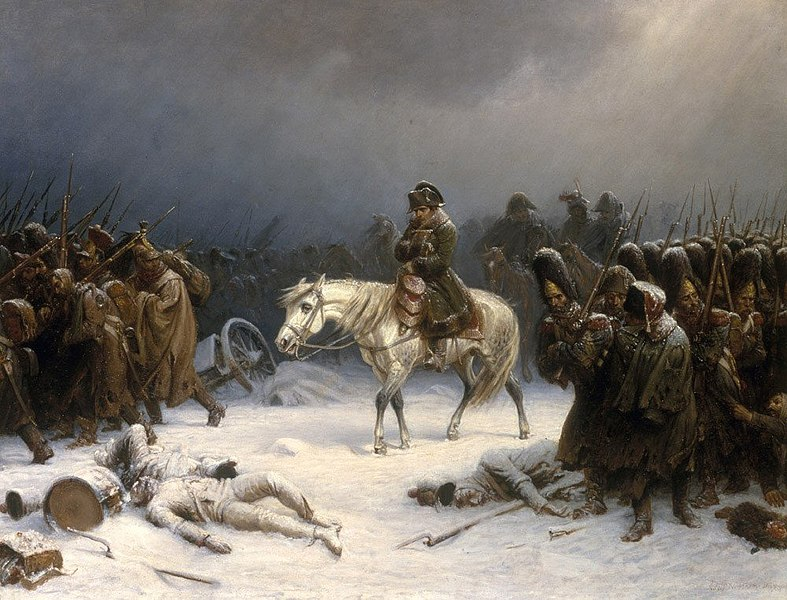
He left on October 19. At Maloyaroslavets on the 24th the Russians blocked the southern route through untouched farmland, and rather than force it he turned back onto the Smolensk road, the same road his own army had already stripped bare on the way in. He marched his starving men through their own wreckage, past their own unburied dead.
The first real snow came in early November. That is when winter enters the story, and it enters against a force already down to maybe 50,000 effectives. The cold did not defeat an army. It disassembled a column of sick, hungry stragglers. The horses had no frost caulks on their shoes and could not keep footing on ice, so guns and wagons were abandoned by the hundred. Men burned their muskets for warmth. Discipline stopped meaning anything.
At the Berezina in late November, Eblé's engineers stood chest deep in freezing water building two trestle bridges by hand so the remnant could cross. Almost none of those engineers survived. Around 40,000 organized troops made it over. Thousands of stragglers did not, and drowned or were cut down on the east bank when the bridges were fired.
Napoleon left the army on December 5 and rode for Paris to hold his government together. Of the central force that crossed in June, roughly 25,000 recrossed the Niemen in December in any organized state.
If you want the whole thing in one image, look up Charles Minard's 1869 chart of the campaign. One thick band going in, one thin thread coming out, with the temperature scale running along the bottom. It has been called the best statistical graphic ever made, and it makes the point without a word: the line is already collapsing long before the cold shows up.
Winter did not beat Napoleon. Disease, logistics, dead horses, and a Russian refusal to play his game beat him. Winter just buried the body.
El discurso de Alexander Zverev que tenés que escuchar. ❤️
🗣️ “Quiero agradecer a una persona más. Alguien que nunca ve realmente mis partidos, pero que es la persona más importante de mi vida tenística y de mi vida en general.
Cuando tu hijo de 4 años es diagnosticado con diabetes y los médicos te dicen que su vida y su práctica deportiva serán muy, muy limitadas, hace falta una madre muy fuerte para salir de ese consultorio y decir:
‘Mi hijo estará donde quiera estar. Si quiere ser tenista, será tenista. Si quiere hacer otra cosa, hará otra cosa. Pero esta enfermedad no nos va a definir’.
Mi madre es la persona más importante y fuerte que conozco. Hace falta una mujer increíblemente fuerte para hacer lo que ella hizo”.