Two new Build Station sidetracks just dropped 👀
🥩 @MarinadeFinance - $3,000 for the best @Solana staking-focused build
🔐 @accretion_xyz - $500 for research / security
More reasons to ship this week.
Prague, Oct 3–7.
1/ On Sep 25, an attacker tried to take over the Marinade DAO with two malicious proposals. Both were vetoed by the DAO council. No funds moved. mSOL, Native Staking and SAM were never affected. Here's what happened 🧵
5/ Next: a permanent code fix, extra safeguards for sensitive proposals, and AI-driven analysis of every new proposal. We've also notified the @realmsdaos maintainers so other DAOs can stay protected.
239 of 653 Solana validators went the last three months without a single downtime incident.
The other 414 went offline at least once.
If you stake SOL, one of these validators is holding it. Most people have no idea which group theirs is in, because downtime is quiet.
What downtime looks like
A validator can stop voting. Voting is how it confirms blocks, and Solana pays staking rewards for every vote that lands on time. When your validator goes silent, your rewards stop too. Nothing gets slashed and your APY barely moves, so you end up with a little less SOL and no idea why.
It can also stop producing blocks. Every validator gets turns to make blocks, based on how much stake it holds. A node that's down or slow leaves those turns empty, and the fees and tips from those blocks never reach you. It can keep voting the whole time, so most dashboards still show it as healthy.
What it cost
Between them, Solana validators spent about 4,200 hours offline since the start of July. Stakers missed roughly 3,400 SOL in rewards, and that only counts missed votes.
Plenty of big names were on the list:
@binance: 5.4 hours offline, 185 SOL lost by its stakers
@P2Pvalidator: 8.4 hours across 8 nodes, 89 SOL
@Helius: 2.5 hours, 77 SOL
@everstake_pool: under 2 hours, 71 SOL
@coinbase: 9.8 hours across 18 nodes, 28 SOL
On August 12 one hosting provider had a routing failure and 167 validators went dark at once. Stakers lost 224 SOL in about half an hour.
Who got paid back
About 64 SOL of the total sat on stake delegated through Marinade. When a Marinade validator goes down, the validator pays Marinade stakers back.
The other 3,357 SOL belonged to everyone else. Nobody paid it back.
Explore
We built Explore so you can check this for any validator on Solana. Every incident shows how long it lasted, how much SOL stakers missed, and whether anyone covered it.
Look up yours at https://t.co/Zf5mzHzE9g
239 of 653 Solana validators went the last three months without a single downtime incident.
The other 414 went offline at least once.
If you stake SOL, one of these validators is holding it. Most people have no idea which group theirs is in, because downtime is quiet.
What downtime looks like
A validator can stop voting. Voting is how it confirms blocks, and Solana pays staking rewards for every vote that lands on time. When your validator goes silent, your rewards stop too. Nothing gets slashed and your APY barely moves, so you end up with a little less SOL and no idea why.
It can also stop producing blocks. Every validator gets turns to make blocks, based on how much stake it holds. A node that's down or slow leaves those turns empty, and the fees and tips from those blocks never reach you. It can keep voting the whole time, so most dashboards still show it as healthy.
What it cost
Between them, Solana validators spent about 4,200 hours offline since the start of July. Stakers missed roughly 3,400 SOL in rewards, and that only counts missed votes.
Plenty of big names were on the list:
@binance: 5.4 hours offline, 185 SOL lost by its stakers
@P2Pvalidator: 8.4 hours across 8 nodes, 89 SOL
@Helius: 2.5 hours, 77 SOL
@everstake_pool: under 2 hours, 71 SOL
@coinbase: 9.8 hours across 18 nodes, 28 SOL
On August 12 one hosting provider had a routing failure and 167 validators went dark at once. Stakers lost 224 SOL in about half an hour.
Who got paid back
About 64 SOL of the total sat on stake delegated through Marinade. When a Marinade validator goes down, the validator pays Marinade stakers back.
The other 3,357 SOL belonged to everyone else. Nobody paid it back.
Explore
We built Explore so you can check this for any validator on Solana. Every incident shows how long it lasted, how much SOL stakers missed, and whether anyone covered it.
Look up yours at https://t.co/Zf5mzHzE9g
On a normal validator list, it can be difficult to identify how much one operator is truly controlling.
On @MarinadeFinance Explore Coinbase for example is one operator with ~40M SOL and 9% of all stake across 25 validators.
It maps the network by real operator - AND you can delegate from your own wallet on every page.
we run on quarterly objectives, and hit 2 of 4 in Q3
missing an objective isn't a failure if you learn from it
this quarter we learned via an AI rock ballad
I was driving one of the quarterly rocks (objectives) in Q3.
Instead of using just slides to share the learnings during all-hands, I made clankers produce a rock ballad.
I don't think I'm driving a quarterly rock ever again. DM me for tips on strategic incompetence.
Marinade started at a Solana hackathon in 2021. Small team, bootstrapped, still is.
We shipped the first liquid staking token on Solana and kept building through the crash.
Slow cooked since 2021. Thank you all for your support! 🙏
7/ More block builders and more clients is the decentralization Solana has been working toward. It also means the best yield moves around. An open auction follows it. That is the whole idea behind mSOL.
Data: https://t.co/XtmF6EIOfL. Delegation logic: https://t.co/qaT1QVggQa.
1/ Solana has never had more ways to build a block. JitoBAM, @jito, @harmonic_gg, @Rakurai_io, @raikucom. Five validator block engines in production. Twelve months ago most of this did not exist. Good for the network. Also good for stakers, if your stake can move.
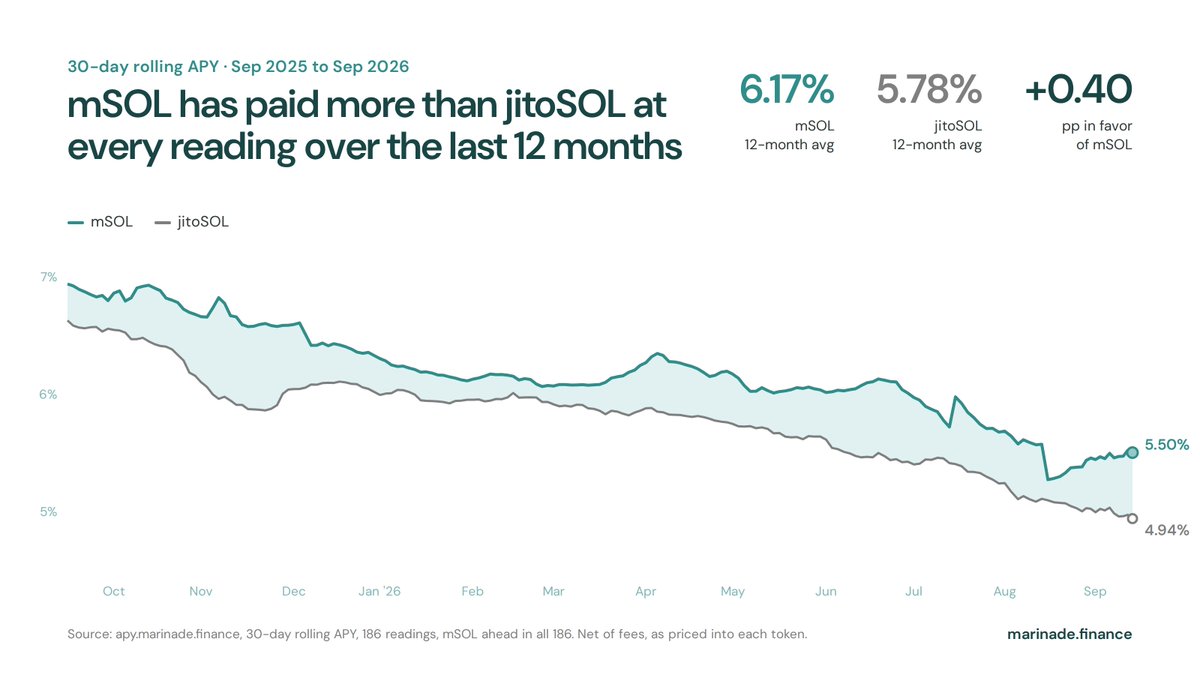
6/ The result is in the chart. 30-day rolling APY, September 2025 to September 2026, source https://t.co/XtmF6EIOfL. mSOL 6.17% average, jitoSOL 5.78%. mSOL was ahead at every one of 186 readings. Today it stands at 5.35% vs 4.85%, the highest of the major LSTs.