Your inbox shouldn't go dark when your signal does
We've just launched offline mode for MarineTraffic Inbox, so shipbrokers, vessel operators, and shipping teams can keep working on long-haul flights, at sea, or anywhere connectivity is unreliable.
Enable it and Inbox downloads your last 30 days of email history to your device. Reply, read, and forward as normal. The moment you reconnect, everything queued in your outbox sends automatically.
For teams coordinating across time zones and oceans, staying on top of communications shouldn't depend on having four bars of signal.
Offline mode is available now on the #MarineTraffic Inbox mobile app.
Contact our experts to learn more: https://t.co/Feg3kJe0To
Chokepoint activity diverges
#MarineTraffic data showed a widening contrast in vessel movements across the Strait of Hormuz and Bab el-Mandeb. Hormuz recorded eight confirmed crossings, a 33% daily decline, with most traffic following the Iranian Unilateral Scheme. Activity through Bab el-Mandeb increased 18% to 26 confirmed crossings, including three dark transits. The IMO reported no additional confirmed vessel attacks. MarineTraffic continues to provide visibility into vessel movements, routing decisions and changing traffic patterns across both waterways.
Traffic data reveals fragile flows
#MarineTraffic data highlights how headline volumes can obscure underlying maritime risk. Strait of Hormuz crossings fell from 10 to eight on 4 August, with seven vessels exiting the Middle East Gulf and only one entering. Five of the eight movements used the Iranian Unilateral Scheme, while no Hormuz Traffic Separation Scheme crossings were recorded. Bab el-Mandeb traffic rose from 25 to 34, including 18 vessels entering the Red Sea and 16 exiting. Yet four dark transits, two sanctioned crossings and six shadow fleet movements indicate that visibility, routing concentration and compliance exposure remain central concerns.
Saudi VLCCs reroute around Africa
Six Saudi-flagged VLCCs sailing in ballast have turned away from the Bab el-Mandeb route and are now heading south through the Indian Ocean. According to #MarineTraffic data, for five of the six vessels the first AIS destination changes were recorded between on 30 July, as the tankers headed south. Ghinah and Laynah updated their destinations to Durban, Burqan initially signalled Durban before switching to Algoa Bay and later Port Elizabeth, while Dilam and Hazm first listed Gibraltar. Hazm subsequently changed her destination to Durban at 22:20 UTC on 31 July.
Chokepoint traffic remains uneven
#MarineTraffic data shows 39 combined crossings through the Strait of Hormuz and Bab el-Mandeb on 2 August, as traffic patterns across the two corridors continued to diverge.
Hormuz recorded nine transits, compared with 23 on 31 July and 11 on 1 August. Five vessels exited the Middle East Gulf and four entered. Seven used the Iranian Unilateral Scheme, while two routes were undetermined and none used the Hormuz traffic separation scheme. The daily total included two sanctioned and two shadow fleet vessels.
Bab el-Mandeb recorded 30 crossings, down from 41 on 31 July and 37 on 1 August. Twenty vessels exited the Red Sea and 10 entered. One dark transit, two sanctioned crossings and three shadow fleet crossings were recorded.
Hormuz traffic hits five
#MarineTraffic data highlights sharply contrasting trends across the region's main maritime chokepoints on 30 July. Strait of Hormuz crossings fell to five from 22 the previous day, a 77% decline. All five vessels used the Iranian Unilateral Scheme, while no Hormuz TSS or Route Undetermined transits were recorded. Bab el Mandeb remained comparatively active with 47 crossings, including 27 vessels entering the Red Sea and 20 exiting. The dataset also identified four sanctioned vessel transits, eight shadow fleet crossings and one AIS dark transit. The figures suggest that while traffic continues through both corridors, routing patterns and operational risk remain closely linked to the evolving regional security environment.
Fire involving two LNG vessels disrupts Damietta terminal
A fire involving the Energos Winter floating storage and regasification unit and the LNG carrier GasLog Salem has disrupted activity at Egypt’s Damietta LNG terminal. Following the incident, both vessels were moved offshore as authorities assessed the damage, while another #LNG carrier scheduled to discharge at the terminal also departed the area. The blaze was contained and no casualties were reported.
Maritime traffic remains resilient
A total of 53 confirmed vessel crossings were recorded across the Strait of Hormuz and Bab el-Mandeb on 28 July, with 12 transits through Hormuz, an increase of 50% from the previous day, and 41 through Bab el-Mandeb, up 5%. Traffic through Hormuz remained highly concentrated, with 10 of 12 vessels using the Iranian Unilateral Scheme and none using the Hormuz Traffic Separation Scheme. In Bab el-Mandeb, the latest data identified 4 dark transits, 4 sanctioned vessel crossings and 8 shadow fleet movements, reinforcing that while commercial traffic continues, routing behaviour and vessel transparency remain the key indicators of operational, compliance and geopolitical risk.
Improve port operations visibility
Join our live MarineTraffic Platform Walkthrough on 30 July to explore how better port and terminal intelligence can support more efficient operations.
The session will cover live #port activity, port calls, arrivals, departures, expected arrivals, berth calls and congestion monitoring, alongside practical best practices to enhance planning and operational visibility.
Whether you're just getting started or looking to deepen your knowledge, this session is an opportunity to unlock more value from the platform.
Register here: https://t.co/3FZkK1561b
Transit patterns diverge
#MarineTraffic data highlights diverging patterns across two of the world's most strategically important maritime chokepoints. Between 24 and 26 July, the Strait of Hormuz recorded 29 verified crossings, including 21 vessels exiting the Middle East Gulf and 8 entering. Routing remained evenly split, with 14 transits using the Iranian Unilateral Scheme, 14 classified as Route Undetermined, and one using the Hormuz Traffic Separation Scheme.
By comparison, Bab el-Mandeb recorded 100 verified crossings, with 51 vessels entering the Red Sea and 49 exiting. Ninety vessels followed the Traffic Separation Scheme, while 10 completed dark transits. Several vessels that had previously delayed or reversed course later completed their crossings, suggesting operators are continuing to assess risk dynamically rather than avoiding the route altogether.
Hormuz traffic falls as Bab el-Mandeb activity rises
Maritime activity remained uneven across the region’s key chokepoints on 23 July, with no new confirmed IMO attacks reported. According to #MarineTraffic data, traffic through the Strait of Hormuz fell to just six confirmed crossings, down 60% day-on-day. Five of the six vessels followed the Iranian Unilateral Scheme, highlighting the continued concentration of traffic along that route.
Meanwhile, Bab el-Mandeb recorded 49 confirmed crossings, including five sanctioned vessels, 11 shadow-fleet vessels and four dark transits. Several ships that had previously reversed course in the Gulf of Aden and Red Sea later completed their passages, while others remain on hold.
China-linked VLCCs clear Bab el-Mandeb
Two China-linked VLCCs carrying a combined 4 million barrels of Saudi crude have crossed the Bab el-Mandeb Strait. According to #MarineTraffic data, the Singapore-flagged Xin Long Yang reversed course and paused in the central Red Sea on Tuesday before resuming her southbound voyage late on Wednesday. She crossed Bab el-Mandeb at 07:13 UTC on 23 July, followed by the Hong Kong-flagged Cosnew Lake at 10:40 UTC. Both 333-metre tankers departed Yanbu Industrial Port on 20 July and are sailing laden, each with a reported draught of 19.6 metres.
Before the transit, both vessels updated their AIS destination fields to “CHINA CREW & OWNER”, replacing previously listed Chinese discharge ports. They are now sailing east through the Gulf of Aden, with Xin Long Yang underway at around 13.3 knots and Cosnew Lake at 12 knots.
Maritime traffic remains under pressure
#MarineTraffic data shows commercial shipping continuing through both of the Middle East's critical maritime chokepoints, although traffic patterns reflect growing operational caution. On 21 July, 9 verified vessels transited the Strait of Hormuz, compared with 29 crossings through Bab el Mandeb. Over 20 to 21 July, Hormuz recorded 22 crossings, with 16 using the Iranian Unilateral Scheme, while Bab el Mandeb handled 73 crossings. Vessel behaviour is also shifting, with four verified U turns near the Gulf of Aden following heightened security threats. Combined with 61 confirmed maritime incidents reported by the IMO, the data suggests that geopolitical risk is increasingly influencing routing decisions, even as commercial traffic continues.
First Red Sea diversions emerge
According to #MarineTraffic data, the first operational response to heightened security risks in the Red Sea is now visible. Two laden crude tankers, the Singapore flagged XIN LONG YANG and the Liberia flagged RODOS, have altered their planned voyages after departing Saudi Arabia.
XIN LONG YANG departed Yanbu, Saudi Arabia, on 20 July 2026 at 04:31 (UTC+3) with a reported destination of Qinzhou, China, before turning back in the Red Sea. RODOS departed Al Muajjiz, Saudi Arabia, on 20 July 2026 at 23:40 UTC with a reported destination of New Mangalore, India. Earlier today, at 09:17 UTC, RODOS updated her reported destination to the Suez Canal.
Hormuz traffic remains muted
The latest #MarineTraffic data show traffic through the Strait of Hormuz remained subdued over the weekend, with 30 verified crossings between 17 and 19 July and continued variation in route selection. Although no new confirmed attacks were reported during the latest monitoring period, the security environment remains elevated and shipping patterns continue to respond to geopolitical uncertainty. Monitoring daily vessel movements and routing choices remains essential for understanding operational risk and the resilience of global trade flows.
Hormuz traffic reaches three week low
MarineTraffic data indicate confirmed crossings through the monitored Strait of Hormuz zone fell to eight on 16 July, down from 15 a day earlier and marking a three week low. Seven of the eight transits followed the Iranian route, with no crossings via the Omani route and no shadow fleet movements recorded. Traffic was evenly split between commercial and non commercial vessels, while half of all crossings were Iranian flagged. The latest data reflect a continued decline in vessel activity, reinforcing signs of a more selective operating environment across one of the world's busiest maritime chokepoints.
Read more here: https://t.co/ZaNRDa7bqE
Confirmed crossings via the Strait of #Hormuz declined day-on-day on 15 July, with 13 transits recorded, based on @Kpler data. For a 3rd consecutive day, traffic remained heavily concentrated on the Iranian Route, which accounted for 10 of the 13 crossings.
Video: @MarineTraffic
Strait of Hormuz risks deepen despite slight rise in crossings
Vessel activity through the Strait of Hormuz increased slightly on 14 July, with 21 confirmed crossings recorded, according to #MarineTraffic data. Commercial traffic accounted for most movements, including vessels carrying crude oil, LPG, methanol and iron ore.
The security outlook, however, deteriorated further after three additional attacks off Oman were verified, bringing the reported total to 56 confirmed incidents and 17 seafarer fatalities. No vessels used the Omani route, while traffic continued to favour Iranian-approved routing, highlighting declining confidence in the alternative corridor. The Strait remains passable, but renewed security threats and reports that the US may consider a 20% cargo transit toll are adding further legal and geopolitical uncertainty for operators.
Hormuz crossings continue falling
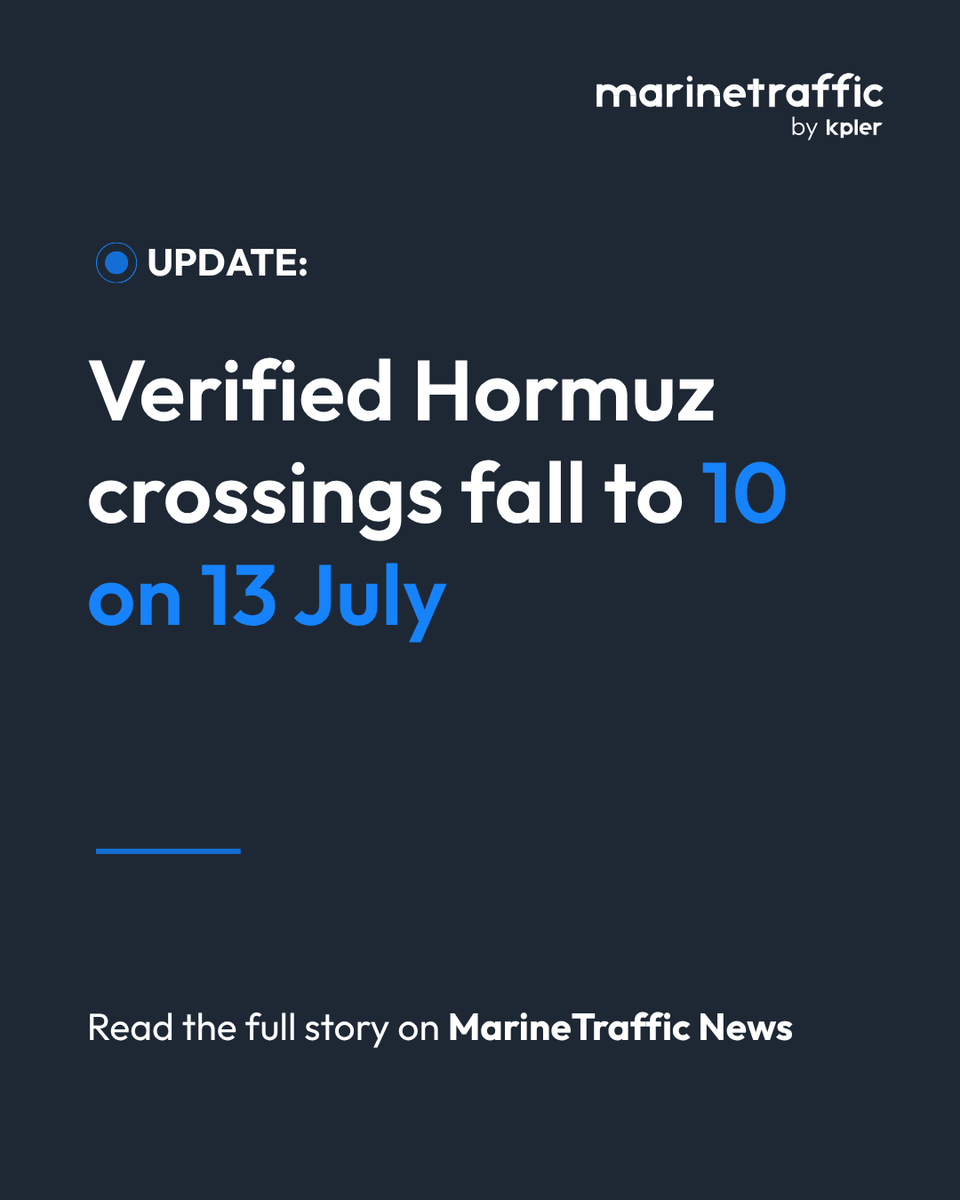
Just 10 verified crossings were recorded through the monitored Strait of Hormuz zone on 13 July, marking a further slowdown in maritime activity as renewed conflict continues to affect regional shipping. Low risk commercial vessels accounted for the sharpest day on day reduction, while nine of the 10 crossings used the Iranian Route. The IMO has now confirmed 53 incidents and 14 seafarer fatalities, with another attack added to its incident tracker. At the same time, public exchanges between Washington and Tehran have further weakened the diplomatic outlook, increasing uncertainty around access and navigation. For operators, crew safety, insurance costs and operational acceptance remain the primary constraints on transit decisions.
Read more here: https://t.co/INfAIS1M1f
Strait of Hormuz traffic turns defensive
Vessel activity through the Strait of Hormuz declined sharply over 10–12 July, with confirmed crossings down by around 52% week on week, according to #MarineTraffic data.
Traffic also shifted back toward more defensive routing patterns. Use of the Iranian and Dark routes increased, while activity on the IMO and Omani corridors fell to minimal levels, indicating that operators continue to prioritise perceived security over more direct transit options.
Although no new IMO-confirmed physical attacks have been reported since 27 June, renewed US-Iran tensions and recent IRGC warnings continue to weigh on confidence, reinforcing a cautious approach to commercial shipping through the region.