Building Tamable #1
Why I brought Tamable back ↩️
I've always enjoyed writing. I used to share the journey of building Ripplr on its blog, I have my personal blog, and I've tried writing for Twitter a few times (I even built Tweetboard, a Kanban board for tweets and threads).
While building MustLoop, I wanted to talk to indie hackers. A lot of indie hackers, solopreneurs and builders are here on X, so I decided my content would focus on X. I went with Typefully, which I'd used before and works great.
And I found a workflow that worked even better: storing my ideas in Typefully through its MCP, and letting an AI assistant expand them.
Then I wanted the same workflow for my personal blog: the assistant doing the heavy lifting, organizing my thoughts, scheduling posts for the best time slots. Typefully couldn't do that.
So I repurposed Tamable. It started as a simple CRM for influencers and content creators, and it never worked, but it already had a really nice text editor (TipTap). Now it's the back office for everything I write: my posts here on X, my personal website, and maybe other places in the future.
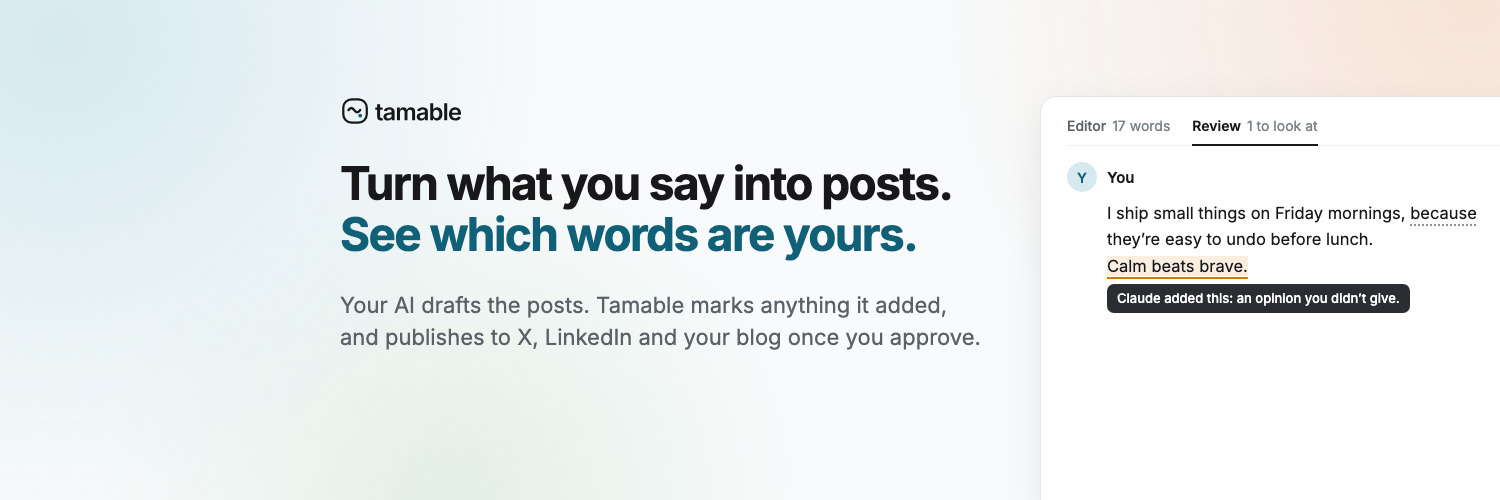
Here's how it works now: my AI interviews me, my answers become ideas and drafts, and I still review and approve everything before it goes out.
We don't have time for many things, and there's a lot going on in our lives. I believe this is a really nice way to ease writing, publishing and being present on the internet. At least for me, it feels like I finally found a workflow that works.
Building Tamable #2
Tamable has a new website, and it's no longer part of the app.
Why split them now? I want to start investing in organic content marketing and organic search (SEO as a growth engine, hopefully). If I'm doing that, it made sense to do it properly.
I needed a framework that handles server-side rendering and all that sort of stuff, like Nuxt does.
I also wanted to use Tamable to write about Tamable, on Tamable's own blog. That way I get the full experience Tamable's customers have.
That led me to build a proper Nuxt website, and it also made sense to keep the app on a different subdomain.
One small tweak along the way: when the website was ready, I still didn't have any blog content. I really wanted to launch the new website and the new landing page, so to not block the release, I kept the blog hidden at first.
It's live now, with the first posts of "Shipped, and why": what changed in Tamable, and why.
@dg_aswin For now I’m doing only the “Shipped and why” posts, which is a fancier way of saying build logs I suppose 😅
But the plan is to eventually focus on specific posts and keywords
Rewriting Tamable's landing page took me about a week.
A week of going back and forth with Claude: figuring out the messaging, the positioning, the visuals, and the copy, over and over.
Is there a lesson about copy I'd share? Honestly, I don't know. I don't have a proper process for this. It's super organic: I read it countless times and go a lot by gut feeling.
One thing that helped me rewrite it and better understand the positioning and the messaging was this: https://t.co/rRzbXihDMD
I'm happy with it now. Let's see how well it performs 😄
https://t.co/p9UVJiDAcR
The biggest change being a dad brought to how I build: it forces me to be focused.
I have a lot less time, so I have to be ruthless about priorities and about the scope of what I build, to make the most of the short time I have.
That's great, especially for me as an engineer, because I tend to overbuild a lot of stuff.
And it doesn't stop at side projects. It shows up in my full-time job too, and in pretty much everything else.
@Michaelchoong5 Yeah... From my side the thing I struggle the most with, is finding the right people to talk to.
Leaving the build mode on its own is already quite challenging, but figuring out who should I talk to, and where do I find those people/conversations, is the hardest thing for me.
What excites me most about AI: the autonomy it gives me as a builder.
I can now execute the vision and the plans my brain comes up with in every vector: design, code, infrastructure, product, marketing...
I've always been a decent developer. But I always felt my biggest differentiator was being more than an engineer. I brought product sense, a business perspective and customer success context into everything I did. It helped me make better decisions, prioritize better and, in general, impact the business more efficiently.
Now I can do pretty much anything, and own a whole product or a part of one. I think that's really interesting for the companies that I work for.
@Michaelchoong5 Agree! Choosing what to focus on has always been quite super important, especially today, in this AI era.
Personally, I don't have a "process" per say, I just organically/naturally decide what is worth investing my time on, and what is not.
How do you handle this?
@dev_niladri Honest answer from someone who had the same problem: what got me posting consistently wasn't discipline, it was simply talking ideas through with Claude, ask it to draft posts using my own words, and reviewing things before scheduling them.
Building Mustloop #3
Honestly, Mustloop was a bit paused for a while.
When I brought Tamable back, that's where my biggest work spike went. I was crunching big time on it.
Mustloop still got bug fixes and small improvements, some of them for free through sparkling-ui, the UI library both products share.
But in early November it got my attention again, and a big chunk of it:
- projects, each with its own strategy
- a new home: https://t.co/zViI8IIsEO the app lives at, https://t.co/KG9EaENgwd is the website,
- and the one I'm most excited about: product events
Product events let my products tell Mustloop what people actually do in them. When someone stops, Mustloop notices and drafts a check-in for me to review and send.
That changed how I see Mustloop. I've had a bigger vision for it in my head for a long time: not just following up on leads, but helping me with everyone I'm in touch with about my products, from the first conversation to trying it to being a customer.
A few days before, my positioning for it was still all about that first step. Product events brought it to a whole other level.
And the two products feed each other now: I write for Mustloop in Tamable, and I use Mustloop to manage the relationships for both.
That's it for today! See you next time 👋
I'm building my own UI library, sparkling-ui.
PrimeVue has been great. But like any library, it means depending on a lot of things I don't control. In its latest major it became a paid library, which is totally fine (Tailwind UI does it too).
I've thought about building my own countless times. Now it finally feels like the right timing:
- With AI, plus everything I know about building UIs, I can build a really powerful UI library and actually maintain it.
- I'm building more than one product at the same time, so a shared library matters a lot more now.
- I don't have to import a huge library where I won't use most of it. I can be intentional about what I build.
I finally have that flexibility and that freedom.
How I actually build my side projects, as a dad with a full-time job:
Evenings and weekends. But not in a neat "1 hour every day" kind of way.
It comes in spikes. Some weeks the full-time job gets heavier, or I have lots of family/social events, birthdays, life in general... Then I get 1 or 2 days where I can work harder, and I build a bunch of things at once.
That's how I keep making progress 😄
How do you fit your side projects around everything else?
My brain is kind of chaotic. Lots of thoughts, lots of things I'd love to cover and talk about.
Every time I write something by hand, it takes me ages. Ages to get to a first finished draft, and then countless hours polishing it, trimming some stuff, rewriting other things.
Now, I write differently. I talk my ideas out with Wispr Flow, then hand them to Claude (or any other assistant) and let it expand them.
I gave it everything I've written on the internet, so it learned how I like to write and how I like to talk to people. And thankfully, it works really, really well.
The assistant does the heavy lifting and organizes my thoughts. I still read everything and edit the small details before it goes out.
@LiveaAi Absolutely! A better prompt makes a huge difference, although I found that once I enter the “polishing phase” it’s quite unavoidable to go through a bit of back and forth.
This happens even more if I’m trying to explore things first, from a creative/visual perspective.
The part of working with AI that I don't enjoy: being just an executor.
Sometimes I find myself simply prompting agents, reviewing what they deliver, and keep doing this until the quality standards are met and the designs are implemented as spec'd
It's easily the worst part of my job, because it doesn't require any creativity at all.
Being just an AI operator isn't interesting or fulfilling for me.