We don't often say this but Baseline's smart contract can be thought of as an active market participant.
The typical market participant is rational and self-interested. While this behavior is no different for Baseline, the fact that it's a smart contract matters:
1. Rationale is defined in code & cannot be manipulated. Compare this to human market participants that, while rational most of the time, behave irrationally surprisingly often.
2. Self-interested but "self" refers to all tokenholders, not an individual entity. So by buying the token, the holder is essentially entering an implicit agreement with the smart contract that it will work FOR the tokenholder, not against.
No other AMM does this hence why so many token price charts look like PvP environments.
GM.
The @asph0d37 playtest turned out to be a very thorough trial of our systems... we had 48k mints/rerolls, 33k duels, and 706 festivals in total.
That means 706 Marked Taruchi....
(Also, our infra crashed at least 5 times. Probably more. We didn't track that one.)
I think we’ve begun the rotation out of Ethereum. I think this started around 6 months ago.
I’ve seen a large amount of bear takes on Ethereum calling for 3 digits and felt resistance to it. But now I do genuinely believe we are just starting to see the rotation out of Ethereum.
I’m not sure how long it takes but I do see Ethereum going towards $1000. Every under water DAT will sell ETH on their balance and buyback their own shares. No one is buying these sell flows.
If anything people are going to rotate early and it’s going to unravel slowly and there is no demand to meet it.
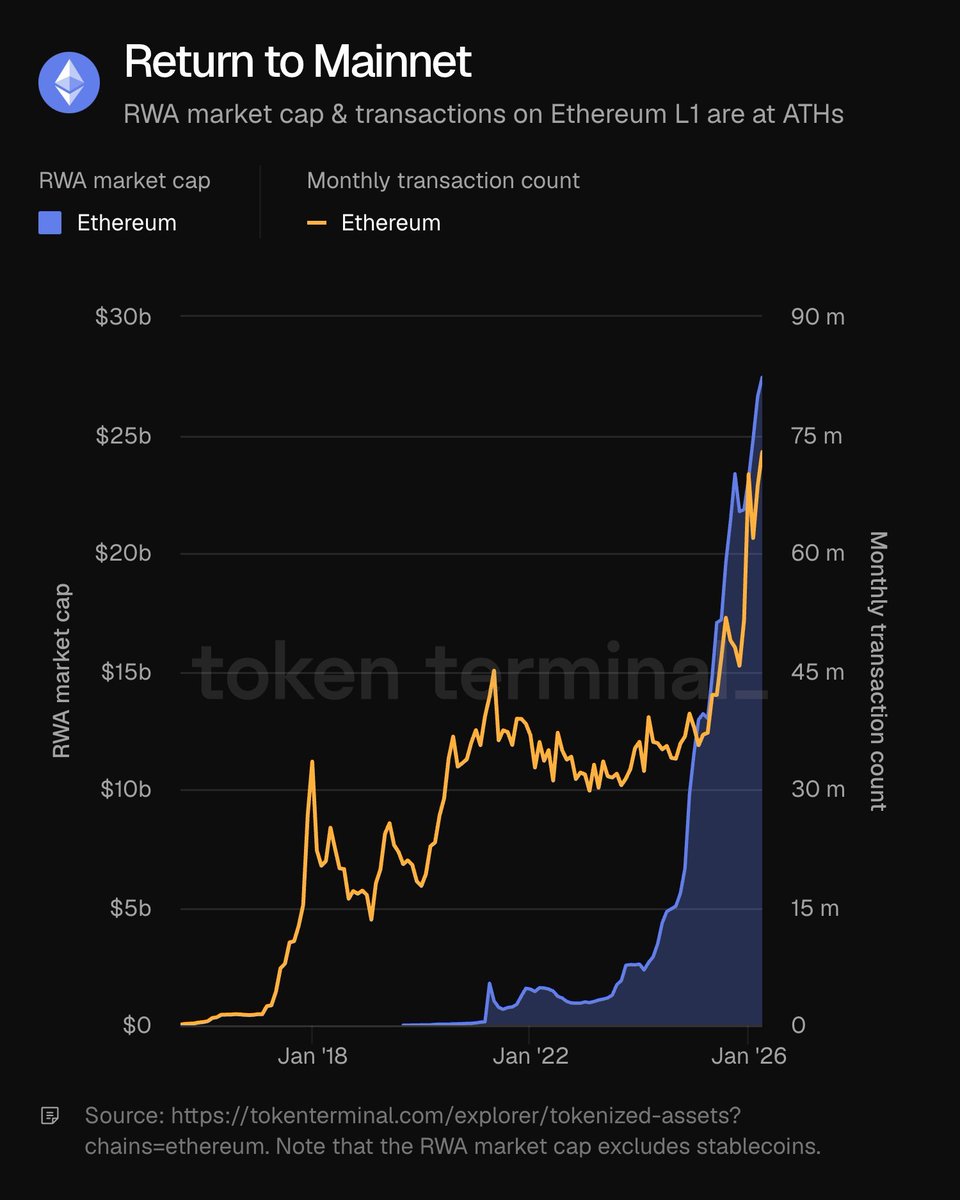
Ethereum is winning institutional issuance.
Just as companies choose between the NYSE & Nasdaq, institutions issuing tokenized assets choose venues based on reputation, performance, & audience.
@ethereum's edge: the liquidity & institutional activity are already there.
@Evan_ss6 Only one of us is aware that we are a slave to ETH, and cannot stop talking about it
See if you can, or if your programming always overrides your will
The agentic economy will have trillions of agents, each with their own token.
It’s not realistic for this to be built on market infrastructure that requires human market makers or liquidity that has to be managed.
Virtuals saw this pretty early, and are leading the charge implementing a new kind of token infrastructure where trading activity is more tightly integrated with token value and holder benefits.
@BaselineMarkets explained simply ⛽️
A lot of people are asking what Baseline actually changes for $REPPO, whether they need to mandatorily stake, rebuy, how exactly is this is bullish for the network.
The simplest answer:
You don’t need rebuy, stake/unstake, or move anything.
Baseline is not asking holders to become LPs. It makes the token itself manage its own liquidity.
That is the key difference. 🧵
when most ppl first hear of @BaselineMarkets, they think it’s too good to be true
a token with a floor price?
running its own pool?
that makes more fees?
and you can stake and chill with no IL?
but once it clicks, you can’t unsee
this is the way all tokens should be