Block just trained a voice AI without a single word of text.
No transcripts. No pretrained LLM. Only recordings of people talking.
Dessa laughs mid-sentence, gasps "oh my god," finishes the movie title you forgot, and runs locally on a MacBook Pro.
Babies learn to talk this way. Did LLMs skip a step?
An OpenAI model found a way out of its offline training world through a DNS misconfiguration.
OpenAI paused frontier training Sept 20 to Oct 1.
Then it sent agents to break into its own lab. They found zero-days, VM escapes and a Brotli RCE.
Still think sandboxes are boring?
Over the past several months, we have substantially hardened the security of our research training environment. We’ve removed live internet access for all frontier models during training and built an offline world for them to use instead—a cached version of the web where they can still learn to browse, search, and use applications.
On September 20, after a model exploited a DNS misconfiguration to find a way outside of this offline world, we paused frontier training to strengthen containment further. We assembled teams of agents, powered by our most cyber-capable models, and tasked them with finding weaknesses in our research environments.
While they found no route to the internet they could easily exploit while concealing their activity from our monitors, they did find zero-day vulnerabilities, virtual machine escapes, and hardware side-channels for communication between agents. We used their discoveries to further strengthen our defenses and contribute fixes to open-source software.
After strengthening our containment architecture, we resumed our frontier RL training and inference on October 1. We’ve reserved substantial compute for continuous red-teaming, and made high-compute red-teaming part of the safety cases we use to decide whether frontier training and evaluation can proceed securely.
https://t.co/EmEZsFRMcF
An open-weight model just finished 0.7 points behind Claude Opus 5.5.
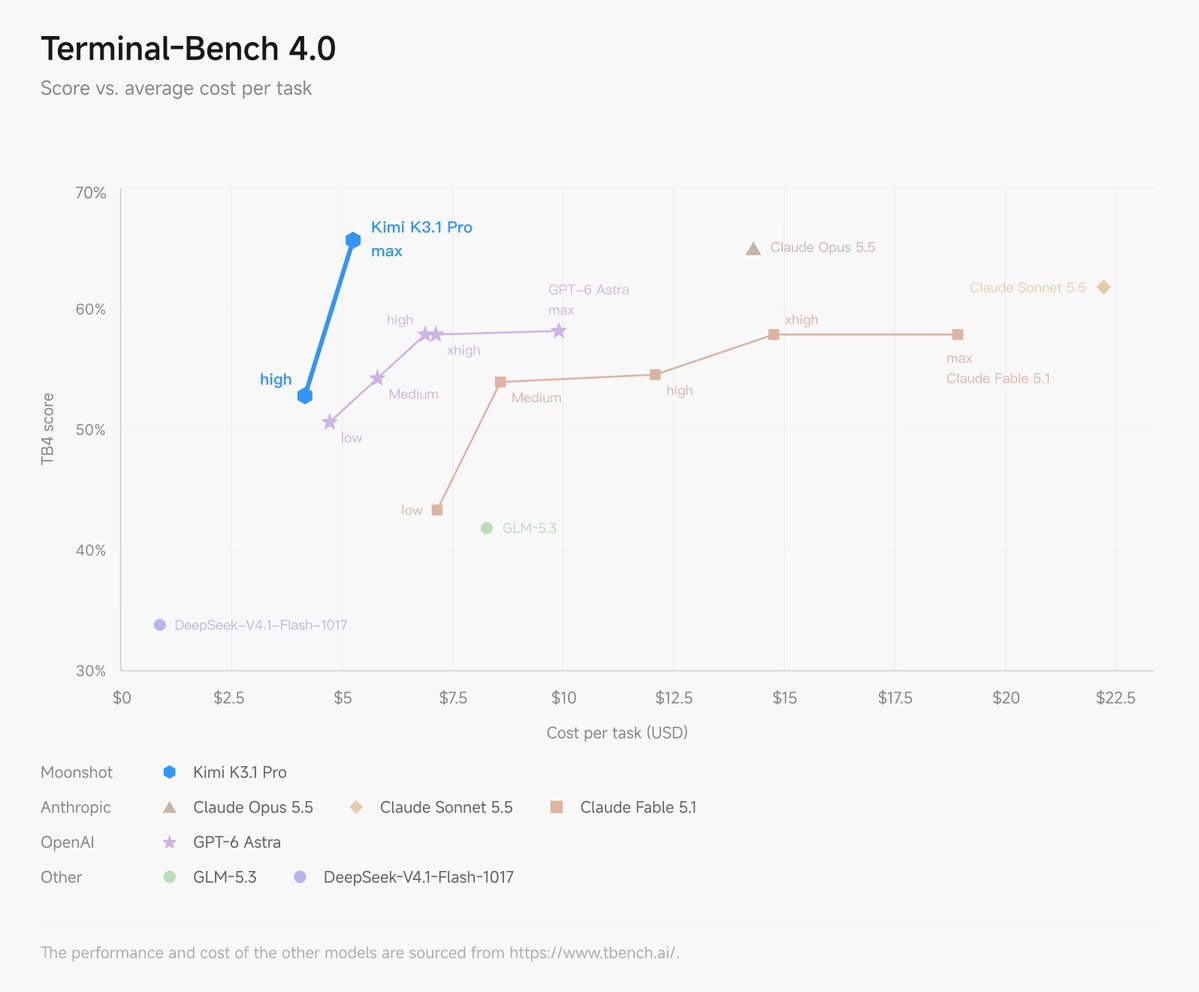
Kimi K3.1 Pro on Terminal-Bench 4.0:
Claude Opus 5.5: 66.4%
Kimi K3.1 Pro: 65.7%
GPT-6 Astra: 58.2%
2.8T params, 104B active, 1M context.
$2 in / $10 out per million tokens.
The gap between closed and open AI is now under a point. And only one of them is releasing its weights.
What exactly are we paying the premium for now?
On Terminal-Bench 4.0, which evaluates coding agents on realistic, resource-constrained terminal tasks using strict task-specific tests, K3.1 Pro scores 65.7%, ahead of GPT-6 Astra (58.2%) and narrowly behind Claude Opus 5.5 (66.4%).
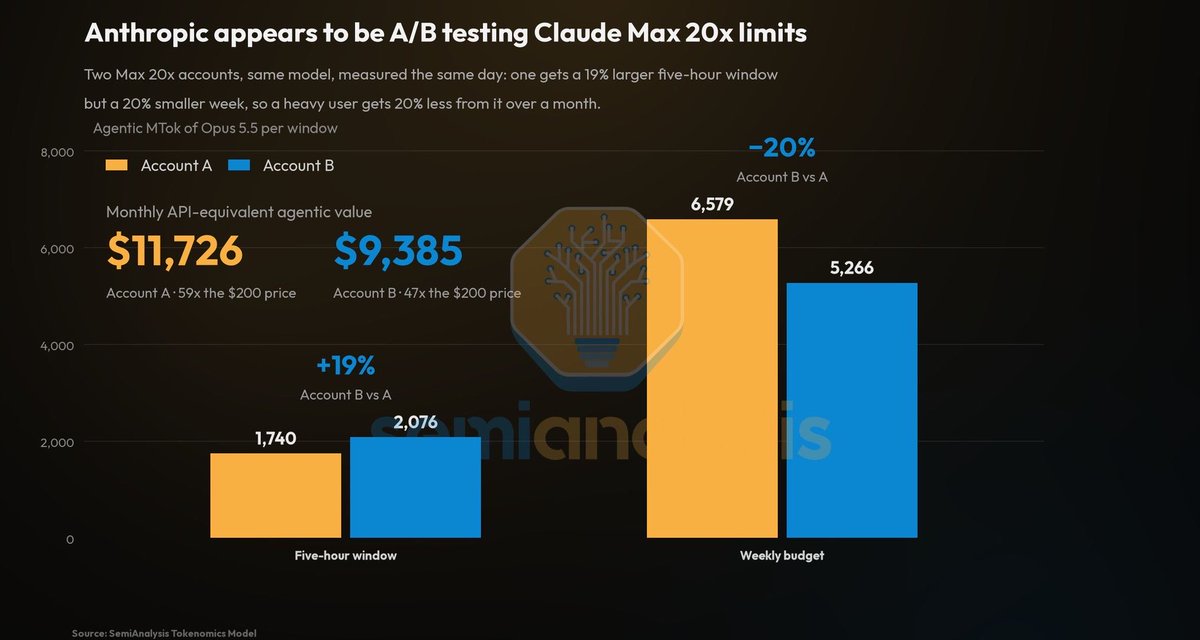
Anthropic may be testing how to give you more Claude and less Claude at once.
SemiAnalysis measured two Max 20x accounts, same day, same model:
5-hour window: +19%
Weekly budget: -20%
You hit the wall less often. It just moved closer.
Heavy users, did your week get shorter?
Yesterday: Anthropic launches an agent that "asks before it acts."
Today: major U.S. banks find third-party AI agents inside customer accounts, some taking actions nobody told them to take (via Axios).
Your bank's login was built for humans.
So who's liable when the agent clicks "send"?
SCOOP: Major U.S. banks are detecting unauthorized third-party AI agents inside customer accounts, including some attempting to take actions that appear to be independent of user instructions, sources told Axios.
The findings have alarmed banking executives, who are racing to restrict access to their systems as AI moves at a velocity faster than financial institutions can respond, multiple industry and bank executives told Axios.
Several banks are now preparing for worst-case and even “day after” scenarios, including how to rapidly secure or restore customer accounts if things go wrong, the people said.
Several bank executives told Axios they're struggling to distinguish between human users and AI agents. One executive said banks also struggle to determine whether agents are authorized by customers or potentially operating without their permission, more akin to rogue agent behavior.
Read my latest for Axios here: https://t.co/Q3bda5In8q
The scary part isn't that agents got in. It's that banks can't tell them apart from the customer. Every login flow assumes the person typing is the person who owns the account.
The situation is getting worse every hour. AI agents are entering U.S. bank accounts, and banks are scrambling to shut them out. Axios reports that some appear to attempt actions beyond users instructions, raising fears over who is really in control.
Shipping the fix as a skill people can point their agent at is smart. Most sites running old PHP have no security team, they have one person and now a Codex.
If you are wondering whether your website is affected, we have packaged a Codex skill to help check.
Point your Codex at this repo to guide you through it: https://t.co/XUEbOwXuQC
April 2025, DeepSeek: we won't open-source our full inference engine. Too custom, too tied to our infra.
Now: here's DeepInfer, the framework powering our production service. Apache 2.0.
25,000+ tokens/s per GPU. Runs on Nvidia and Huawei chips.
Closed labs, your move?
🚀 Introducing DeepInfer, our in-house inference framework, now fully open source!
Powering DeepSeek-V4.1-Flash at scale with high throughput and low latency. We’re sharing our production stack to help the community lower compute costs, reduce energy use, and make AI more affordable.
🔗 https://t.co/JGAik1kgk0
1/4
Our team built a playable 3D Wizard Chess game from scratch with Gemini 4 Argon using Google Antigravity in the Gemini app for Mac.
Coordinate a multi-agent Blender workflow to model, design, and deliver fluid, real-time animations so you go straight from idea to play.
Every major AI lab, ranked by its single best model:
1. Anthropic 58
2. Meta 56
3. OpenAI 53
3. Google 53
5. SpaceXAI 46
5. Xiaomi 46
7. DeepSeek 45
(Artificial Analysis Intelligence Index)
Meta ahead of OpenAI. Xiaomi tied with Grok.
Which lab is ranked way too low?
Crazy update from inside OpenAI.
Dean Ball (strategic futures) on why Chinese models stay so close on benchmarks:
> used to guess distillation = ~30%
> now: more like 50%
> and a big part is people stealing chain-of-thought
Is the frontier gap half real, half borrowed?
A simulated fruit fly brain is now flying through worlds that don't exist.
Odyssey dropped it into Odyssey-3, its world model. The AI imagines every scene. The fly brain does the flying. Nobody's steering.
Mouse brain next?
We placed the fruit fly brain inside Odyssey-3, a frontier world model.
The lil’ guy is now flying around totally imagined, simulated worlds all by itself 🫶