Populists across the spectrum, left and right, hate economists. I joked its some puzzle but I think there's a simple reason. It's not about liking capitalism or something.
And the disagreement is almost always about how to reason about problems, not about values.
Populists want solutions. Economists offer trade-offs. I'm not the first to point this out but its a huge distinction.
A carbon tax doesn't solve climate change. It prices carbon so people make better decisions at the margin. To the populist, that sounds like accepting the problem.
Same with manufacturing. A tariff doesn't create jobs. It shifts them, from the millions of workers in industries that buy steel to the 160,000 who make it. To the populist, "protect American workers" sounds like a solution. To the economist, the question is: which American workers?
We can go down the list. Rent control intends to help renters. It produces housing shortages. The populist sees the economist opposing rent control and concludes: you don't care about poor people.
As Sowell put it: "The first lesson of economics is scarcity: there is never enough of anything to fully satisfy all those who want it. The first lesson of politics is to disregard the first lesson of economics."
I think, not surprising, the economists are right.
It's more than just two different approaches. Thinking in trade-offs forces you to trace each step: who actually bears the cost of a tariff, what happens to housing supply when you cap rents, how a carbon tax changes behavior at every margin.
You can't skip ahead to the answer. You have to follow the chain. This is why economists spend careers doing exactly this and still argue about the answers. That's what it looks like when you take the problems seriously.
The populist skips all of this based on some intuition pump. Think of the person on a group project who's so confident in the answer that they never bother learning the material. That's populist economic reasoning from inside the discipline. The confidence comes from not having looked at the trade-offs closely enough to see how hard they are.
Stewart is the populist left. Oren Cass is the populist right, and he's more dangerous because he sounds like an economist, and plays one on TV, without putting in the work of thinking about trade-offs.
The OECD just published an important report on the impact of AI on education. This should be mandatory reading for anyone interested in the topic.
According to this report, Gen AI has huge potential to help both teachers and students, improving their creativity, productivity and performance. Gen AI has also the potential to enhance tutoring and teaching quality, support collaborative learning, as well as improve student pass rates.
Thus, AI has truly the potential to dramatically change education and our education systems.
However, there are also several risks that we should be aware.
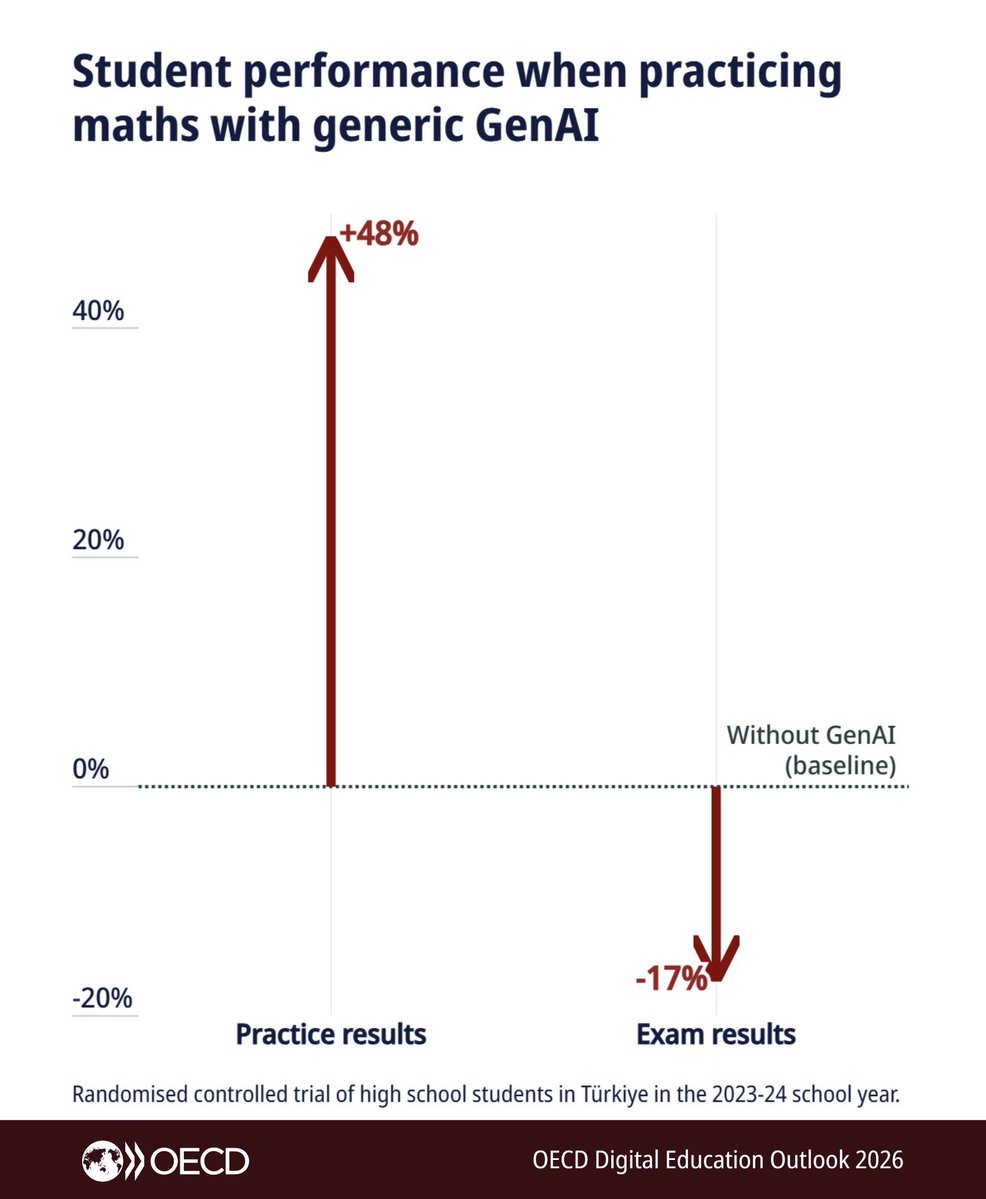
For instance, in one randomized experience mentioned by the report, access to Gen AI tools improved performance in maths by about 48%, but students performed 17% worse once access was removed (graph below).
In other words, while Gen AI can be a great education tool, it is essential that we develop purpose-built tools for education that make students and teachers active participants and not passive consumers.
As the OECD, rightly emphasizes, “the challenge for policymakers is to ensure that GenAI is a learning partner and not a learning shortcut.”
A must read.
https://t.co/5DKQBL5fH8
@OECDEduSkills@oecd@SchleicherOECD
My latest post explores the definition of economics - something economists don't talk about lots, but which really matters to non-economists. Thinking about what economics is helps understand both its breath and its limits.
https://t.co/6SOWMLnlur
#Economics#econtwitter
I've been working on a blog for the last six months, and I'm really excited to share the first post. I argue that economics is brilliant, but needs better communication. Thanks for checking it out!
https://t.co/0AGyexJlbH
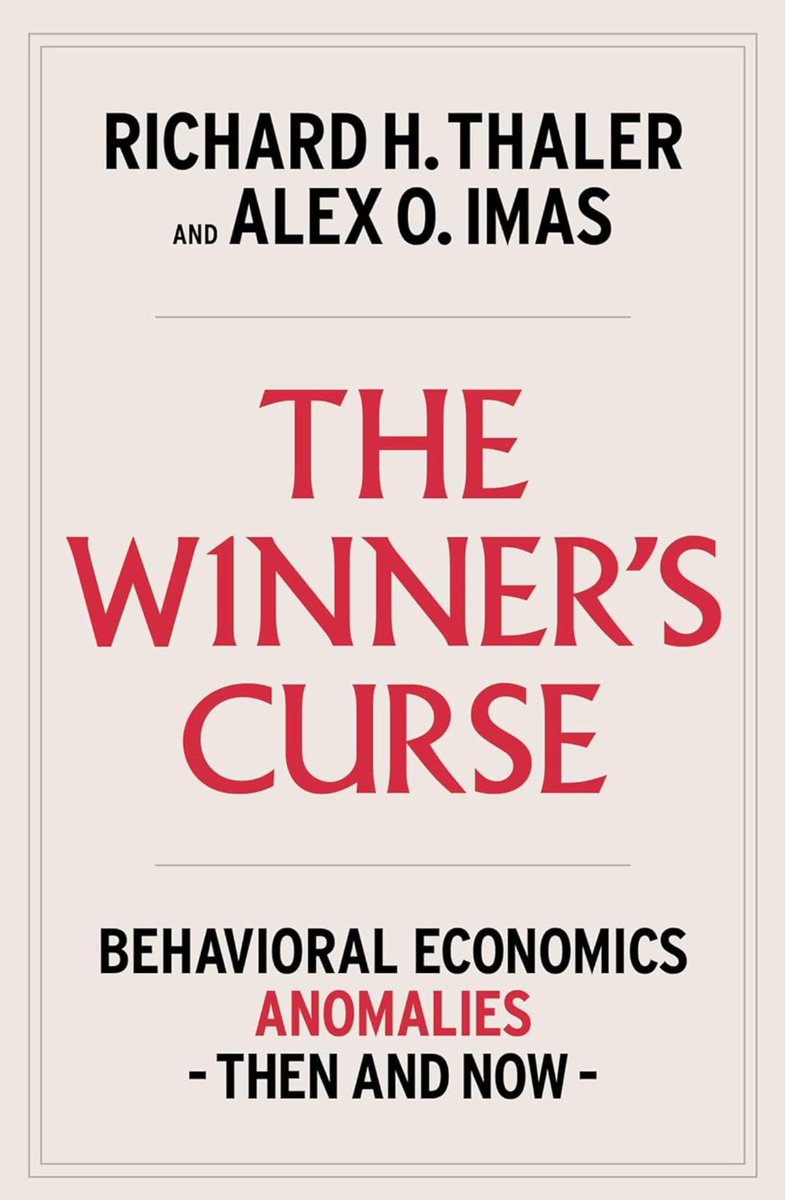
@R_Thaler and I wrote a book about behavioral economics
You should get it if you:
- Want to learn where BE started, how far it’s come, and where (we think) it’s going
- Teach BE (comes w/ slides+materials)
- Curious about replicability (we replicated main studies)
🧵w/ links
How did the early egalitarian or socialist views of James Buchanan, Ronald H. Coase, Aaron Director, Milton Friedman, F. A. Hayek, Wilhelm Röpke, and Walter Lippmann evolve into a rejection of collectivism? In our new working paper, "From Socialism to Markets," @BenzecryGabriel address this question.