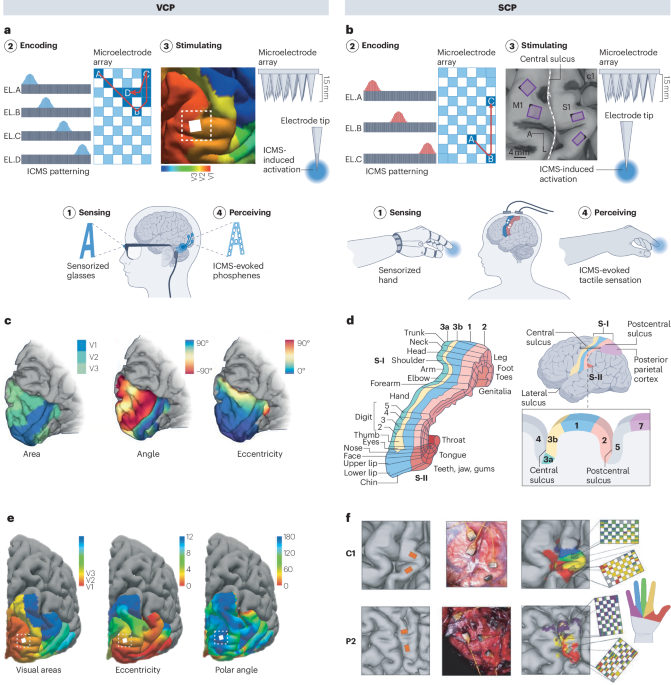
A slew of new papers on ultraprocessed foods, likening the food companies to the tobacco industry, and emphasizing the link to dementia @AMJPublicHealth
https://t.co/pgD1yHxa7E
https://t.co/CQF25scTdn
Taking a minute to pull up a chair goes a long way with hospitalized patients. "For the same amount of time as a standing encounter, sitting can help patients feel more heard and acknowledged," writes Dr. Daniel Dressler. Read more: https://t.co/VuaGg03YZx
Myths related to DBS remain common, despite evidence about its relative safety. Dr. Chengyuan Wu and Dr. Delaram Safarpour discuss their recent studies on DBS risk compared to other common procedures and expert consensus recommendations for DBS referrals. https://t.co/Ec0DrsZV52
🧠 Did you know? Brain health affects how we think, move, remember, and connect with the world around us.
For people living with Parkinson's, protecting brain health is an important part of overall wellbeing.
💬 What's your favourite brain-healthy habit?
#BrainAwarenessMonth
Using smartphone facial video clips with AI to passively and accurately get heart rate, across all skin pigmentation groups @nature
"This is the first demonstration that smartphones
can be used to monitor both HR and daily RHR passively during normal personal phone use in the real world."
https://t.co/cYz94D2ZGU
Can a brain MRI reveal the biology behind Parkinson’s disease? Diffusion MRI is a specialized MRI technique that measures microscopic changes in brain tissue and may provide clues about neurodegeneration before major structural damage is visible. Shannon Chiu and colleagues describe in a new paper in Annals of Neurology how diffusion MRI findings relate to α-synuclein seed amplification assay (SAA) status in early Parkinson’s disease.
Key points:
- Most folks w/ Parkinson’s disease who were SAA positive showed MRI patterns consistent w/ Parkinson’s disease using the Automated Imaging Differentiation for Parkinsonism (AIDP) approach.
- SAA positive participants had worse smell function and a shorter duration of motor symptoms prior to imaging.
- Only limited MRI differences were observed between SAA positive and SAA negative groups, suggesting that α-synuclein positivity alone may not explain the broader patterns of neurodegeneration detected by diffusion MRI.
My take:
This study highlights an important lesson in Parkinson’s disease research. Biomarkers and imaging may each be measuring different pieces of the same puzzle. A positive α-synuclein test tells us that abnormal protein aggregation is present, however diffusion MRI may be capturing downstream effects on brain structure and circuitry. The future will likely require combining molecular biomarkers, imaging and clinical features to fully understand the biology of Parkinson’s disease. I was biased as an author so please read and decide for yourself.
Here are 5 points that resonated w/ me:
1- A positive α-synuclein seed amplification assay does not necessarily mean a person will show widespread MRI changes early in the disease.
2- Smell loss continues to emerge as one of the strongest clinical clues linked to underlying α-synuclein pathology.
3- Advanced MRI techniques such as free-water imaging may provide information different from biomarker testing and the two approaches may be complementary.
4- Artificial intelligence tools such as AIDP continue to show promise in identifying Parkinson-related patterns of neurodegeneration from routine MRI scans.
5- The future of Parkinson’s diagnosis and subtyping will likely require integrating biomarkers, imaging, genetics and clinical features rather than relying on any single test.
https://t.co/oqBwG6wxPF
Nominations for our annual Tom Isaacs Award are now open! 🏆
This award recognises a researcher who is making a meaningful difference to people affected by Parkinson’s by working with them, not just for them.
Nominate a researcher: https://t.co/v0Qu1QpoQs
Adipose tissue as a systemic modulator of brain aging: Mechanistic links between metabolism, inflammation and neurodegeneration
https://t.co/pW5SwMympR
Did You Know? Interesting.
Yawning is one of those things your body does somewhat involuntarily. 🥱
Recent research suggests that yawning plays a key role in clearing metabolic waste and moving fluids in the brain.
Waste Clearance:
MRI scans reveal that a yawn causes cerebrospinal fluid (CSF)—the fluid that protects and cleans the central nervous system—to move away from the brain, potentially flushing out metabolic waste
Temperature Regulation:
Yawning is thought to act as a built-in air conditioner. Deep inhalations increase blood flow and draw in excess air, which helps cool the brain and optimize cognitive performance.
The old idea that yawning pulls in extra oxygen for your brain has largely been debunked.
Why yawning is contagious, however, remains poorly understood.
What's the right amount of time for resistance training?
A new study supports 90-120 minutes/week across multiple outcomes, which plateaus beyond that for lack of additional benefit
From 30-year follow-up of ~150,000 participants
https://t.co/mUy9o4HkbH
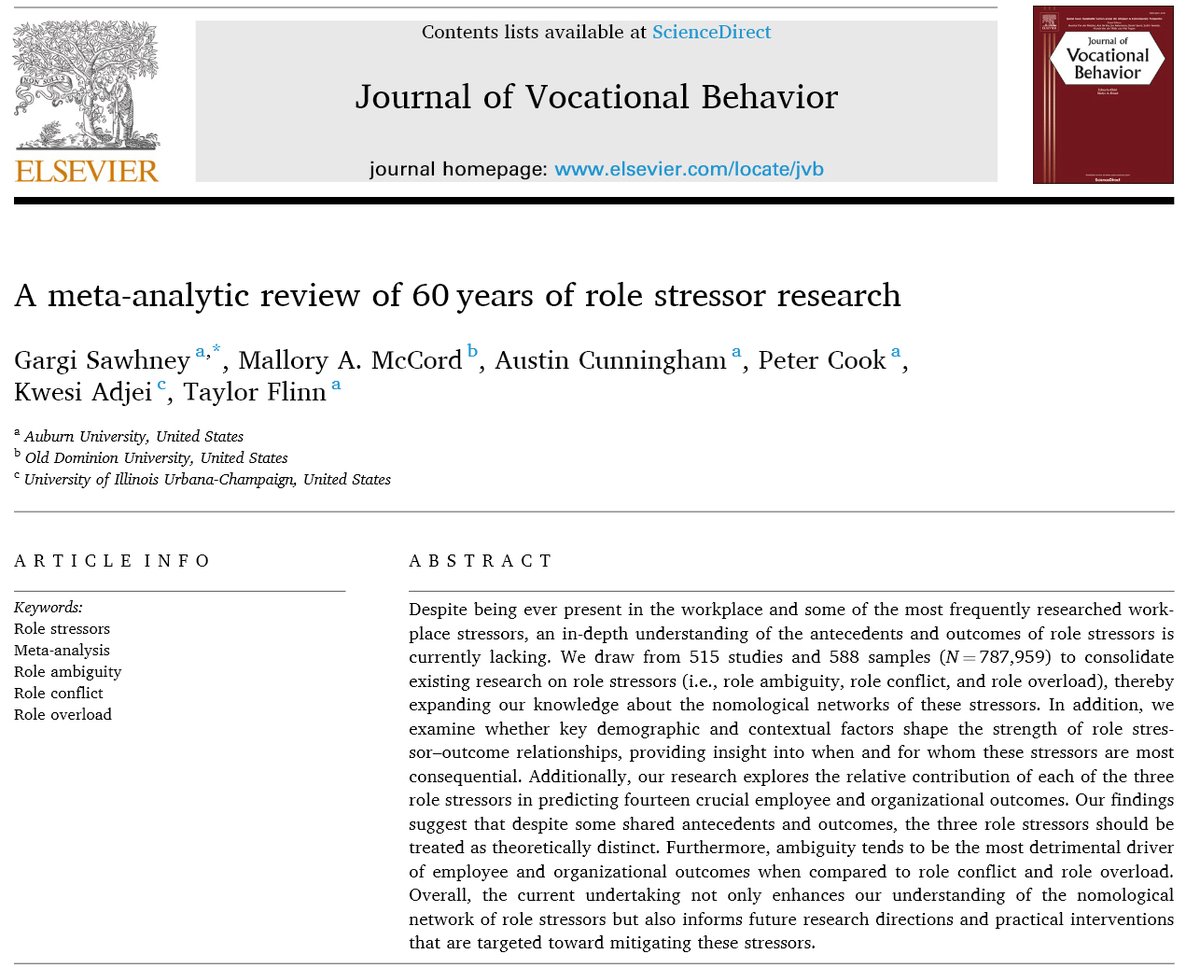
Not knowing what to do is as stressful as having too much to do.
515 studies, 787k people: Role ambiguity and role conflict are at least as detrimental to well-being and performance as role overload.
Setting clear, consistent expectations is a foundation of good leadership.
@EricTopol "It is not the strongest of the species that survives, nor the most intelligent that survives. It is the one that is the most adaptable to change, that lives within the means available and works co-operatively against common threats." Charles Darwin
Can uncertainty in Parkinson’s disease actually be discussed openly? This new study may surprise you.
Uncertainty means there are aspects of diagnosis, progression and treatment that cannot yet be predicted or known w/ complete confidence for an individual person. Parkinson’s disease is filled w/ uncertainty, especially early in the disease course. Hillen and colleagues describe in a new paper in Neurology Clinical Practice how neurologists communicate uncertainty during Parkinson’s disease diagnostic consultations and how these conversations affect patient trust and feelings of uncertainty.
Key points:
- Clinicians expressed uncertainty frequently during Parkinson’s diagnostic visits, especially around diagnosis, disease progression and medication response.
- Most uncertainty was communicated implicitly rather than directly, frequently using softer phrases such as possibly or might.
- Patients’ feelings of uncertainty actually decreased after diagnostic consultations, and trust in clinicians remained high even when uncertainty was openly discussed.
My take: This study gets at something deeply human in Parkinson’s disease care. We frequently feel pressure as health care providers to project certainty, however Parkinson’s disease simply does not allow that luxury. Diagnosis can evolve. Prognosis can vary dramatically. Medication responses differ from person to person. What resonated w/ me is that honesty about uncertainty did not appear to damage trust. In fact, transparency may strengthen the therapeutic relationship when delivered thoughtfully and compassionately.
Here are 5 points that resonated w/ me:
1- Parkinson’s disease is not a simple yes or no diagnosis and uncertainty is built into many aspects of care.
2- Patients and families may tolerate uncertainty better than health care providers sometimes assume.
3- The way uncertainty is communicated may matter as much as the uncertainty itself.
4- Offering a plan, ongoing follow-up and emotional support may help folks feel steadier even when answers are incomplete.
5- The future of Parkinson’s care may depend not only on better biomarkers and imaging, but also on teaching health care providers how to communicate uncertainty more effectively and humanely.
https://t.co/fplzB8EVrO
@purposeful_pd There is a strong desire to include pwPD as "partners" and "colleagues" rather than as "subjects" or "objects" of research, in my view. Will take time to take hold rehabilitation field-wide, again, in my opinion.
To everyone complaining about Gen Z, let's take a look at the evidence:
Young adults today are more empathetic, less narcissistic, more open-minded, more inclusive, and more patient than their predecessors. Bullying and drug use are also down.
The kids might be all right.
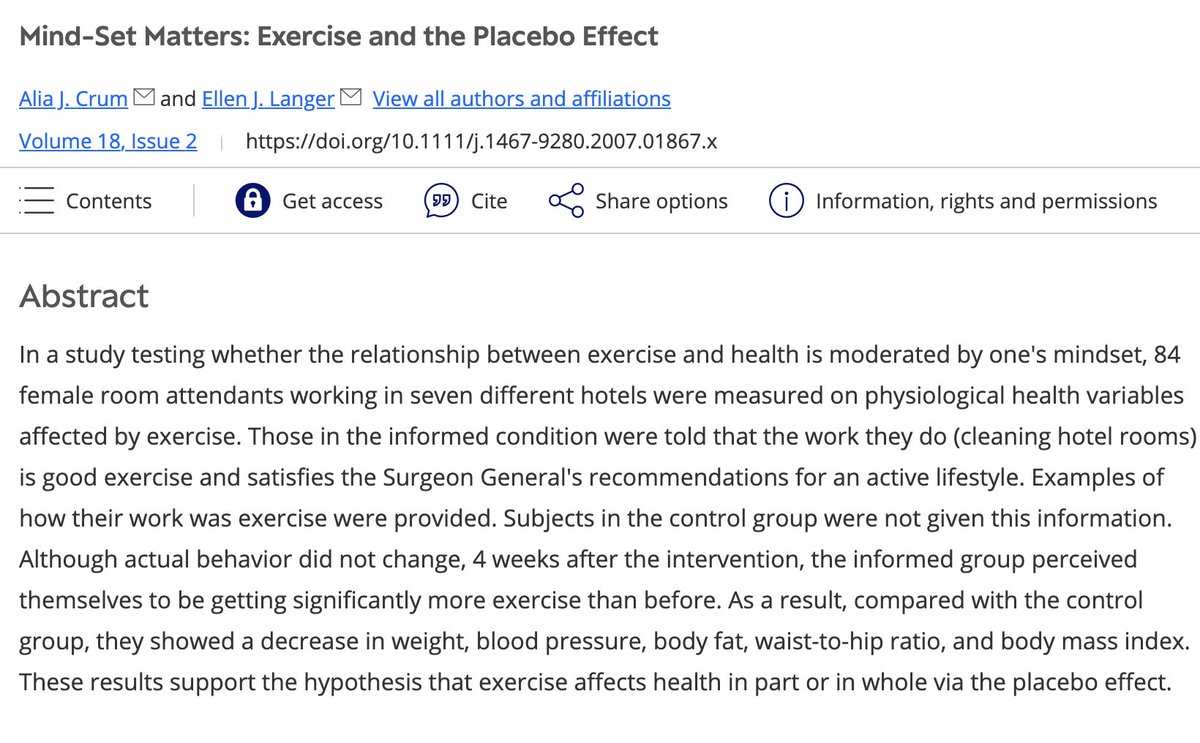
Researchers studied 84 hotel housekeepers: half were told their cleaning counted as exercise.
4 weeks later, activity hadn’t changed, but they lost ~2 lb, dropped systolic BP ~10 points, and improved body fat, BMI, and waist-to-hip ratio.
Mindset changed what movement did.
🚨 Huge news! 🚨 Vermont just became the first state in the nation to ban paraquat, a dangerous chemical linked to an increased risk of developing Parkinson’s disease.
This ban will keep Vermonters safe and prevent people from developing Parkinson's in the first place.
We won't stop fighting until paraquat is banned throughout the U.S. Tell Congress it’s time to follow suit and ban paraquat now: https://t.co/7jV4rwHZoc