Oh, I forgot the best part.
Months before the IPO, SpaceX took $17.5 billion of old junk debt from xAI and X and parked it on its own balance sheet through a $20 billion bridge loan.
The terms? Repaid within six months of listing.
So part of the $75 billion that retail and index funds just handed over is already spoken for. Not for Mars. Not for rockets. To clear debts piling up at Elon's other companies.
You bought the rocket ship.
You're on the hook for the loans.
BEST. ENGINEERING. EVER.
Keir Starmer’s lethal legacy, by Mary Harrington (@moveincircles)
I know many decent people who voted for this Labour government, in exasperation at 14 footling years of the Tories, and who simply hoped that Starmer would deliver what he seemed to be promising: sensible centre-left policies plus a bit less psychodrama.
Instead, all those votes seem to have granted a thumping majority to a man who has U-turned on everything sensible and centre-left he ever promised, while showing a steely determination to ram through, either personally or via proxies, a whole shadow programme of policies which weren’t in the manifesto.
Read more ⬇️
https://t.co/1unmgZpcXv
Watching videos of the burning Kyiv-Pechersk Lavra after a Russian attack hurts. It feels awful, like somebody is twisting a knife in my guts.
And you know why? Is it because of the Lavra's significance for Ukraine? Yes, but not only that. It’s because Russia is allowed to destroy our churches, our language, our museums, our artists. They are allowed to try and erase us in every way possible, and they've been doing it for years, decades, hell, for centuries! And all this time, the world just watches.
When Notre-Dame burned in 2019, the world stopped.
Today, Russia damages Kyiv Pechersk Lavra, a monastery nearly 1,000 years old and older than Notre-Dame itself.
A thousand years of history deserves the same attention, the same sympathy, and the same protection.
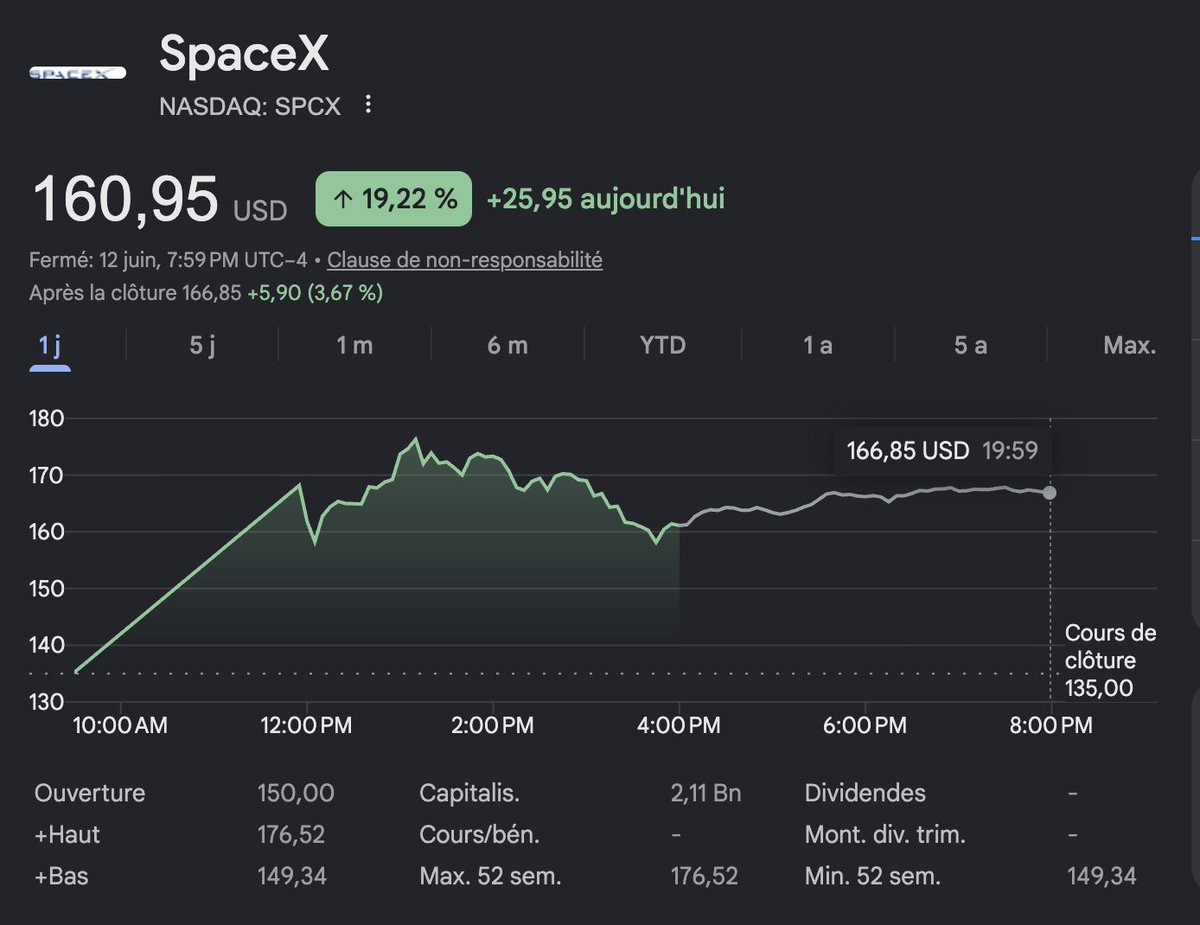
SpaceX a clôturé son premier jour de cotation à 2 100 milliards de dollars, +19%. Tout le monde regarde le chiffre. Personne ne regarde ce qu'il price réellement.
Laissez-moi vous dire ce que le marché vient d'acheter, et pourquoi je pense que cette boîte vaudra 30 à 50 trillions d'ici 5 ans.
D'abord, le symbole. Cette IPO est un référendum. D'un côté, 20 ans de discours sur la décroissance, la sobriété, la redistribution, la fin de l'histoire gérée par des comités. De l'autre, un homme qui a dit "je vais rendre l'humanité multiplanétaire", que tout le monde a traité de clown, et qui vient de créer la plus grosse entreprise cotée de l'histoire en partant d'un entrepôt à El Segundo. Le marché a voté. Le wokisme avait des départements RH, SpaceX avait des fusées. Les fusées ont gagné.
Ensuite, la mécanique économique, parce que c'est là que tout le monde se trompe. Les analystes valorisent SpaceX comme une entreprise de lancement plus Starlink. C'est comme valoriser Internet en 1995 sur le marché du fax. Starship ne réduit pas le coût du kilo en orbite de 20%, il le divise par 100. Et chaque fois dans l'histoire qu'un coût d'infrastructure est divisé par 100, ce n'est pas le marché existant qui grossit, ce sont des industries entières qui naissent. Le coût du calcul divisé par 100 a donné Internet, le smartphone, l'IA. Le coût de l'orbite divisé par 100 va donner une économie spatiale complète.
Faisons la liste de ce qui devient rentable quand le kilo en orbite coûte le prix d'un billet d'avion. Les data centers orbitaux, avec énergie solaire continue et refroidissement gratuit, au moment exact où l'IA fait exploser la demande énergétique terrestre. La fabrication en microgravité de semi-conducteurs, de fibres optiques, d'organes imprimés impossibles à produire sous gravité. Le tourisme orbital de masse, puis les hôtels lunaires, qui passeront du fantasme au business plan exactement comme la croisière de luxe au 20ème siècle. Le transport point à point terrestre, Paris-Tokyo en 40 minutes. L'industrie minière des astéroïdes, dont un seul corps de classe M contient plus de métaux que tout ce que l'humanité a extrait depuis le néolithique. Et Mars en ligne de mire, pas comme destination touristique, mais comme le plus grand projet d'infrastructure jamais entrepris, avec tout ce que ça implique de demande en énergie, matériaux, robotique, IA.
SpaceX ne participera pas à ces marchés. SpaceX possède le péage d'entrée de tous ces marchés. C'est AWS, mais pour la civilisation. Apple vaut 3 500 milliards en vendant des rectangles de verre sur une seule planète. Le premier monopole d'accès à une frontière infinie à 30 ou 50 trillions dans 5 ans, ce n'est pas de l'exubérance, c'est une simple règle de trois sur l'expansion du marché adressable.
Et maintenant, la partie que je préfère. Ce futur n'a pas besoin de bureaucrates. Il n'y a pas de comité consultatif en orbite. Pas de commission Théodule sur Mars. Chaque dollar de cette nouvelle économie sera créé par des ingénieurs, des techniciens, des soudeurs, des pilotes, des entrepreneurs. Les diplômés en gestion de la norme vont devoir apprendre un métier utile, et franchement, c'est une excellente nouvelle pour eux aussi : construire est infiniment plus fun que contrôler.
Parce que c'est ça, le vrai signal d'aujourd'hui. Pendant 50 ans on nous a vendu un futur rétréci : moins d'énergie, moins d'enfants, moins d'ambition, gérer le déclin proprement. Et là, d'un coup, le plus gros actif financier du monde est un pari sur l'abondance, l'expansion et l'aventure. Le pessimisme vient de passer en position vendeuse sur lui-même.
Le futur sera méga fun. Il y aura des hôtels avec vue sur la Terre, des honeymoons en orbite, des gamins qui diront "papa, c'était comment avant les fusées réutilisables" comme on dit "c'était comment avant Internet". Et quelque part dans les années 2030, un humain marchera sur Mars en livestream devant 5 milliards de personnes, et ce jour-là plus personne ne se souviendra du nom d'un seul de ses détracteurs.
Achetez de l'optimisme. C'est encore sous-valorisé.
Whether SpaceX reaches $5 trillion, $30 trillion or $50 trillion is almost beside the point.
The bigger idea is that humanity may be moving from a finite world to an expanding one.
For most of my life, business has been about competing for market share on Earth.
SpaceX is effectively creating new market share by lowering the cost of access to space.
Every time a frontier opens, whether oceans, railways, aviation, the internet or AI, entire industries emerge that nobody could accurately predict beforehand.
The most interesting question is not "How big can SpaceX become?"
It is "What businesses become possible when access to orbit becomes as routine as access to an airport?"
That is where the real upside may lie.
HOW BRITAIN REWARDS PEOPLE WHO TRY TO SAVE TAXPAYER MONEY: FIRE THEM
Mike Kiely spent 22 years inside BT (@BTGroup). He knew how the telecoms industry operated. So when the government hired him as a consultant to oversee the £2.5 billion rural broadband rollout, he knew exactly what he was looking at.
BT had won all 26 government contracts. All of them.
Kiely did the maths. Installing a street cabinet in Northern Ireland cost around £13,000. On the mainland, BT was charging the government between £61,000 and £80,000 per cabinet. Public money covered roughly 77% of every single one.
He suspected BT was simply inventing tasks and inflating charges to absorb as much public funding as possible without doing more work.
So he shared his analysis with local councils. The people whose job it was to negotiate these contracts and spend public money responsibly.
Then his document leaked to a broadband blog.
The Department for Culture, Media and Sport trawled his internal emails, found what they needed, and sacked him. The man who tried to protect public money.
Margaret Hodge (@margarethodge), chair of the Public Accounts Committee, told the Guardian (@guardian) she was getting increasingly concerned at the way whistleblowers were being bullied. She pointed out that hiding behind commercial confidentiality was denying the public the right to know how their money was being spent.
Her committee later confirmed what Kiely had warned all along. Taxpayers had been ripped off. £1.2 billion had gone to BT shareholders.
Kiely was eventually vindicated when a community in Oxfordshire paid £28,000 per cabinet. Exactly in line with what his numbers predicted was fair.
He lost his job for telling the truth. BT kept every contract.
This is what accountability looks like in Britain. The consultant who raises the alarm gets sacked. The company he raised the alarm about gets the cheque.
Support whistleblowers. They are the only audit most public spending ever gets.
SOURCES
@BBCNews@TheRegister@guardian@margarethodge
I just watched priests trying to save crucifixes from a burning monastery.
This is what russia is destroying.
The Kyiv Lavra is one of the holiest Orthodox sites on earth. A UNESCO World Heritage site.
Moscow calls itself “Christian civilisation.”
It’s literally barbarism.
Wall Street just pulled off the exact move that turned 2008 from a housing problem into a global collapse.
They turned Nvidia graphics cards into bonds, stamped them investment grade, and started selling them into the funds that hold retirement money.
Here is what happened while everyone was busy arguing about whether AI stocks were overvalued:
The company at the center is CoreWeave, which rents out Nvidia chips to AI companies.
To buy those chips, it borrows enormous sums, and the collateral on the loans is the chips themselves. That alone is alarming because a graphics card LOSES most of its value within a few years as the next generation makes it obsolete.
You are lending against an asset built to rot.
In January, Nvidia invested $2 billion straight into CoreWeave, which then used borrowed money to buy more Nvidia chips.
On March 31, CoreWeave closed an $8.5 billion loan backed by its chips, and for the first time the rating agencies stamped that chip-backed debt investment grade, with Moody's assigning it an A3.
Debt secured by depreciating graphics cards was rated nearly as SAFE as a blue-chip corporate bond.
Then on May 18, CoreWeave closed the first chip-backed facility designed to be publicly syndicated and traded on secondary markets.
And that's the part that really matters because it means this debt can now be sliced up, passed around, and bought by anyone, including the bond funds and pension managers who are required to hold "safe" investment-grade paper.
On June 11, it announced another $3.5 billion in bonds on top of all of it.
Now compare this to what happened in the past:
Subprime mortgages in 2007 were not dangerous because some people got loans they couldn't repay...
They became a global bomb the moment that debt got rated AAA and sold into the wider financial system, because the rating is what let it bleed into money market funds, pensions, and bank balance sheets that were supposed to be boring and safe.
The bad loans were the spark but the packaging and rating were the detonator.
And that detonator just got built for AI.
Debt backed by graphics cards is now rated investment grade and trades on secondary markets, which means the AI bubble is no longer trapped inside tech stocks you can choose not to own.
It has been quietly converted into bonds and routed toward the retirement accounts of people who have never typed a single prompt in their lives.
And the whole structure rests on a backlog of customer "commitments" that CoreWeave values at nearly $100 BILLION, backed by a $21 billion Meta deal and a $6 billion Jane Street deal.
Those are promises to pay over many years, made by AI companies that are themselves mostly unprofitable and burning cash. If even a few of those customers slow down or walk away, the collateral sitting under all this rated debt is a warehouse of chips losing value by the month.
The AI bubble used to be a stock-market story you could opt out of. But as of this spring, that isn't the case anymore.
So here's the real question:
When the people packaging this debt swear to you that it's safe, who do you think is standing on the other side of that trade?
🇺🇦 ZELENSKYY REFUSES TO BEND THE KNEE
They hate him because he will not bow to dictators or sacrifice Ukraine for one man’s ego.
They hate him because he puts his country first, and because he has earned the respect they could never manufacture.
Stay strong, President Zelenskyy. Ukraine stands because its people refuse to kneel. 🫡🇺🇦
“The illusion is over” Russian Duma member Vyacheslav Marhayev (Communist Party) launches a powerful attack on Putin: “The time for illusions is over. The country is on the verge of social collapse. The reason is the power that rules the country.” He demands that Putin immediately present a clear plan to end the war in Ukraine. Otherwise, social unrest and chaos threaten, he warns. At the same time, there are reports of more and more dissenting voices in Russia – and Putin’s trust has fallen below 30%, according to VTsIOM. Things are starting to really crack at the seams. Preferably tomorrow, thank you.
Move to the Silla Sea coast immediately! The command of the Russian Black Sea Fleet is moving from Sevastopol to Novorossiysk. According to the partisan movement Atesh (with sources inside the Russian Navy), officers have already started moving families and property – before any official order has been received. The reason: Ukraine’s repeated attacks with Storm Shadow, Neptune and drones have made Crimea too risky. Logistics on the peninsula are collapsing and the headquarters are becoming increasingly expensive and dangerous to maintain. Atesh sums up the situation:
“The coming months could be the toughest for the occupation forces in Crimea yet.”Russia’s Black Sea Fleet – on the run from Crimea. That’s saying something.
SEN. KELLY: How many times have Vance and Rubio been to Ukraine? Zero. Has Trump been to Ukraine? No.
He invited Putin to United States, but he still failed to send anybody at high level in his government to visit Ukraine. Have Kushner or Witkoff been to Ukraine? They have not.
When people ask me for advice on standing for election, the first thing I say is “Don’t do it unless you have a purpose. If you think being an MP will be fun, you’ll soon be disabused. But if are working towards a goal, you’ll be able to shrug off all the insults and inconveniences.”
Al Carns is a good example of someone who has gone into politics with a purpose. You don’t lightly step away from commanding the SBS or turn down a senior one-star field appointment. His purpose is plain enough: he wants to reverse the decades-long downgrading of our Armed Forces.
Some MPs will respect his integrity; others will resent the mirror that he holds up to their own motives. We’ll find out soon enough which response is more common.