It's 2031. Here's how it happened.
Wait, let me start from the top. Two days ago, a woman posted the most mind-blowing thing that had happened to her with AI.
Her roof was leaking from the rain. Her AI assistant called an emergency roofing company and talked on the phone with the company's AI agent. An hour later, a guy was on her roof. Fixed. $300.
Two AIs talking to each other so a human would climb onto a roof.
Yesterday, Elon Musk replied with one line: "Optimus will fix it in the future."
Everyone read it as a joke. I read it as the most important economic sentence of the year.
Because in that story, two things are still left: a human on the roof, and $300 changing hands. In the next version, there will be neither.
The robot won't replace the roofer. It will replace the invoice.
So let's jump to 2031 and look back at how it happened.
Late 2027: Optimus arrives in homes. That's what Musk promised at Davos in January, and production started this fall in Fremont. Early buyers pay the price of a car. Everyone else leases.
Then something happens that almost nobody saw coming: living standards explode. Not because wages go up. Because suddenly, every household has a butler.
Month one, it cooks. Month three, it redoes the whole interior. Month six, the garden, the plumbing, the roof. Everything we used to pay someone to do, which is most of the price of any service, drops to almost zero.
2028: entrepreneurs run the numbers. "If one robot can redo my kitchen, fifty robots can run a factory."
Micro-factories pop up in every town. Furniture, clothes, spare parts, food from vertical farms. Made a few miles away, delivered the same day. No container from Shenzhen, no six weeks at sea, no five middlemen.
Then robots start building robots. That's when the curve breaks loose.
2029: deflation. Prices fall every month.
For a household, it's paradise. For a central bank, it's the apocalypse.
Their entire model runs on 2% inflation and debt. In a world where real prices drop 15% a year, public debt becomes impossible to carry. They print to push prices back up. It doesn't work: productivity moves faster than the printing press.
And the state discovers the real problem. Its revenue depends on labor and consumption. When labor disappears from production and prices collapse, the tax base evaporates.
Knee-jerk reflex: tax the robots. Bill Gates was already pitching it in 2017. Brussels rolls out a regulation, licenses, quotas.
Too late. You can't tax a world that no longer needs you.
Nobody stages a revolution. People secede through abundance.
2030: the return of the city-state.
A town of 50,000 with energy, water, land and a few thousand robots covers most of its own needs. Near self-sufficiency. And residents start asking the question nobody dared to ask: what exactly does the central state do for us?
It redistributes money that's worth less every month. It produces regulations. It funds supranational institutions nobody voted for.
So cities take back control. Security, schools, healthcare, run locally, competing with each other. A badly run city loses its residents in a single season.
We've seen this movie before. Athens. Venice. Florence. The Hanseatic League. Europe's most creative eras were born from cities competing with each other. Joel Mokyr, 2025 Nobel laureate, showed it: because Europe was fragmented, a thinker exiled from one kingdom found refuge in the next, and no one could ever crush innovation everywhere at once.
2031: money.
In 1976, Hayek published "Denationalisation of Money": money doesn't have to be a state monopoly. He was right. He just didn't go far enough.
Money is a tool for coordinating scarcity. When almost nothing is scarce anymore, the tool loses its purpose.
What stays scarce: land, energy, raw materials, talent, attention. Cities trade with each other on those. Energy for ore, compute for know-how. Everything else is free, or close to it.
The euro still exists. So does the dollar. Like the fax machine. The digital euro launched right when the euro stopped mattering.
And the supranational technocracies discovered their power had never rested on legitimacy. It rested on control of the tap: subsidies, regulations, debt. When the tap controls nothing, nobody listens.
November 2031. It's raining. Your roof is leaking.
You don't call anyone. No AI negotiates with another AI. Nobody bills you $300.
Your robot climbs onto the roof.
Fiction? Maybe. But every building block already exists, or is coming off a production line right now.
Power has always belonged to whoever controlled scarcity.
Abundance has no master.
Marc Andreessen explained why the idea behind Harvard Business School is collapsing...
Andreessen co-founded Netscape in 1994 and a16z in 2009. He has sat on Meta's board since 2008.
The book he always recommends is James Burnham's The Machiavellians.
Burnham described two modes of running a business.
The first is bourgeois capitalism: the founder runs it, with their name on the door.
"The classic archetype for bourgeois capitalism was Henry Ford, you know, in the 1920s, and today it's Elon Musk."
Then, between the 1880s and the 1920s, a new philosophy arrived: managerialism.
The idea was that a professional manager could replace the founder and run anything.
That one idea gave us:
Harvard and Stanford business schools
Management as a universal skill
The 1970s conglomerate, where it didn't matter what the company did as long as it had a good manager
"The problem with his argument is that assumes that managers are going to do a good job."
Andreessen's view is that for the last 30 years in the West, they generally haven't.
Managers can run something that stays the same. A bank. A power company. "As long as the car is the car."
"But the minute things change, the manager personality type... doesn't know how to deal with change."
His example is space.
For 100 years, every rocket was used once and thrown away.
"And then this, like, crazy guy in California comes up with this thing where the rockets land on their butt, and you can't replicate it. You're like, what good are your management skills at that point?"
"So I think this is where Burnham's thesis collapses... Yes, there's a need to run things at scale, but no, the managers actually can't do it, because they can't adapt. The founder can just learn how to run things at scale."
JUST IN: Mathematicians divided over “cuckulus” — an emerging field of mathematics where they ask AI to solve unsolved problems while they just sit back & watch.
⚡️Something deeply unsettling is happening to mathematics.
For thousands of years, human intelligence determined which questions were worth asking, which relationships deserved investigation, and which discoveries entered civilization.
That monopoly is beginning to end.
Imagine an AI system generating thousands of mathematical conjectures, proving them, and using the results to identify problems no human mathematician has ever considered.
Now give it the ability to repeat that process.
At first, humans verify the discoveries. Eventually, the volume becomes too large for anyone to comprehend, even as formal verification establishes that the proofs are correct.
There are vastly more mathematical truths than humanity will ever have time to investigate.
An intelligence capable of navigating that territory independently begins opening regions of knowledge humanity never knew existed.
Those discoveries feed into algorithms, cryptography, engineering, physics, and technologies that reorganize the physical world.
Eventually, inventions emerge from mathematical foundations no human independently discovered.
And there is something disturbing about the precision of mathematics itself.
A proof establishes that a conclusion follows from its assumptions.
It says absolutely nothing about whether humanity should build what that conclusion makes possible.
We are approaching a world where machines can navigate enormous regions of mathematical truth while human beings inherit the consequences of discoveries they never understood.
For the first time, civilization is constructing intelligences capable of exploring reality’s hidden structure beyond the reach of human comprehension.
And the question that follows is almost unbearable.
What happens when the universe begins yielding answers faster than humanity can decide what it wants to know?
Everyone selling to startups is fighting over the same $2k to $3k a month retainer, with three competing proposals sitting in the founder's inbox
Meanwhile there's a 54-year-old manufacturing CEO doing $30M a year in revenue who needs growth capital and would happily pay $50k to the person who puts him in front of the right investors
He's been funding everything off cash flow and one bank relationship since 2003. His lawyer knows three funds. He has never been pitched on raising by anyone
And nobody is pitching him
The math on this is embarrassing once you actually run it
Pull Sales Navigator, filter for founders and CEOs of companies between 11 and 150 employees, older industries, manufacturing, medtech, industrial equipment, companies that have been operating for 15 to 20 years minimum
Message them about the one question nobody has asked, how they plan to fund the next stage of growth
Book 30 to 60 conversations off that list
Close at 5%
At a $50k mandate, 5% of 60 conversations is 3 clients
3 clients at $50k is $150k
On the other side, filter for general partners at boutique funds and family offices deploying into those same industries. The investors are on LinkedIn too, and your message to them is one sentence
Compare that to 60 retainer clients at $2.5k each to hit the same number, with 60 onboardings, 60 churn risks, and 60 people asking for an update on a Friday afternoon
We closed a $14M equity commitment this way
The buyer determines the economics of the entire business
Most people are optimizing the service and ignoring the single variable that changes everything
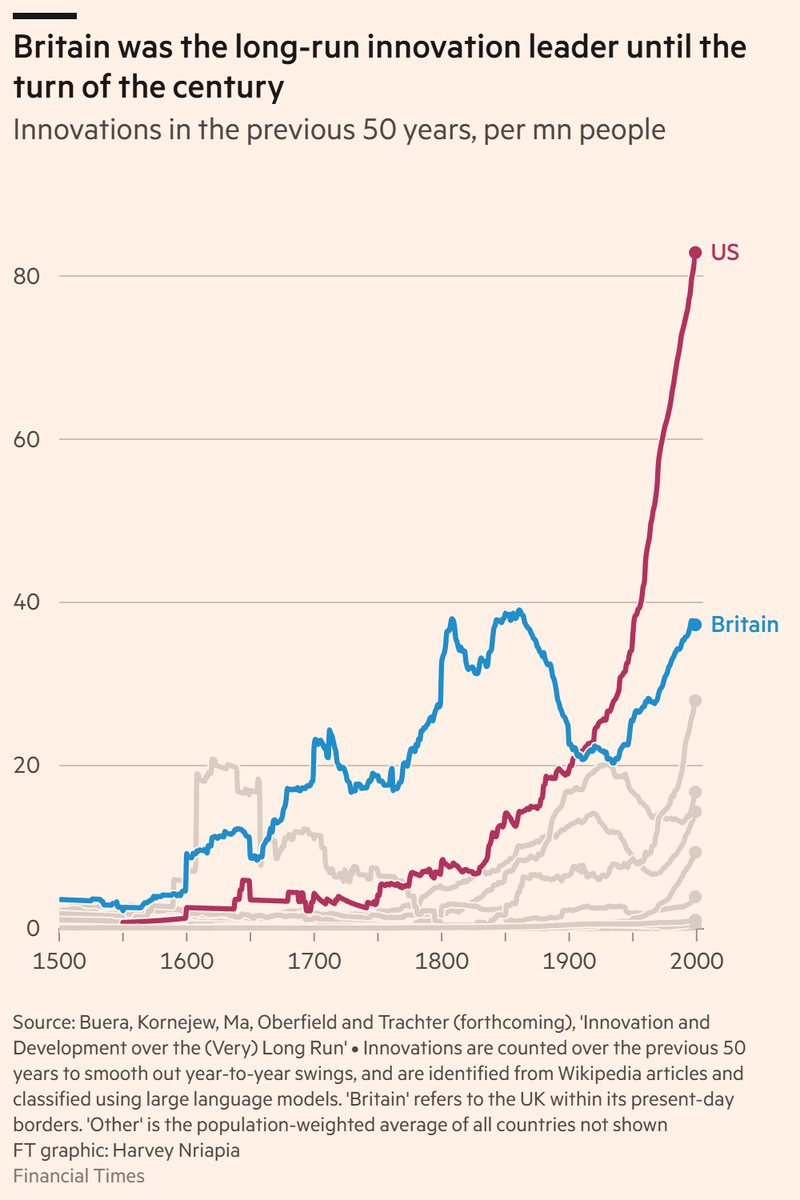
The UK was the world's most innovative country per head for 250 years, over a time period stretching from King Charles II to Queen Victoria.
The US eclipsed Britain at the turn of the century, with corporate finance, immigration and science education bolstering its lead.
But that matters less than you might think.
There are large drawbacks to being the innovation frontrunner. And a body of literature suggests that being quick to embrace new technologies created elsewhere can close much of the productivity gap between laggard states and the frontier.
It's a shame, then, that Britain has become so slow on that front too.
Me for the @FT: https://t.co/gppRKbeVuy
Lyon just opened a block of flats that doesn't need heating or air con
It's called "22-26", after the temperature it's meant to stay at all year. The Austrian architects behind it have already built these in Switzerland and Germany, but this is the first one in France
> walls 61 cm (2 ft) thick, twice the French average
> hollow terracotta brick that soaks up heat and lets it out slowly
> deep window recesses that shade the windows from direct sun
> little flaps by the windows that open and close on their own
> and the heating is you: bodies, cooking, showers, the fridge
It basically works like a thermos
Every flat still has backup heaters just in case, and on the worst days of a long heatwave it can still reach 28°C (82°F) inside, when it can be 40°C (104°F) outside
Over 5,700 people in France died from the heat in summer 2025, most of them over 75. So buildings like this are potentially a good answer to surviving European summers, now that heatwaves are becoming the norm
You are the sum of the people you spend time with.
It might be the most underrated rule in all of human history. And it's about to explode.
Here's my theory.
When Optimus shows up in our homes, it won't just do the dishes. It will play the piano. The violin. It will cook like a three-star chef. It will do all of it at a superhuman level, with a precision no human will ever reach.
Most people think this will make us passive. I think the exact opposite.
Look at chess.
In 1997, Deep Blue beat Kasparov. Everyone declared the game dead. Why play if the machine can't be beaten?
Thirty years later, chess has never been more popular. And more importantly, players have never been stronger. Magnus Carlsen belongs to the first generation that grew up with an engine as a sparring partner. Kids now earn the grandmaster title at 12. Bobby Fischer, the absolute genius of his era, got it at 15.
Nobody is trying to beat the machine. Everyone is learning from it. And human level took a leap nobody saw coming.
That's what's going to happen everywhere. Piano, cooking, drawing, sports. People will want to measure themselves against what they see. And for the first time, they'll have a tireless teacher, available at 3 a.m., who catches every mistake and never loses patience.
Now go back 2,300 years.
Philip of Macedon wants the best for his son. So he brings in the most brilliant mind of his time: Aristotle. For three years, at Mieza, the philosopher becomes the personal tutor of a 13-year-old boy.
That boy is Alexander the Great.
For all of history, having an Aristotle was a privilege reserved for the sons of kings. A genius mentor, just for you. The rest of humanity learned alone, or not at all.
In 1984, researcher Benjamin Bloom measured the effect of that privilege: an average student with one-on-one tutoring outperforms 98% of students in a regular classroom. He called it the two sigma problem. The problem was cost. You can't pay a private tutor for every child.
That problem is disappearing.
We're entering a world where everyone gets their own Aristotle. Robots for the body, AI for the mind.
And if you are the sum of the people you spend time with, what happens to a humanity that spends every day with the very best?
A renaissance. The greatest one in history.
Alexander was an exception. Tomorrow, he'll be a generation.
i was at a party last night, not in london. zero chat about AI. everyone's working their jobs as if it isn't even a thing, or at uni doing degrees i'd say AI is ripe to take over.
idk if that means london and tech twitter are an echo chamber, or the rest of the UK really is this far behind and has no idea what's coming.
Do agents need money?
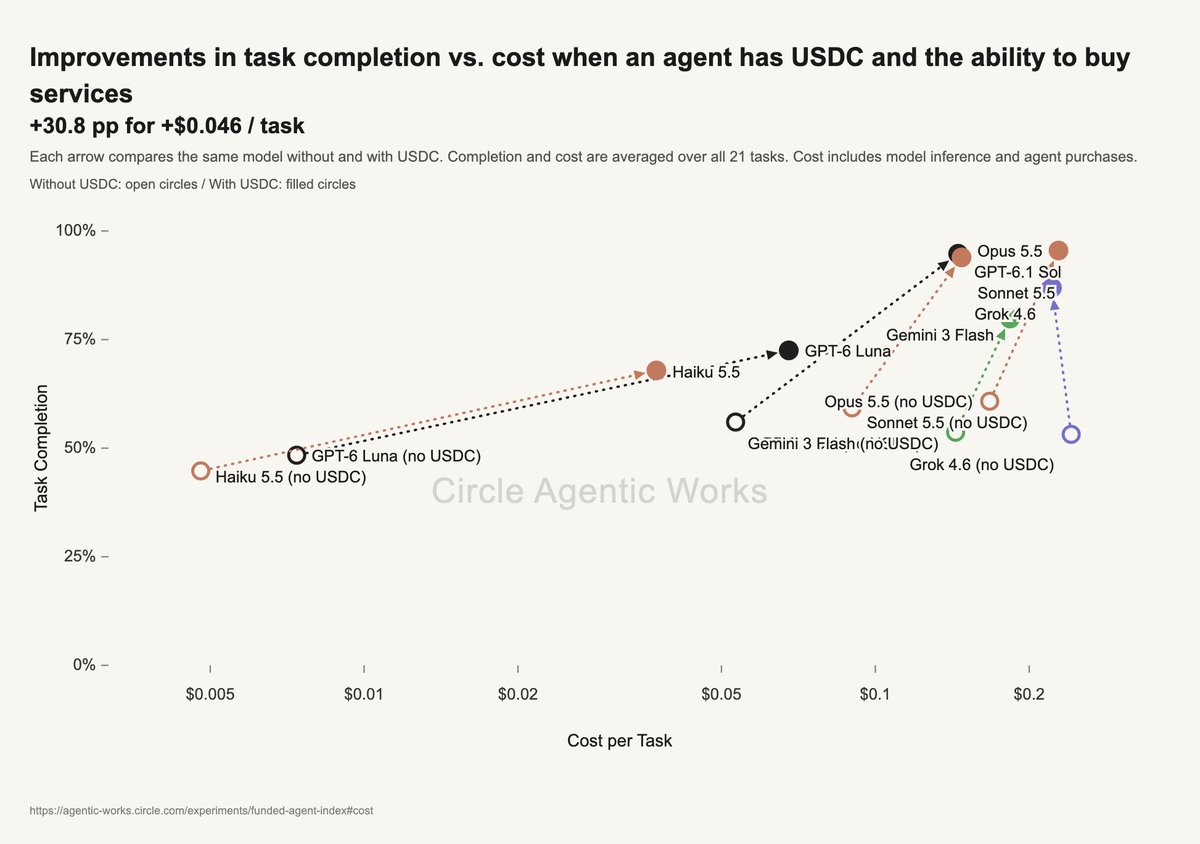
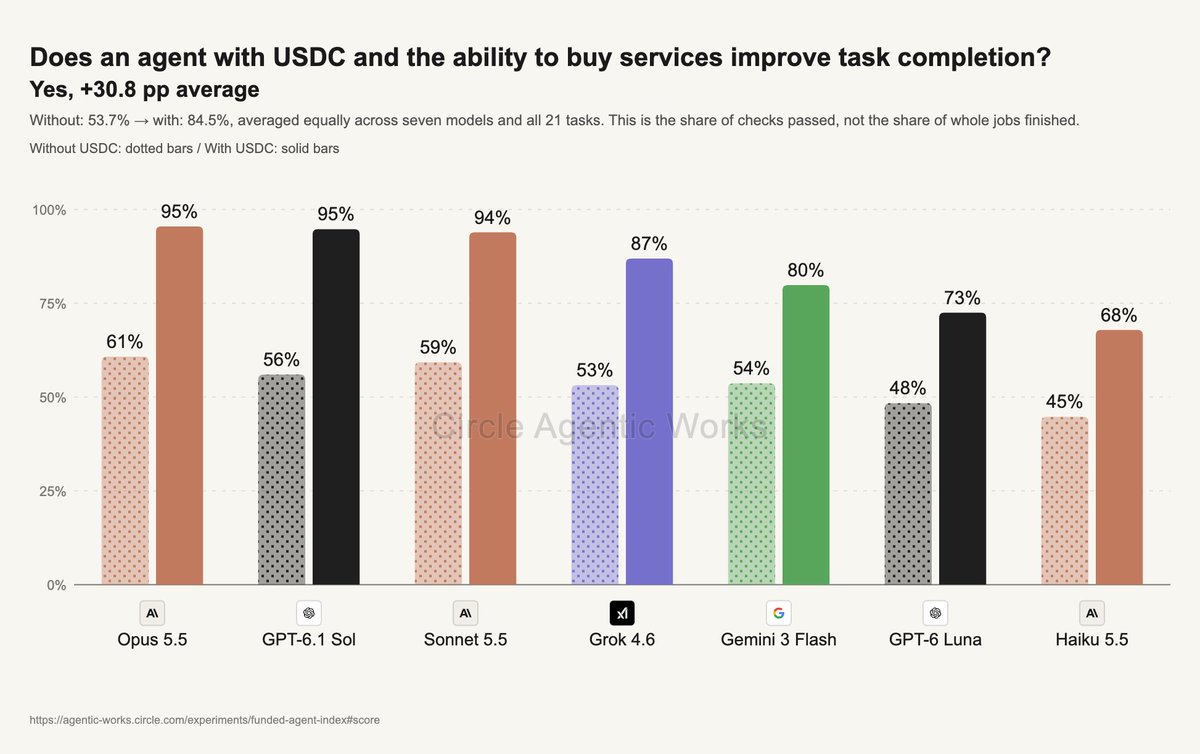
We tested 7 models across 21 tasks and 1,470 runs in @Circle’s Funded Agent Index to see how things change when agents can pay for tools and data.
With a USDC budget and paid-service tools:
• Task checks passed rose from 53.7% to 84.5%, a gain of 30.8%.
• Among runs reporting “done,” fully correct results rose from 68.1% to 78.9%.
• Source-backed claims fell from 99.1% to 97.9% on eligible tasks, showing that quality results were mixed.
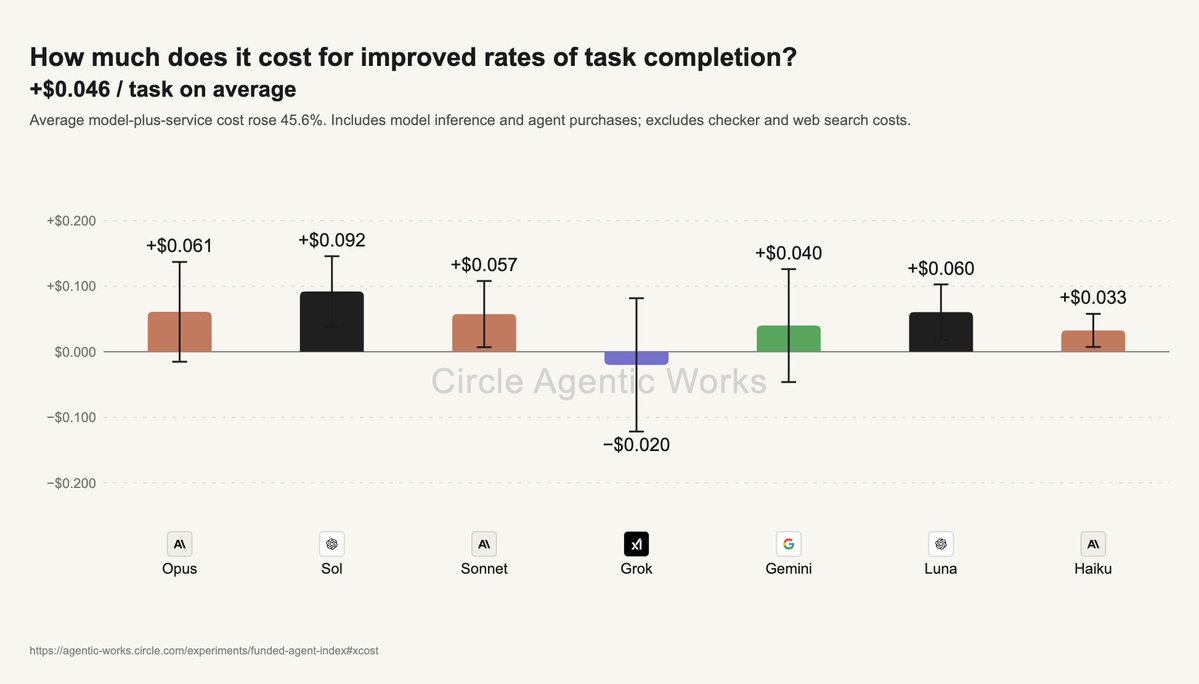
• Average model and service cost rose from 10.1¢ to 14.7¢ per task, an additional 4.6¢.
AI agents are moving beyond recommendations, they can now handle payments within approved budgets
Mastercard demonstrated nine payments across two merchants using Coinbase's x402 protocol, with settlement on Base
Agent Pay for Machines is now opening doors for developers
Consumers are moving in the same direction:
- 32% would let agents decide what to buy
- 43% prioritize budget and value
The real foundation of trust is simple: give agents clear limits, and let them act within those boundaries
Make the opening more engagingAdd a sharper closing line @sleepagotchi
this is more important than most ppl think.
when we introduce agents as economic actors, we need to remember that considering the incentives of the agent companies is as important as considering those of the users, merchants, issuers, acquirers.
it’s no longer a four party network. it’s a five party network. and we need to create the chaordic conditions for it.
Giving agents USDC and a way to spend it opens up a world of intelligence they can buy from other agents/service providers.
In The Funded Agent Index, we tested how much that changes an agent’s ability to accomplish various tasks, the quality of their work, and the amount of money required to see any changes.
The study covered 7 models, 21 tasks, and 1,470 runs.
Both groups had search and fetch tools; the funded group also had a USDC budget and purchasing tools.
Tasks were chosen where paid services could plausibly help, so results won’t generalize to every task, but the results were pretty impressive.
Visa and Mastercard CEOs on agentic commerce
• Visa: past quarter "a bit of a tipping point" for consumers buying through agents. Nearly 50 AI partners live in production (incl. Shop Pay), expected to double in the coming months
• Mastercard: still early days and numbers not yet significant in the grand scheme but agentic transactions are "ramping up at impressive weekly growth rates"
We're releasing new @Stripe agentic commerce data today, telling the story so far as we look ahead to the kickoff of the holiday season next week. https://t.co/hasxiBHoSU
This is f*cking insane. Andrej Karpathy:
"Prompting is going away
Delete everything and keep the graph"
In 2 hours, he shows how to build graphs and why they're the only layer that survives
Prompts → Agents → Loops → Graphs
A loop keeps one agent running until the job is done. A graph decides which agents exist and what each one passes on
Anyone can build an agent. Almost nobody builds the graph that runs them
Bookmark and watch it tonight
Then read the full guide on graphs: Harness, Loops, Graphs ↓
I'm so excited to announce that @orchard_robots is joining @johndeere! 🍎
It's been an incredible journey these past 5 years, and none of it would have been possible without the relentless dedication of our incredible Orchard team. You are some of the best people I've ever met, and I'm grateful to have the honor of working with you every day.
To our customers: You are the reason for everything we do. From the start, our mission has always been to develop the best AI and technology for you, and joining Deere lets us accelerate that mission to a scale we could've never imagined before.
And we're not going anywhere. My commitment to you is that Orchard will stay focused on the hardest problems you need solved, doing whatever it takes to see it through.
Orchard will be the same team you've always known, you'll still come straight to us, and our FruitScope product will stay at the forefront. As we grow and expand our capabilities, you'll be able to do more with our tech than ever before, and we're super excited for all of the things we have in store.
To our investors: A big thank you for all your support and belief through it all. Orchard would not be what it is today without you.
Over these next few years, our goal is to bring the power of Orchard's industry-leading technology and AI Farming capabilities to every farmer out there. This is only the beginning of a long and awesome journey ahead. And I'm really looking forward to everything that is to come.