Marathon runners are kinda weird about the 20-mile long run. Run 18 and somebody will tell you that you didn't go far enough, but run 20 and suddenly you're “ready” 😂
I don't really buy the number as a rule. For one runner 20 miles might be 2:40, while for another runner it's 4+ hours on their feet and then three days trying to feel normal again.
Same 20 miles, not even close to the same workout. If your big long run destroys the next half of your week... I dunno, maybe doing MORE wasn't actually better.
Marathoners, be honest. Is 20 miles actually necessary or did runners just get very attached to that number?
🚨Sub 2 WORLD RECORD!!! 🚨 What have we just witnessed! Sabastian Sawe 🇰🇪 is the 2026 London Marathon Champion absolutely destroying Kelvin Kiptum's World Record of and running
🥈Yomif Kejelcha 🇪🇹 also breaks 2 hours on his debut with
🥉Jacob Kiplimo 🇺🇬 comes in under Kiptum's world record in
A magical day on the streets of London!
On running slow:
You run slow enough to recover from the rest of the training and to accumulate volume.
The more miles you run and heavier training load there is...the more you have to compensate somewhere.
It acts as a kind of safety mechanism. When you're running 100+ miles per week, your body makes it where you can't go out the door at 6 minute miles after a long run or hard workout. So you listen to your body and ease into it.
If you're running way fewer miles, you can handle running a bit faster and still bouncing back and recovering.
The danger though for lower mileage runners, especially amateurs is...just because you can get away with it, doesn't mean you can do it.
If you run 25-30mpw and because of the low mileage can hammer all day, it's sometimes what prevents you from being able to increase the load. Sure, you can handle going fastish on every 4 mile run, but when you try to bump up the mileage, you often fail because it's hard to extend that 4 miles fastish to 5, 6, 7, etc.
It's why even off quite moderate mileage, amateur runners need to run much slower. They have a lower capacity to handle the load AND no built-in governor or ability to listen to their body to naturally slow down like the elites have.
So sure when we see John Korir run 9min pace, we need the context that he's running 130 miles per week. And that doesn't mean every amateur runnign 30mpw should run comparatively slow.
But at the same time, we still have a lot of amateurs who end up running way too fast at 30mpw, which prevents them from handling the one thing that would help them breakthrough, gently bumping up the volume for a sustained period of time.
Working hard doesn't make you better.
Stress + rest = growth.
That's the equation. Miss either half and you stagnate.
In a society that glorifies grinding, it takes guts to rest.
Stephen King said it best: "For me, not working is the real work."
The body doesn't know miles. It knows time and effort.
It's why the physiological demands of an 800m is slightly different for elite men and elite women.
Or why a marathon is a different task for a 4 hour versus a 2:20.
The miles may be the same, but the demands are different.
Since the release of Do Hard Things, the question I’ve received most is:
“What about the David Goggins, be a badass and ignore your limits, approach to toughness?"
Here's your answer. On the difference between tolerating pain and performing well: https://t.co/WcJjIimQLj
Correct. Research shows that running at <70% of max heart rate is efficacious and lowers injury risk. It’s the bread & butter of training.
Then it’s a matter of targeting other areas for improvement. Power/speed development, lactate shuttling, etc.
Jack Daniels, the legendary running coach and exercise physiologist, has died at the age of 92. 🕊️
He was a collegiate swimmer in the 50s and earned degrees from Colorado School of Mines and the University of Montana (double major in physical education and math) before serving in the U.S. Army in Korea. He earned a team silver medal and a team bronze medal in the modern pentathlon at the 1956 and 1960 Olympics, respectively. His curiosity about elite performance is what eventually drove him to running and more degrees from the University of Oklahoma (M.Ed.) and University of Wisconsin (Ph.D. in Exercise Physiology).
Daniels’ genius lay in combining cutting-edge science with genuine care for runners of all levels. From Olympic champions to recreational joggers. He coached at Oklahoma City University, Texas and SUNY Cortland (where he led 8 NCAA Division III national titles and 130+ All-Americans from 1986 to 2003), NAU, Brevard College and Wells College. Nike also hired him in the 80s as a researcher and physiologist and he helped athletes like Joan Benoit Samuelson prepare for the 1984 Olympic Trials, where she won gold.
Most notably, he developed the VDOT concept: a practical proxy for VO₂ max that incorporates efficiency, mental toughness, and race performance. He’s also best known for publishing the Daniel’s Running Formula, which pulled together his decades of training philosophy into formulas focused on allowing runners to train at the right intensity to improve.
News of his death was first reported by Runner’s World.
There are going to be days when you don't want to get out the door. More often than not, they are the days you should. Start easy and see where it takes you.
As Ron Hill said, it's a long hard road to the top. Be prepared to do the weeks, months and years it will take. Most of all, enjoy each step on the way. From enjoyment comes endless possibilities.
Stop trying to prove fitness, and start trying to do what is best to get you to the starting line fit, healthy, and ready to go.
The need to prove oneself comes from insecurity.
It’s a lack of trust in the plan and the process.
Legendary runner Ron Clarke summed up the balance of hard workouts:
“You have to train hard enough to have an effect and easy enough to be able to train the next day.”
Nearly every elite athlete I've been around will have a few drinks with friends, eat dessert, chow down on junk food, etc.
There's a difference between dedication that helps you live and perform. And neuroticism that gets in the way.
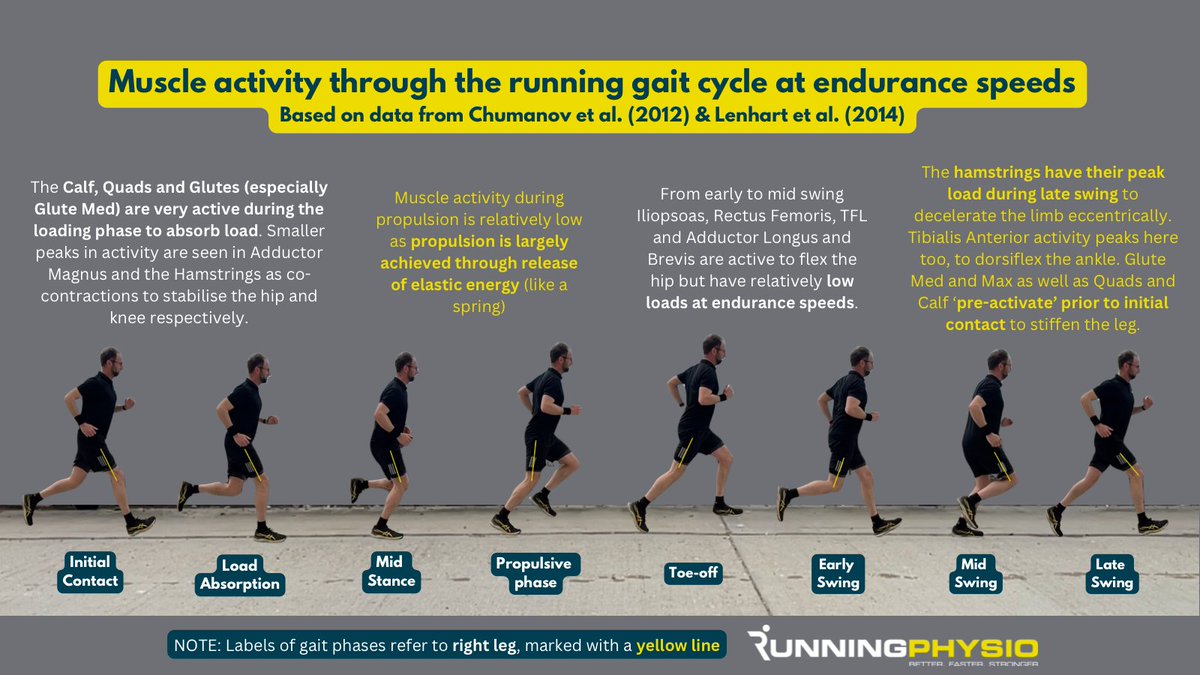
INFOGRAPHIC: Muscle activity during running 🏃♀️
Peak loads on the calf, hamstrings and hip flexors will increase significantly with faster running and sprinting.
Ever been health-shamed?
“You’re obsessed.”
“Why are you still dieting?”
“Come on, one cheat day won’t kill you.”
“You work out too much—it’s unhealthy.”
Funny how no one says a thing when you skip workouts, eat like crap, and feel miserable.
But the second you start showing up for yourself?
Suddenly, everyone has an opinion.
Ignore the noise. Protect your progress. The right people won’t make you feel guilty for trying to be better.
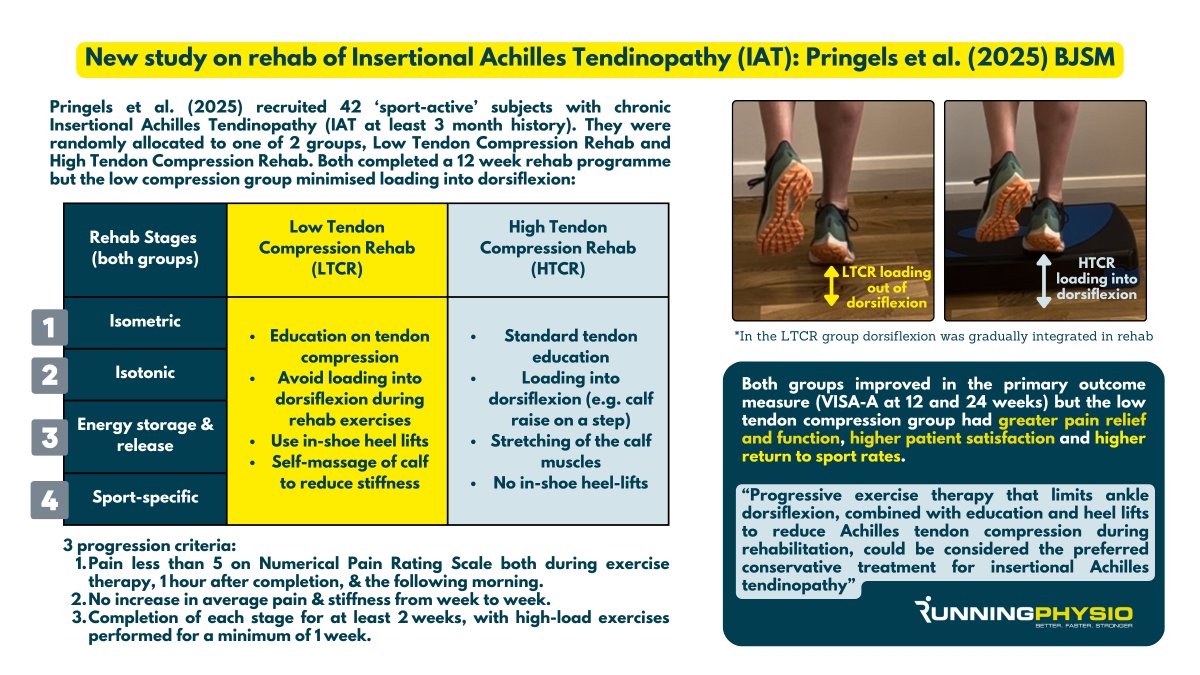
An excellent new study from Dr Lauren Pringels et al. in the BJSM has found that reducing tendon compression (by limiting ankle dorsiflexion during rehab) leads to better outcomes in Insertional Achilles Tendinopathy. See full paper for details: https://t.co/OIWfcxiD3z
Want better running form? Think tall and relaxed.
Imagine a string pulling from the top of your head.
Keep your posture upright, shoulders down, and lean slightly forward from your ankles.
Small tweaks lead to big improvements.
I love how mitochondria seems like it's the new thing in the health space.
I'm just going to call this the era of the distance runner.
If you want more and better functioning mitochondria, come join the running cult.
We've been telling ya'll for a while...