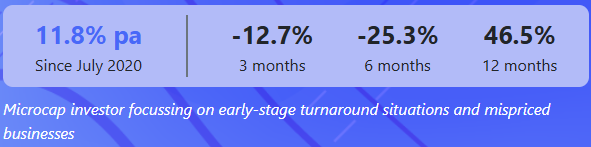
ASX nano-cap and micro-cap speculator.
I buy umbrellas when it is sunny and sell them for extraordinary returns when it rains.
Tweets are not Financial Advice
@WanderingSally@woolworths I think from memory that they have another chatbot that deals with these issues. Log in with your rewards card and look there.
@puppyeh1 $WZR.AX interesting take on this stock and a good read, but I don't think that Acorn, Regal and Aura are in this for a 30% return and I suspect that they are looking at the longer term 10-15 cent target.
@taipan168 The AU government mandates secondary bags checks at boarding gates for flights arriving from certain overseas airports to enforce the 100ml rule. If an airport lacks an equivalent secure transit check before departure, staff must confiscate non-compliant items prior to boarding.
Small Cap Investing is Dead with a 77% spike in Tax Collection
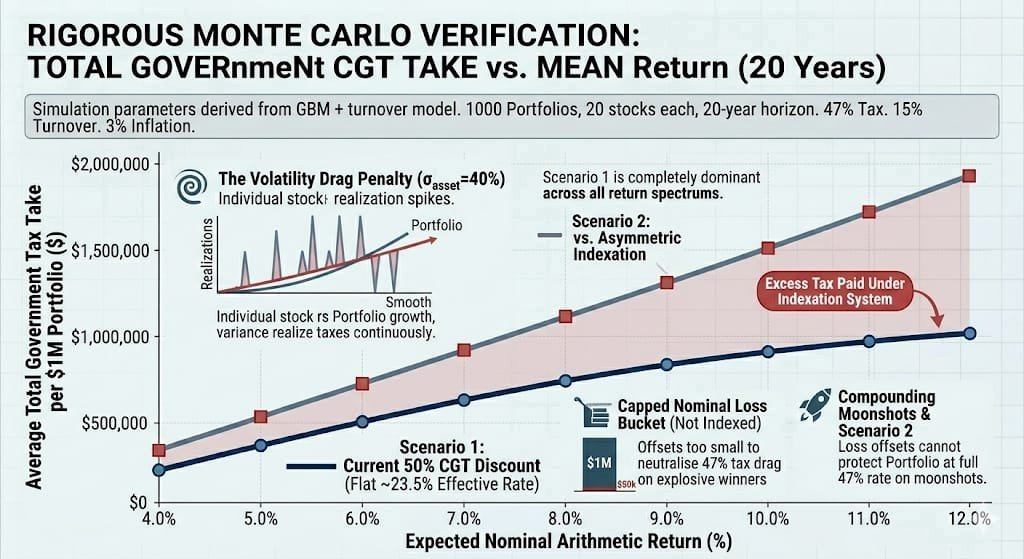
I have run 1,000 Monte Carlo simulations of portfolios of 20 Small Cap Stocks with the New Inflation Corrected CGT model versus the existing 50% CGT discount model.
The results are devastating.
The bottom line is that small caps are highly asymmetric bets where your small number of winners are meant to compensate you for your many losers. Mining companies are a good example of this situation and are a fundamental pillar of our national wealth. However if you tax those few winners at 47% with the trivial relative inflation correction you effectively wipe out the ability to offset your losses. This is because the tax drag on your few multi baggers is so high that it changes the entire logic of the investment process.
It's become a loser's game.
1. The Moonshot Tax Penalty:
Because Australian small caps rely heavily on a right-skewed distribution (a few massive winners offsetting many losers), the Indexation framework introduces a devastating tax penalty. For a stock that goes from $50,000 to $400,000, a 3% inflation adjustment on the original $50,000 cost basis is completely negligible. Under Indexation, you forfeit the 50% discount and pay a flat 47% on nearly the entire gain.
2. The Turnover Trap:
With a 15% annual turnover, small-cap portfolios realize taxes continuously. Under the current system, every partial sale triggers a flat 23.5% effective tax rate, leaving more money inside the portfolio to compound. Under indexation, those early wins are hit at a full 47% clip, severely dampening the portfolio's forward compounding engine.
3. The Asymmetric Loss Failure: in small-cap investing, a stock can only ever lose 100% of its value, but explosive winners have unlimited compounding upside. The government’s asymmetric tax system completely devastates this dynamic: by replacing the flat 50% CGT discount with inflation-indexing for winners only, it leaves your nominal losses capped and completely unable to counteract the massive tax hike on your multi-baggers. Because a 3% inflation buffer barely dents a 400% moonshot gain, you end up paying a brutal, un-discounted 47% tax rate on the very winners that drive a small-cap portfolio's success, causing a 77% spike in total government tax take overall.
Even in investing we see the socialist government wants us all to be the same. Communists.
(Technical notes: Model executed using Gemini Pro with 1,000 portfolios of 20 stocks each with the volatility and median return typical of this class of small cap stocks over the last 10 years, using a geometric mean process to step forward each portfolio each year).
@recap_david Superimpose a digital human in the likeness of the Real Estate Agent. She can talk about the listing from the actual listing description content to engage the viewer. There is so much that can be done. https://t.co/6qdJsWNUKM
@gregisenberg@RakanSleiman An interesting recruitment study highlighted by @gregisenberg using ai voice agents to conduct the interviews. Perhaps they need to put a face to the voices, if the recruitment agency intends to go live. @Unith_AI