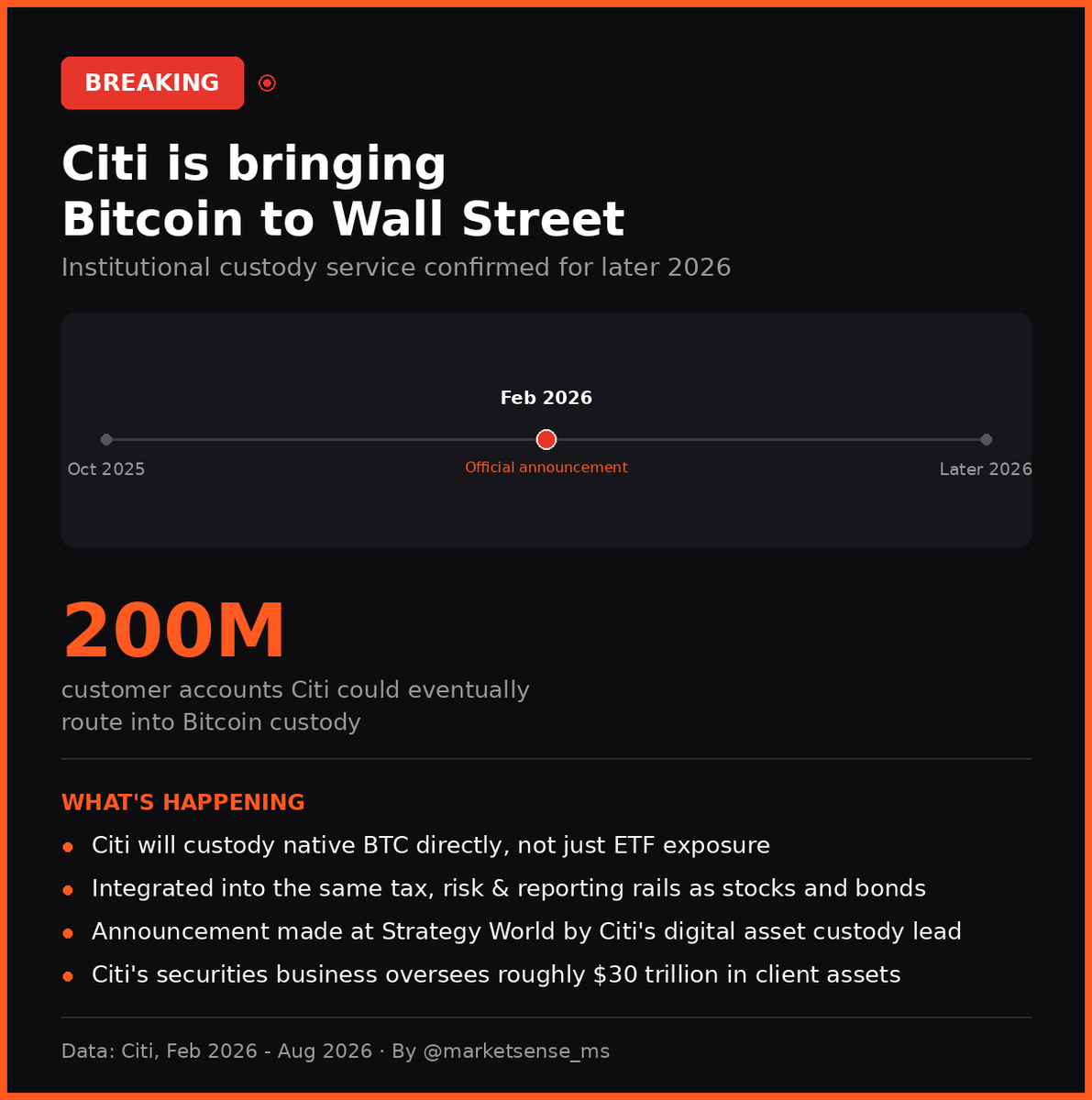
Citi just confirmed it's building direct Bitcoin custody for institutions, going live later this year.
Not an ETF wrapper. Actual BTC, held the same way Citi already holds stocks and bonds for clients. Same risk controls. Same tax reporting. Same compliance rails.
Citi's securities business oversees close to $30 trillion in client assets. Even a small slice of that flowing into direct BTC custody would be a meaningfully bigger structural shift than another spot ETF approval.
The bigger story isn't the announcement itself. It's that "held on a bank's balance sheet" and "held in cold storage" are starting to blur for institutions.
🇺🇸 $2.8 trillion banking giant Citi announces they will go live with Bitcoin custody services later this year.
They have over 200 million customer accounts.
Trillions will enter crypto over the coming years.
We are still so early.
The 30-year Treasury just did something it hasn't done since 2007.
• The U.S. is issuing near-record volumes of government debt to cover persistent deficits
• Inflation is proving sticky, with tariffs and rising energy costs keeping pressure on prices
• AI companies are raising massive amounts of capital, pulling investor cash away from bonds
Longer-dated bonds move the most when investors demand more compensation for lending over decades, and right now that compensation keeps climbing.
It's now just 14 basis points from erasing the entire post-2008 decline and reclaiming its 2007 peak.
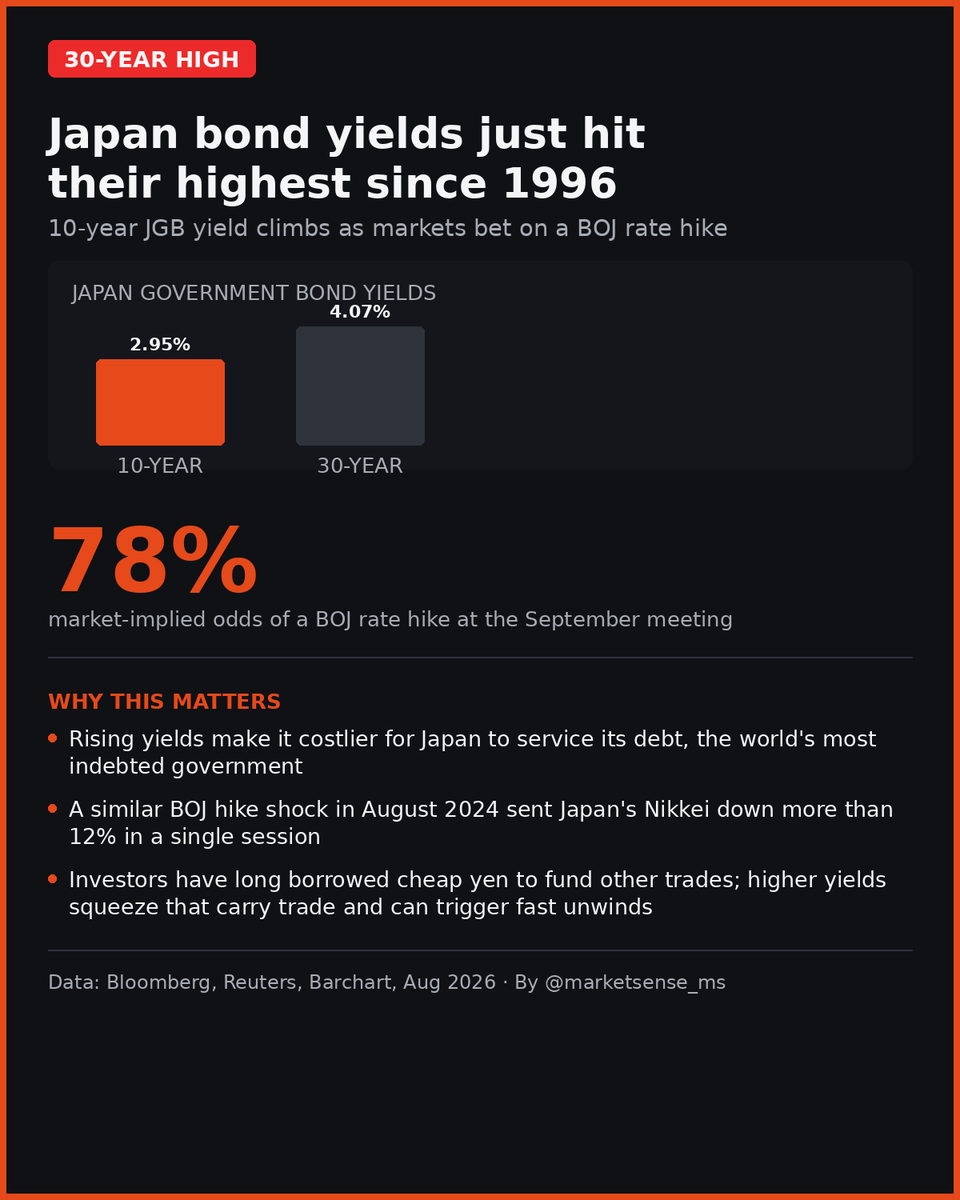
Japan's 10-year bond yield just hit its highest level since 1996.
• Markets now see a 78% chance the Bank of Japan hikes rates next month
• Rising yields make it more expensive for Japan to service the world's largest government debt pile
• A similar shock in August 2024 sent Japan's Nikkei down more than 12% in one session
In plain terms: investors have borrowed cheap yen for years to fund trades elsewhere. When Japanese yields rise, that "carry trade" gets squeezed, and unwinding it fast is what caused the 2024 crash.
Worth watching heading into the BOJ's September meeting.
Diesel just broke an all-time price record, and almost nobody is talking about it.
• Middle East exports down: Hormuz standoff plus a Houthi strike on a Saudi refinery
• Russia banned diesel exports after Ukrainian strikes hit its refineries
• China is holding back exports on fears of its own shortages
In plain terms: unlike crude oil, there's no strategic reserve for diesel. When supply tightens, prices move fast with nothing to cushion the fall.
Analysts warn this stays tight and expensive well into next year.
@zerohedge Worth noting the diesel crack is basically the cost of turning crude into fuel. When it runs this hot, it usually shows up later in pump prices and shipping costs, which is how it reaches everyday budgets.
@KobeissiLetter This could reshape the whole federal budget. Once interest becomes the single biggest line item, there is less room for everything else, and it keeps climbing until rates come down.
@KobeissiLetter Worth noting that leveraged ETFs cut both ways. A +$100B jump in 3 weeks means a lot of borrowed money is chasing this rally, and those same funds are forced to sell hard on the way down. Great tailwind now, rough exit later.
@unusual_whales Keep in mind one city is a pilot, not a business line yet. The number to watch is how quickly they expand past Austin, since that is where the revenue story either works or stalls.
@cryptorover One thing to keep in mind: when the biggest foreign buyers step back, the US still has to sell those bonds to someone else. That usually means paying a higher interest rate, and higher rates tend to show up in mortgages and car loans.
@spectatorindex Actually, this is the number to watch. Higher 30-year yields usually drag mortgage rates up with them, and safe bonds start competing with stocks for your money.
@TrendSpider This could matter more than it sounds. Overnight sessions usually have thinner volume, so prices can swing harder on smaller orders. Most everyday investors are still better off sticking to regular hours.
@unusual_whales Worth noting the ECB is flagging valuations, not earnings. Unlike 1999, most of these companies actually make money. Still smart to check what price you're paying for that growth.
@FirstSquawk Actually, the interesting bit is at the end. Oil near $91 pushes costs up and makes rate cuts harder, yet chip stocks still gained 1.6%. Money is not leaving the market, it is just crowding into the one story investors still believe in.
@KobeissiLetter This could matter more than the 6% headline suggests. Chip sales nearly doubling since 2020 means China is slowly buying less from overseas suppliers. That is a quiet, long term squeeze on chip exporters rather than a sudden one.
Ray Dalio says today's AI market has the classic signs of a bubble, similar to 1929 and the 2000 dot-com crash.
• Prices detached from earnings
• Retail investors buying with borrowed money
• A flood of new AI stock listings
His point in plain terms: $100 in AI stock bought on margin can fall to $25, but the loan is still owed in full. That gap is where people get hurt.
The US "wealth to money" ratio is around 8.5:1 right now, near the same peaks seen before 1929 and 2000.
@unusual_whales This chart explains a lot. Much of that money loops between the same few firms, so one company's revenue is another's spending. Fine while everyone keeps writing checks.