Companies invest a lot in analytics - but are these investments valuable?
@IsraeliAyelet and I studied ~1,500 online retailers and found that using a descriptive dashboard increased their weekly revenues by 4%-10%.
>>
#MarTech#BigData#Analytics#ecommerce#DataScience
Rock ballads in Hebrew have amazing lyrics.
Here's "put a candle in the window" by Stella Maris. I particularly like "put a candle in the window, and we will dance the dance of souls".
https://t.co/UXd4jWTQOY
@josephfwyer@SolomonHanes Well said (and written) Joe!
@eleafeit and I are actually in the process of finalizing some more innovations in the profit maximizing a/b testing world.
@ben_golub@ben_golub surprised you're promoting such BS. A regime vows to annihilate another country for 40 years, pursues nuclear weapons, builds a huge ballistic missile arsenal, and funds global terrorism. Then it kills 30k of its own citizens.
‼️News publishers that block LLM access receive even less traffic compared to not blocking‼️
In a new working paper with @HangchengZhao
we use daily traffic data , human web-browsing data, historical robots.txt policies, job postings, and historical webpage content to document early shifts in online news production and consumption.
We ask:
❓How do LLMs impact news publishers? Does consumer traffic decline? Do publishers hire fewer employees or generate more news slop?
❓How do publishers respond to LLMs? Does blocking LLM traffic have a positive or negative impact?
Our findings:
1️⃣ Traffic decline wasn’t immediate. Publisher traffic remained broadly stable through mid-2023; a Synthetic Difference-in-Differences analysis shows a decline in traffic that started after August 2024 (−13%) compared to top retail websites.
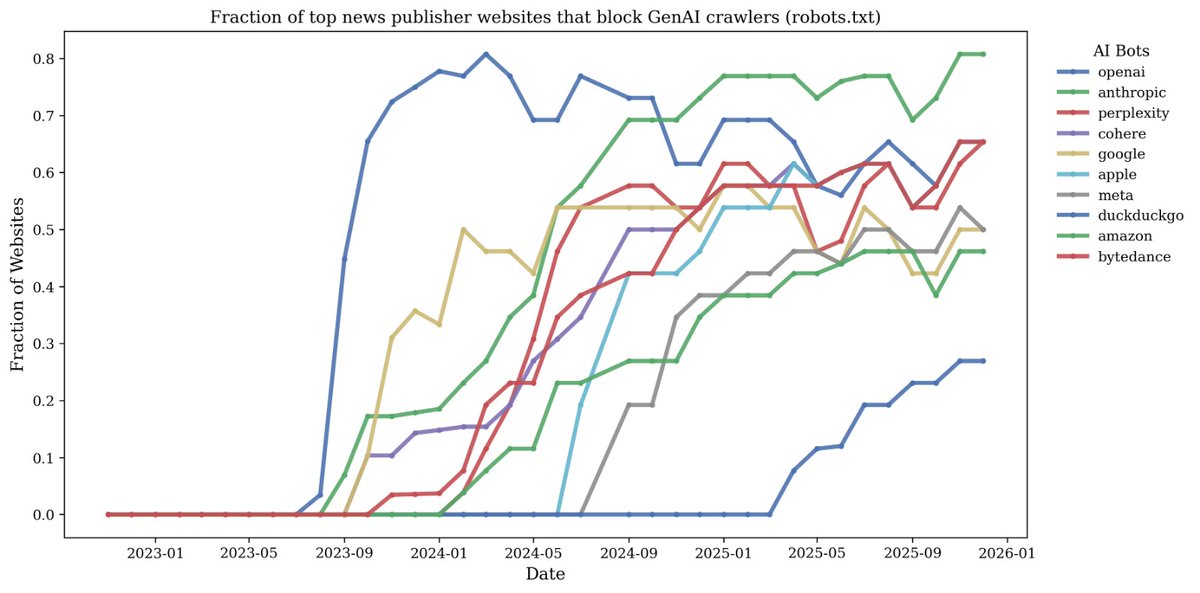
2️⃣ Blocking GenAI crawlers may backfire. ~80% of the top publishers block LLMs using robots.txt.
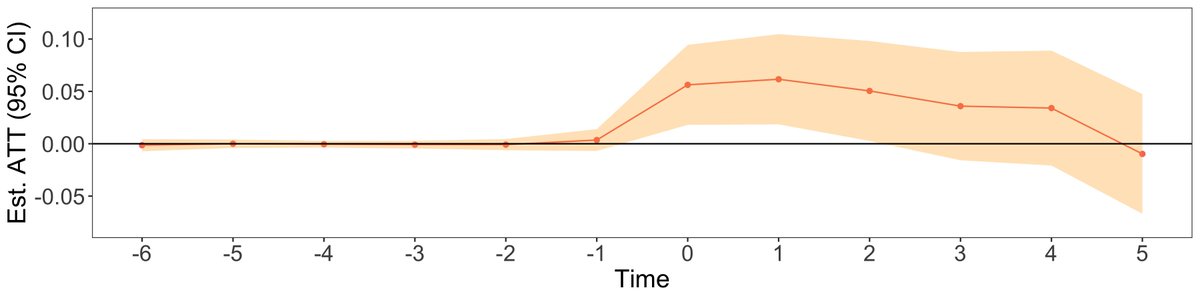
Staggered DiD analysis of the effect of blocking shows that traffic declined after blocking in both SimilarWeb traffic data (−23%) and Comscore data (−14%).
3️⃣ No “newsroom job replacement” yet: Data from job postings show that editorial/content roles do not exhibit a post-GenAI collapse; replacement or reduction of these jobs in the near term appears limited.
4️⃣ Publishers aren’t scaling text volume; instead, they’re “richening” pages. The number of interactive elements rises (+68%) and ads/targeting tech increases (+50%) , while article volume declines relative to top retail websites used as controls.
Key Takeaway: The impact of LLMs is nuanced and sometimes surprising. For example, blocking LLM access using robots.txt may reduce both bot access and real audience demand.
Links to working paper:
SSRN: https://t.co/7rCbfpKGip
arXiv: https://t.co/uXwJvVvZ40
#LLMs #media #news #AI #ArtificialInteligence #DigitalMarketing #digitalmedia
Key Takeaway: The impact of LLMs is nuanced and sometimes surprising. For example, blocking LLM access using robots.txt may reduce both bot access and real audience demand.
‼️New paper‼️
❓How do LLMs impact news publishers? Does consumer traffic decline? Do publishers hire fewer employees or generate more news slop?
❓How do publishers respond to LLMs? Does blocking LLM traffic have a positive or negative impact?
>>
#GenAI#LLMs#Media#news#AI
4️⃣ Publishers aren’t scaling text volume; instead, they’re “richening” pages. The number of interactive elements rises (+68%) and ads/targeting tech increases (+50%) 🎯📈 , while article volume declines relative to top retail websites used as controls.
Full paper here (open access):
“Naive analytics: The strategic advantage of algorithmic heuristics”
Games and Economic Behavior (2025)
https://t.co/cwqTXTIHv9
New paper alert: Most firms believe better and more precise data = better strategy.
My new paper with @heller_yuval shows this is not always true: sometimes biased algorithms make firms more profitable.
>>
Takeaway:
- Bias in estimates isn’t always a bug — sometimes it’s a feature.
- In oligopoly settings, “naive” analytics can sometimes beat sophisticated econometrics or unbiased A/B tests.
- That complicates both firm strategy and antitrust policy.