Finally completed this Quarter's Recap. Enjoy...
(Context: I listen to 400 companies in the S&P 500 a quarter, comment along the way, and then try to do this sort of summary if I have time).
Sen. John Kennedy is my kinda southern. Say it like it is.
Aside from the Helen of Troy comments, the fact that he just says: "Try to get them not to stab one another, because I realize they don't like each other..." I mean... how can you not just absolutely be a fan of this guy 😂😂😂
🚨🇺🇸 Sen. John Kennedy (R-LA) on Jensen Huang:
"I hope he had a good time... it was the most expensive sex since Helen of Troy."
This man is a national treasure 😂😂😂
Writer: Michael
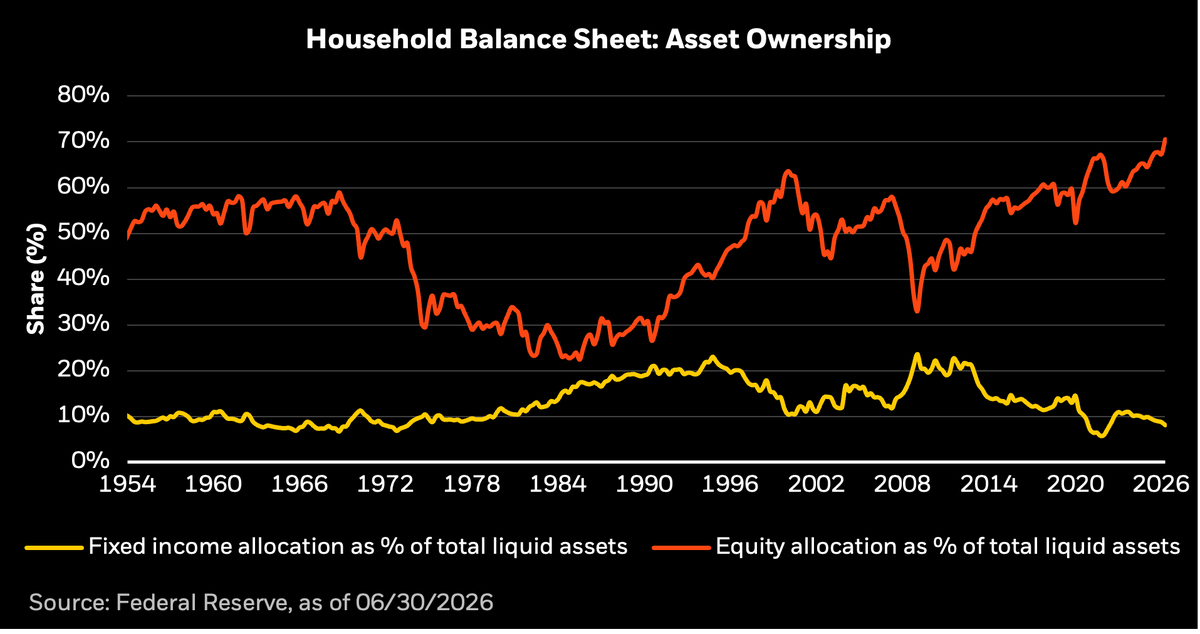
Great Chart Illustrating the Flows $SPY $USD $QQQ $VIXY
What's interesting about the chart below is that, despite the brief pop in fixed income allocations in 2022 following the rate hikes, as investors shifted assets into higher-yielding instruments, the overall allocation of assets has remained heavily skewed toward equities.
And this creates a circular effect. More flows attract more flows, which in turn drive equity prices higher, attracting even more capital.
Recall, too, that we went through an awkward period of relatively low issuance, meaning fewer new investable securities, despite all that capital flowing into equities.
That supply-demand imbalance had its own reinforcing effect on equity prices, further amplifying the cycle.
When markets move fast, balance matters.
It’s been a whirlwind for markets, and households have a lot riding on equities. Stocks now represent over 70% of household liquid assets, while fixed income allocations sit near historic lows. This increasingly equity-heavy backdrop lends important context to the magnitude of the market swings we’ve seen in recent weeks.
With attractive income available across high-quality bond markets today, this environment reminds us of the value that income can play as a ballast for the broader portfolio today.
@CreateYourSun_ Thx for that, but I can be wrong a lot.
On this one, who knows. This has to be worked out but because there is clearly some form of secondary financing market going on that touches far more than $NVDA this is going to be a unique one.
$NVDA... I get it... But again... if your biggest concerns and reason for firing is that the company has violated US laws, then technically, a president suggesting he is not coming after you would be the right way to calm down the board....
Literally, here's how the conversation will go: "I will give you a presidential pardon on my way out if we can overlook this Jensen stuff..."
Is it that confusing what this conversation could have been? IDK, maybe I'm wrong.
President Trump told us this morning “I convinced them” [the board] to bring Jensen back.
There will be endless lawsuits from anyone that sold Nvidia last week after the board told investors there’s no consideration of bringing him back
$NVDA... there is such confusion for folks about this whole Jensen thing.
Really? Someone needs to do this rant....
Do we not understand what is going on here? If you have to unwind the weirdness of what is going on with $NVDA, do you just pull the rug out, or do you unwind it slowly and methodically?
And to all the professionals acting like amateurs today: A reminder: Guess what, pulling the rug is NOT a required feature of a capitalistic market. Pretending it is the only way is either disingenuous or true naivety.
How is it confusing that we have mechanisms in the United States for orderly unwinding of complex situations that affect more than 1 part of the market? Are you going to pretend that's not what half the agencies responsible for handling the field of finance do?
Might I suggest possibly it's a misunderstanding of what the equity markets actually are? Were you thinking the relationship between equity pricing and fair value is actually something it's not.
$NVDA... From an Institutional Investor perspective, here's what I'd think they are thinking. (Game theory/fund flows perspective)
Fund Managers - They will be mostly concerned about performance if $NVDA rallies if they are equal or underweight $NVDA at these levels.
Risk Folks (who often have a meaningful say at the CIO vs the fund level) - They will be concerned that from a portfolio weight perspective the size and directional bias of flows would be a major risk should something bigger come out in the stock. I don't think last night put those fears to rest.
Risk folks (if folks have good ones vs just paper tiger ones) would have most likely been asked to run analysis on correlated stocks/industries and how you might be able to improve upside/downside risk on correlated moves.
Example: $AMD $SNDK etc...
Month End/Year End Dynamic: If a fund was able to escape the earlier weeks' dynamics then they have to weight whether the liquidity dynamics make sense to actually get involved the week before Thanksgiving or peace out until New Year. That will weigh in - as well - to any year end discussions on strategy, taxation/taxlot selling, redemptions, etc.
On rate cuts or increases... I have never deterred from this since the first time I said it 3 years ago. Rates SHOULD NEVER have been where they were, and they shouldn't be there now.
The macro folks key in on any number of reasons other than the one that is actually in the numbers. CORE has been right at or below 2% in the numbers for years now if you remove shelter. SHELTER is 100% rates driven.
AND ALSO, you DO NOT control food inflation with rates. And let's ignore the fact that, given what's going on in Europe, our "help" might require us to do more to get prices down OR that the way you offset tariffs is to make it legit cheaper to be in the United States OR that when we lower rates we necessarily lower the cost of debt to the US taxpayer.
And that's before we take into consideration that under Warsh you finally have less playing games in the curve such that it's way steeper than it's ever been.
I'm not asking for much. I'm just asking for ALL the talking heads to be a lot more consistent in their messaging. I have been for nearly 3 years at this point. It's not that hard. You can't have the exact opposite opinion 3 months ago and now pretend like it's because "macro has changed." That is NOT how it works if there wasn't a real event, except if you are being disingenuous.
You gotta listen every single quarter, not just once, to understand the nature of what people are doing, aka how does the strategy actually fit with the numbers and where precisely are the numbers coming from....
At least that's how I roll.
Jamie Dimon, the CEO of JPMorgan, admitted one phone call could fake $100 million of revenue. sitting right next to him, Warren Buffett said he could fake any number to eight decimals.
in the clip below the two tell CNBC's Becky Quick how a CEO can bend a quarter. it is the first TV interview the two of them have ever done together.
Buffett says he has sat on 20 boards of public companies, not counting Berkshire. he has watched managers he likes get tempted by their own forecasts.
"i'd be glad if they married my daughter or were named as executors of my will"
then the ego gets involved, he says. when they find they can't hit the numbers, some of them make numbers up.
Becky asks Dimon how he would do it at JPMorgan. he says one phone call and a few swaps put $100 million into revenue.
"believe me, you can report any number you want in an insurance company for a while"
so is quarterly guidance an honest forecast - or the easiest number in finance to fake?
$VIX... I did a bunch of butterflies/long condors related to vol coming in below 27, closing out that portion as the market is behaving as if it doesn't trust this rally.
(There was no liquidity, so I put in a random assortment of things and got smacked on a few on Friday at different expiries, which is why I'm happy to tell you but not which strike).
Not yet sure how I feel about my lower leg. But for the expiries I felt were too tight, I closed the upper parts out.
There's only a few folks I know follow me where this convo is relevant. For everyone else, don't do this. It's the part of my soul that is a degenerate gambler that engages in this when I see the VIX over a certain number. But I would NOT advocate this type of trading.
$UPST... took profits on my puts early AM. Will come back in when the market settles a bit.
$UPST is so darn volatile & I want the margin and profits for other stuff.
I still think folks are not thinking about this one and understanding the nature of the "why" they are looking to become a bank.
$NVDA... Acckkk.... he's likely right... I guess it makes sense now that a board member might sell out of a $1b in stock.
I mean... the power moves sometimes. I'm glad I'm a plebian.
100%.... that's why I was saying what I have been saying about understanding the nature of the shareholder bailouts that have been going on from 2022 to current. They need to do the P/E pass the potato game. They aren't necessarily incentivized the exact same way as a typical shareholder might be.
$XLF.... This is really great stuff. My biggest interest in this is how precisely the US financial system continues to evolve mechanistically.
If you pass off the risk to neobanks, then their blow-ups really are the front line & of course, the consolidated funding banks will cut off the tap like a barkeep who is making sure a customer doesn't get out of hand.
Def need to watch folks that provide great insight into this mechanism as I only get to hear the reports quarterly and I don't really focus on small cap neobanks.
Worth putting numbers on the bank side: banks lend $1.80T to nonbank lenders, 12.7% of all loans, and lending to private credit intermediaries and PE funds has each more than doubled since 4Q24. Credit is still clean (0.07% noncurrent), but banks appear to reserve it at about a third the rate of other commercial loans, with $1.1T+ of lines undrawn. https://t.co/47G43Qffw9
$NVDA... I'd just mention that if you have a sitting president supporting Jensen, the most likely the larger political wrong doing risk is somewhat muted over the next few weeks.
And also, I guess these guys are a little bit untouchable.