Those who celebrate @elonmusk's $1 trillion fortune need to be reminded of a simple and vital truth:
That there is a fundamental tension between extreme wealth and the very possibility of democracy.
Women work more hours but earn, on average, 43% less than men per hour when factoring in domestic as well as economic labour – @mrandreescu Valentina Gabrielli, Romaine Loubes & Anne-Sophie Robilliard of the World Inequality Lab
#LSEInequalitiesBlog
https://t.co/xXPIFrqfI8
@GabrielCor54922 You should you expect to pay the same as locals? Museums, national parks, preservation efforts are all funded by local tax revenue which is not that large.
I wonder why people from rich economies expect virtually free entry into the global south, complain about paying for entering museums, and having benefited historically from resources in the region. Can we expect the same treatment inversely? I am all for freer mobility of people
🇹🇭 Why is Thailand changing visa rules for visitors?
✔️ tourism accounts for 15% of GDP
✔️ visitors number⤵️
🇹🇭タイ政府が🇯🇵などを対象に導入していたビザ免除措置の滞在期間を短縮。
観光産業がGDPの15%を占めるのになぜ🤔💭
🙏🏻@pakhead
https://t.co/SRMM23PBeT
Argentina, Brazil, Chile, Peru, Republic of Korea will continue to enjoy 90-day visa-free stay – due to reciprocal bilateral agreements. Let's go for it.
Worth noting: visa overstaying and unlicensed business operation by Western tourists in Thailand, Bali, and across Southeast Asia is well-documented. The concern about people "just staying" and working informally applies in both directions — it just rarely gets framed that way.
📢 𝗔𝗡𝗡𝗢𝗨𝗡𝗖𝗘𝗠𝗘𝗡𝗧
AIR – African Inequality Review launches as a multi-year research and policy initiative led by ACEIR, LSE’s International Inequalities Institute, the World Bank, and UNU-WIDER.
Blog: https://t.co/FgNtwntt3f
Learn more: https://t.co/ZnZBhzVW8Q
Super interesting!
"How Much Does the World Work?" by Amory Gethin and Emmanuel Saez.
"It is often thought that people in richer countries work less. The reality is more nuanced. Hours worked per adult follow a mild bell-shaped relationship with income per capita. They are lowest in poor and rich countries and highest in middle-income economies. Yet income levels explain only a small fraction of global variations in working hours..."
"...cultural and social choices encoded in public policy shape hours worked much more than pure economic development. The balance between work and leisure is not simply about personal preference. It is a collective negotiation embedded in institutions, labor laws, and social expectations."
https://t.co/hDuXftjwEj
Exciting paper on Chilean wealth inequality by @_Ignacio_Flores et al. Key innovation: integrating admin pension fund data to fix survey underreporting. A reminder that open gov data for researchers is non-negotiable for honest inequality measurement in the Global South.
Hello @JeffBezos, since you question the results of our studies on the unfairness of the US tax system, please allow me to remind you of the main conclusions of our work, the most comprehensive research to date on this issue.
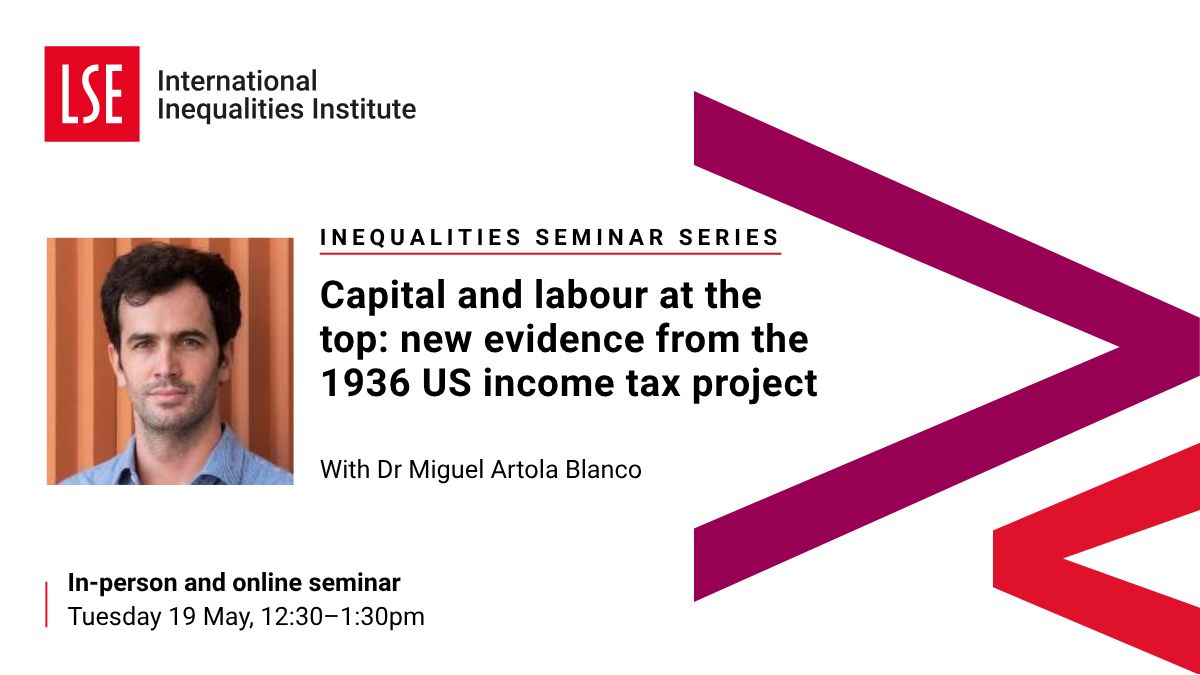
@mig_artola explores how the transition from pre-WWII to welfare capitalism involved not only a decline in income inequality but also a realignment of capital and labour incomes at the top.
🎟️ Attend in-person: https://t.co/SZIRFnzfVw
💻️ Attend online: https://t.co/fsF2bnBLYX