@giuliocurioni Yes, the current fst format is guaranteed to be supported indefinitely and can safely be used for long-time storage, no problem there! At the moment, fst is only available for R and Julia, but Python will be added in the near future.
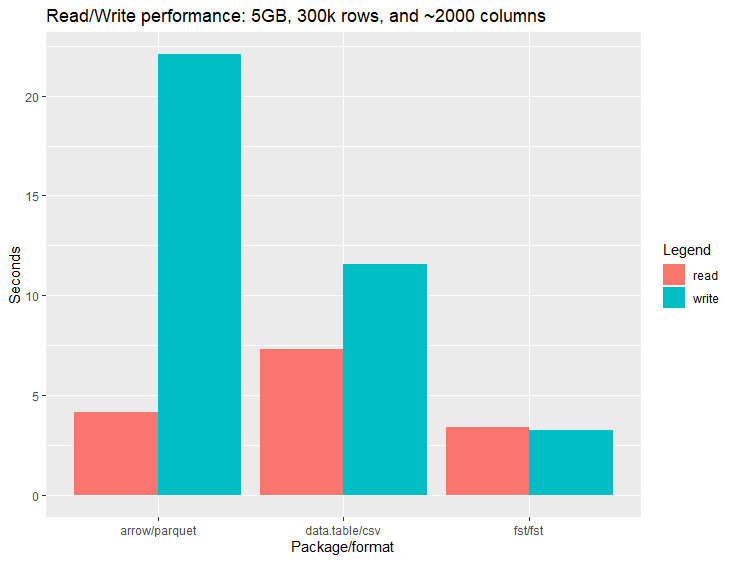
{fst} still beats {arrow}'s read/write_parquet after {arrow}'s upgrade to v0.15.0. Heck, even writing CSVs with {data.table}'s fread/write is faster for datasets with lots of rows. H/T to the #rdatatable contributors! And ❤️ the new ETA messages! @ApacheArrow@ApacheParquet
@D_O_Arantes@MattDowle@arun_sriniv And if you would like to use the index to read the fst file as an ordered (keyed) data.table directly, the reverse indices would be required for fst to map the data to the correct in-memory elements (similar as with the a row selector, see also https://t.co/PhIwbIIVvk)
@D_O_Arantes@MattDowle@arun_sriniv Yes, interesting, you could store multiple indices separately for the same (unordered) data table and restore them as data.table attributes on read. The (integer) index attributes could also be stored in the fst file natively if that would be a useful feature.
@DanRosenheck@DanRosenheck, interesting question! Further parallelizing won't help you except with character columns. For those fst needs to use the single threaded R API to access R's global string cache and they are not using multiple threads yet (but they will in one of the next releases).
Here's an R package of which I had known earlier. Have a data set you love that's more than 1 GB? Use the fst package in R. https://t.co/nJapWQygjJ
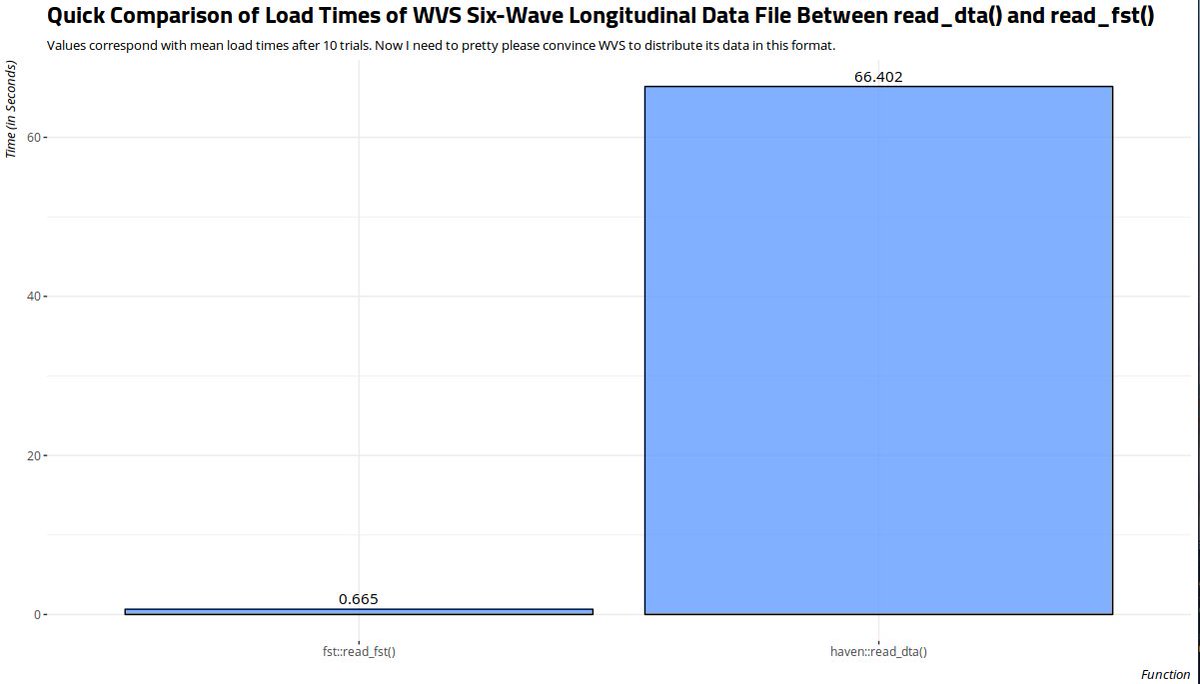
Here's a quick comparison of loading @ValuesStudies longitudinal data via haven::read_dta vs. fst::read_fst.