1/6: Stablecoin depegs caused between $1.5B and $3.3B in losses from 2020 to 2025. That's not including anything from this year. I sat down with @markoinether from @tapirprotocol to talk about what that means and what to do about it. Here's what I learned. 🧵
@Ceazor7@JourneyMacro@grok wdyt r the risks that are not well explained / addressed?
From my point of view all the potential issues have been rigorously researched & addressed, there has been a lot written on this on the ehtresearch forum for the past years
Really sorry to see this drop.
100% staking ratio that we are slowly marching towards means
- no credibly neutral money left in the system
- only staking providers actually make money anyone else just gets diluted
- solo stakers as a last stronghold become irrelevant - they become a footnote on the margin as % of the network
- balance of power shifts heavily towards staking providers, the main SP becomes the kingmaker
📋Withdrawing EIP-8363 from consideration for Hegotá.
EIP-8363 rapidly became one of the most commented-on EIPs in the history of the Ethereum-Magicians forum, with 200+ comments in a few weeks. As we progressed through the Hegotà CFI (Consideration For Inclusion) process, several parties in the industry as well as core protocol and client contributors voiced that a fork scoping exercise was not the right venue to settle an issuance policy change.
We agree and we'd rather acknowledge this now than carry on towards Hegotà in this context. The topic is too important and raised too many concerns that it deserves its own process. We commit to giving issuance its own process and we thank the entities such as @LidoFinance who offered to help steer such an initiative.
We stand by the motivation of this EIP, in particular: “a very high staking ratio is undesirable for two distinct reasons (...), preserving Ethereum’s security, neutrality and resistance to capture, and protecting ETH’s role as money.” Not everybody immediately relates to both reasons and for others recognizing just one of these reasons is enough to justify a change. Nevertheless, we will all benefit from improving our understanding of the issue and what is at stake. The questions we have faced since we published EIP-8363 can be boiled down to 5 categories:
➡️Security: What does a lower ratio actually secure versus a higher ratio?
➡️Industry impact: What else is built on the yield and what will be the impact ?
➡️Curve specs and alternate tools: Is this curve even the right instrument?
➡️Composition: Who is left staking (the effect on the composition of the validator set) ?
➡️Decentralization: How will solo stakers be impacted by the reduction?
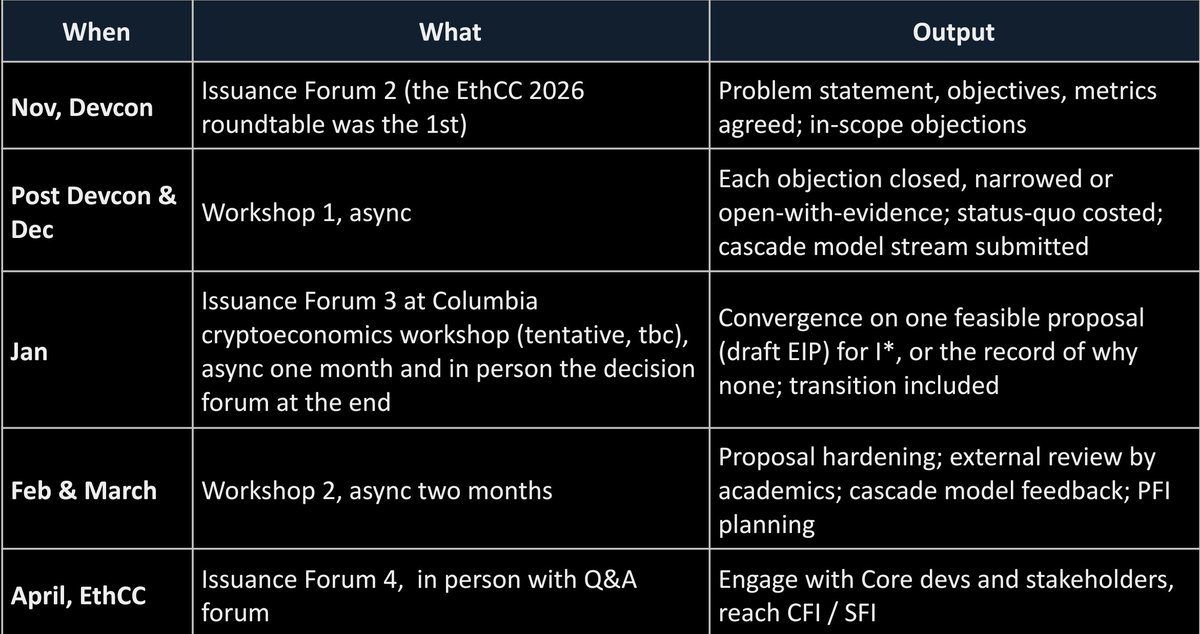
We already argued a lot, conceded some and adjusted a few points in the very long Ethereum-Magicians thread mentioned supra. For a broader consensus to emerge and a better issuance policy for Ethereum to be designed and adopted, we need a dedicated process. We call for all willing hands to help and contribute to this, please do reach out. Here’s our start at what a multi-node process would look like (table attached).
Onward and forward, let’s improve Ethereum.
@JourneyMacro@Ceazor7@grok I think the reasons have been repeated ad nauseam.
The only reason I believe has some ground is the reason that any changing of issuance lowers the moneyness properties, IMO heavily outweighted by the downsides.
anything in particular you disagree with?
@casperBGD Every staker holding LST is paying some portion of his pie in fees to the staking provider, meaning the overall ETH pie is getting redistributed just to them, since everyone else's balance is growing at the same rate.
@jdetychey Thanks for all your hard work Jeremy in this regard, really hope you continue the effort.
Think we need to resolve the issuance debate, the status quo is short term not interesting, but long term not sustainable if we want to keep the $ETH and Ethereum as they are now.
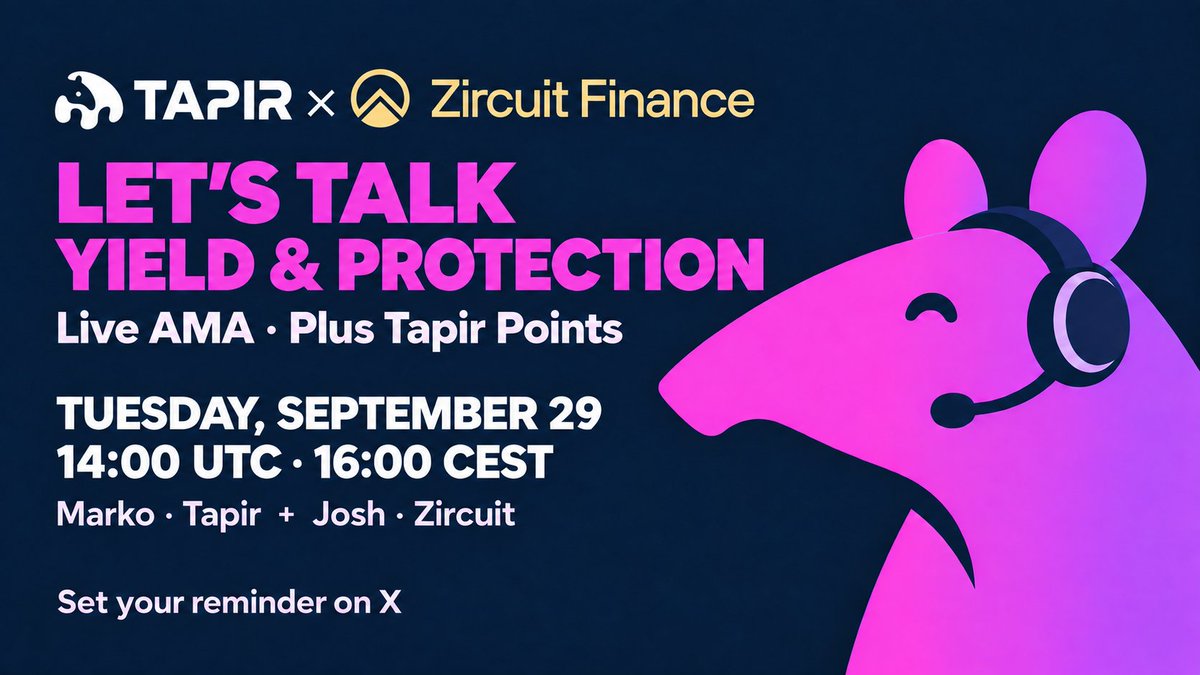
We’re live at 14:00 UTC 🎙️ Join Marko from Tapir and Josh from
@Zircuit
for our AMA on yield, depeg protection and Tapir points.
https://t.co/Rom2fDFuJm
punkdotfun is for the projects politicians don’t like, VCs don’t get, and grants can’t afford to fund
built on ethereum, because CROPS are the only thing that matters
Tomorrow: Tapir × @Zircuit 🎙️
Join @markoinether and @0xJosh0x to talk yield, depeg protection and Tapir Points. Bring your questions!
🗓 September 29 · 14:00 UTC / 16:00 CEST
Set your reminder 👇
https://t.co/OQHIZ42EX9
Tapir points are live.
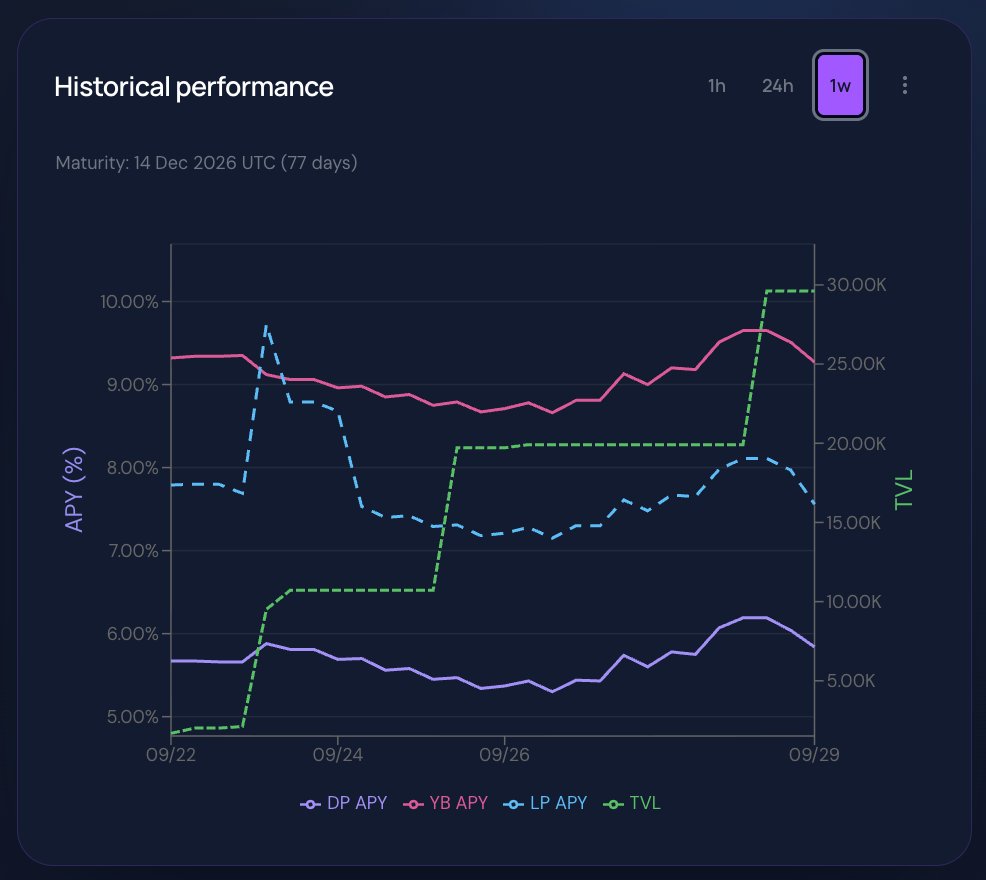
Hold DP or YB and earn points for every full day you hold. Provide liquidity and earn a second stream on your trading fees.
Every finalized point converts 1:1 into TPR.
How to start 👇
This is why @ethereum’s validator set must remain independent. If financial intermediaries dominate consensus, their losses and lawsuits can become pressure to censor or reverse outcomes. Validators should enforce objective rules, not decide who gets made whole.
TTapir points go live tomorrow.
From Sep 25, 00:00 UTC, our @Zircuit USDC market on Base earns points two ways.
Hold DP or YB, and earn points for every full day you hold.
Provide DP/YB liquidity, and earn a second stream on your trading fees.
Every finalized point converts 1:1 into TPR.
Details 👇