CollabAI: AI Teamwork In Practice by Marko Taipale is the featured book on the Leanpub homepage! #Agile#Teamwork#Ai#SoftwareEngineering#InnovationManagement
The practical guide to AI-first teamwork. Includes access to the 'CollabAI AI companion' that helps you run your first session immediately.
Most teams have fast individuals—but a slow system. AI can change that.
CollabAI is the manual for teams who want to stop waiting and start flowing. It moves beyond "chatting with a bot" to a new collaborative rhythm where humans and AI build, test, and decide together in real time.
Find it on Leanpub!
Experimenting with how AI will transform software development! From ideation to UX/UI, devops, and business analytics, I'm integrating AI into every workflow stage. Any insights or know others exploring this? #MobAI https://t.co/eToPfGAVgR
What is an AI anyway? Microsoft AI CEO @mustafasuleyman offers a compelling new vision for the future.
Learn more about where AI is heading by watching his full #TED2024 Talk here: https://t.co/SqaV5aEohT
Clipdrop (by Stability AI) has introduced Uncrop, an AI-powered 'outpainting' tool.
Uncrop uses Stability AI's SDXL text-to-image model to expand the images canvas.
It’s essentially Photoshop’s new Generative Fill, but free.
🤣
Thanks to #AI, we are going to be forced to have more in person meetings for things like job interviews.
Who would have thought. 😂😂😂 One technology killing another.
The underlying spirit in many debates about the pace of AI progress—that we need to take safety very seriously and proceed with caution—is key to our mission. We spent more than 6 months testing GPT-4 and making it even safer, and built it on years of alignment research that we pursued in anticipation of models like GPT-4.
We expect to continue to ramp our safety precautions more proactively than many of our users would like. Our general goal is for each model we ship to be our most aligned one yet, and it’s been true so far from GPT-3 (initially deployed without any special alignment), GPT-3.5 (aligned enough to be deployed in ChatGPT), and now GPT-4 (performs much better on all of our safety metrics than GPT-3.5).
We believe (and have been saying in policy discussions with governments) that powerful training runs should be reported to governments, be accompanied by increasingly-sophisticated predictions of their capability and impact, and require best practices such as dangerous capability testing. We think governance of large-scale compute usage, safety standards, and regulation of/lesson-sharing from deployment are good ideas, but the details really matter and should adapt over time as the technology evolves. It’s also important to address the whole spectrum of risks from present-day issues (e.g. preventing misuse or self-harm, mitigating bias) to longer-term existential ones.
Perhaps the most common theme from the long history of AI has been incorrect confident predictions from experts. One way to avoid unspotted prediction errors is for the technology in its current state to have early and frequent contact with reality as it is iteratively developed, tested, deployed, and all the while improved. And there are creative ideas people don’t often discuss which can improve the safety landscape in surprising ways — for example, it’s easy to create a continuum of incrementally-better AIs (such as by deploying subsequent checkpoints of a given training run), which presents a safety opportunity very unlike our historical approach of infrequent major model upgrades.
The upcoming transformative technological change of AI is something that is simultaneously cause for optimism and concern — the whole range of emotions is justified and is shared by people within OpenAI, too. It’s a special opportunity and obligation for us all to be alive at this time, to have a chance to design the future together.
Never in our wildest dreams did we think that Bitcoin would disrupt the entire payment infrastructure system GLOBALLY and still allow users and merchants to trade in FIAT.
A story of two Russias. We report on Russians who believe what state TV is telling them about Ukraine. And those who don’t, and who are leaving the country. Camera @AntonChicherov Producer @BBCWillVernon@BBCNews@BBCWorld https://t.co/TYRf0LYINR
Take a moment to watch this video. I explore the question everyone is asking - given all the devastating costs to Russia, Ukraine and the world, why on earth is Putin doing this?
A transatlantic task force that will target wealthy Russians' assets abroad. "We will take their yachts, their luxury apartments, their money and their ability to send their kids to fancy colleges in the west," a U.S. official said.
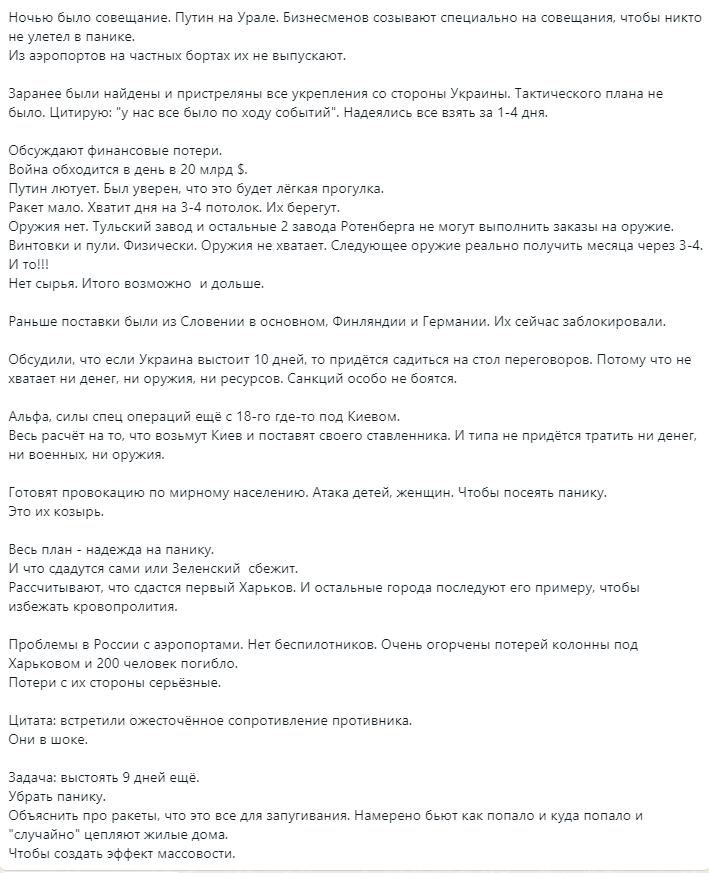
THREAD 1/7 Intel from a Ukrainian officer about a meeting in Putin’s lair in Urals. Oligarchs convened there so no one would flee. Putin is furious, he thought that the whole war would be easy and everything would be done in 1-4 days. @EPPGroup@general_ben@edwardlucas@politico
Kremlin website is DOWN: Russian state websites including media watchdog crash and TV channels 'are hacked to broadcast Ukrainian songs'
Anonymous, you legends!!🤣
We all should understand macro-economics at this level by @RaoulGMI : https://t.co/BsWjOQNvWv (besides I do not like the overly stock photo usage in the video)