South East Water left thousands of homes in Kent without access to water on the hottest days of the year so far. Yet another shocking example of the failure of privatisation.
Given the scale of the crisis in the water sector, a purely regulatory approach is like putting a complaints box on the Titanic.
Public ownership is the only real solution, as I told the Water Minister in parliament yesterday.
20 June, Saturday after Makerfield by-election what 'Starmer Symptom' does the result reveal? A very special event in a very special, location: Newark, Reform UK @RobertJenrick 's constituency.
I remember being called ‘disloyal’ when calling out the PM for not being up to the Job.
Turns out I was wasn't alone!
From genocide to failing economic policy - ministers knew - but did zilch.
And we wonder at the cynicism the public have towards politicians?
Cynicism eats into the foundations of democracy. The authoritarian right know this. Maybe time to stop feeding it.
The media is calling the govt’s refusal to grant new drilling licenses, a ‘ban’.
I disagree with that framing.
Rather it’s the logical conclusion of decades of scientific climate research and global negotiations to keep devastating global temp raises to a minimum.
To now suggest you know new licenses won’t make a jot of difference to energy bills but will lead to enhanced tax revenue is a pretty weak rationale.
If you want more fiscal capacity for govt, without burning the planet, then start by undoing the ridiculously generous N Sea decommissioning costs that will cost the tax payer tens of billions of pounds in coming years whilst the oil companies literally walk away laughing.
This feels less the ‘battle of big ideas’ and more of the same big money, corporate capture that has so damaged Labour these past 40 years.
I guess we’ll all be able to soon see which corporate and multi-millionaire sponsors have been bankrolling these respective ‘leadership’ campaigns.
Should make for interesting, if not depressing, reading.
Phew.
For a moment there I thought we might take a structural approach & understand these problems as symptoms of an extractive economy, shaped by deep cultural & technological forces.
Thank the lord we’ve opted instead to bring in a multi-millionaire to sort it all.
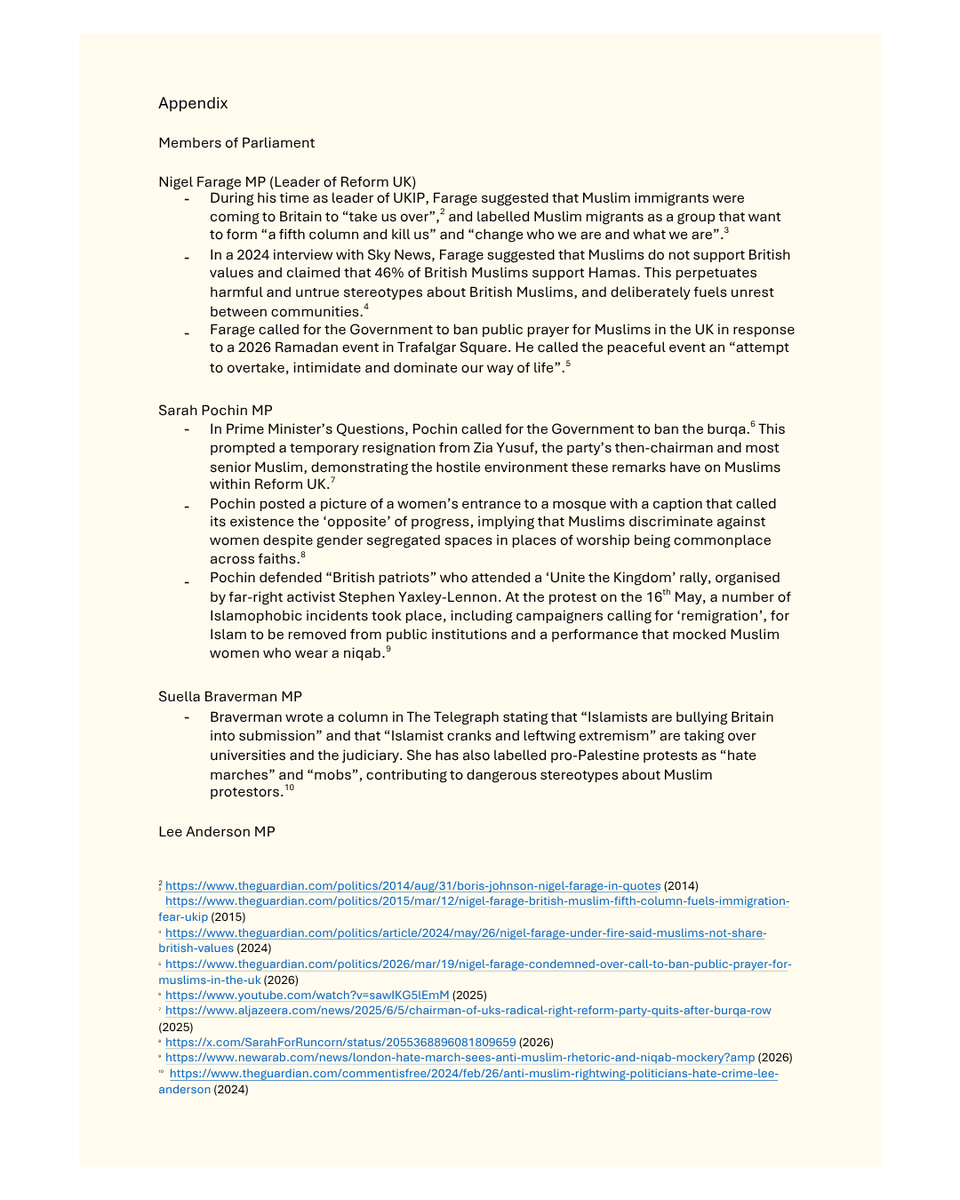
Senior figures and members in Reform UK have repeatedly vilified Muslims, pushed Islamophobic tropes, and used Muslim communities as political scapegoats. This isn’t free speech – it’s dangerous and divisive rhetoric.
When this behaviour goes unchecked, it doesn’t just poison our politics – it puts Muslim voters at real risk.
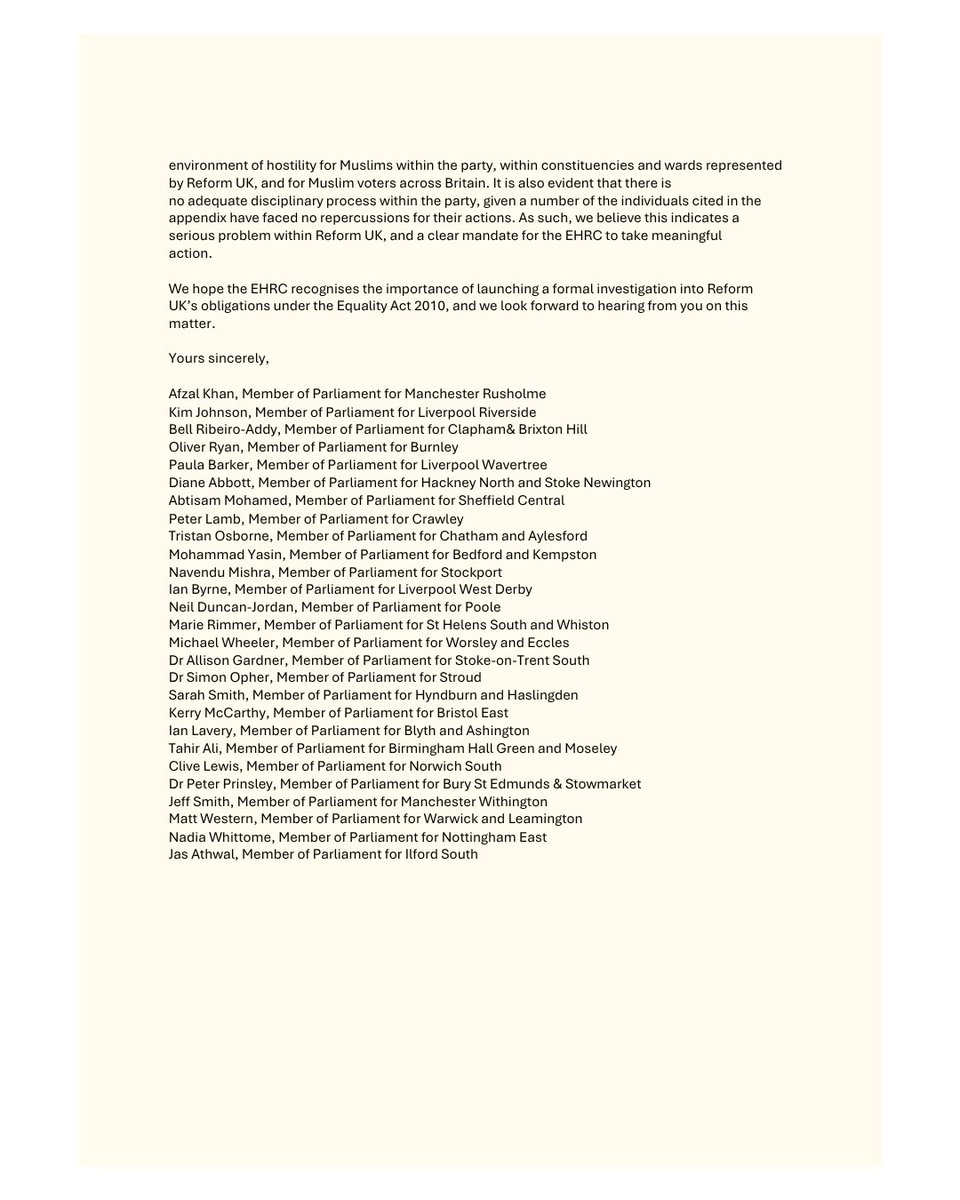
That’s why I’ve signed a formal complaint to the Equality and Human Rights Commission, alongside Afzal Khan and colleagues, calling for a full investigation into Reform UK, and whether their conduct breaches their legal obligations under the Equality Act not to incite discrimination.
No one is above the law. And no community should be targeted for political gain.
Just today we have a superb diagnosis and set of solutions from one of the people that any sane political class would be looking to for leadership out of this crisis, @labourlewis: https://t.co/yAhOJhoMdJ
This is kind of incredible. @TomMcTague' analysis is obviously correct, but he writes as if people on the left haven't been saying exactly all this, and putting forward the necessary programmatic solutions, for literally years (including, like, me...in his own magazine).
The rich and powerful will not politely bow out for their replacement – which is why progressives must take action on these three fronts:
https://t.co/m6oAZBLatL
Whether it is Tony Blair’s interventions, the bond market’s reaction or privatised utilities warning of doom, the pattern is the same.
When anyone suggests progressive change, those with wealth and power push back. Whether the figure in question is @AndyBurnhamGM or @ZackPolanski, progressives need to understand what we are up against, and how to defeat it.
Very often, I find, science fiction names what politics struggles to. In James SA Corey’s series of novels the Expanse, the violent dystopian streets of Baltimore are given a name for what happens when the old order breaks down faster than people can describe it: the Churn. It is the brutal reorganisation of power, when familiar rules collapse and those who survive are the ones who read the signs early.
Britain is in one now. In fact, two churns are happening at once.
The first is electoral. May’s local elections were a rupture with the past. Labour lost roughly 1,100 councillors. Reform won 1,257 seats and 10 councils. The Greens won Hackney and Lewisham. In Makerfield, the parliamentary constituency where Andy Burnham is seeking a route back to the Commons, Reform took every council ward.
The progressive vote has fragmented and Reform has captured a large part of the anger. The container in which transformative politics could once be argued for and delivered – a dependable Labourmajority in the Commons – is visibly crumbling.
The second churn is deeper. Burnham named it when he said Britain had been “on the wrong course for 40 years”. That was a diagnosis of the political economy that has governed Britain since the late 1970s: financialisation, privatisation, hollowed-out public services and the transfer of wealth and power away from workers, communities and the public realm.
This is why the events of recent weeks matter. Burnham needs a state that is able to pay for big-ticket, social-democratic projects: council homes, clean energy, public transport, water, skills and resilience. Those things cannot be wished into being. They require public investment at scale.
That is where Rachel Reeves’s fiscal rules become more than an accounting device. In plain English, they are self-imposed limits on borrowing. They are political choices, not laws of nature. But they matter because they set the boundaries of what Labour says it can afford.
They matter for Burnham’s possible project for the country, because the current rules would inhibit the kind of public investment that a new settlement with the British people would require.
Yet he cannot simply announce he will tear them up. Governments borrow by selling gilts. If investors believe a government will borrow recklessly, they demand higher interest rates to lend to it. That raises the cost of all government borrowing and squeezes the money available for everything else. This is the discipline every Labour politician now feels.
Three weeks ago, Burnham tested the boundary. He floated a defence carve-out: the idea that extra borrowing for defence could sit outside the fiscal rules, as Germany has done by using special funds to increase military spending. It was a narrow proposal but one that raised larger questions about how we finance what we deem to be important. What followed is what some call “market discipline”. From the period around Burnham’s Makerfield announcement onward, the pound came under pressure and gilt yields rose as markets priced political uncertainty. Private creditors warned against Thames Water being brought into public ownership. Then, last Monday, Burnham’s team told Bloomberg he would make no changes to Reeves’s fiscal rules if he became prime minister. The defence carve-out was ruled out too.
I was not surprised by the retreat. Nor do I think it is useful to call it betrayal. Burnham cannot win a leadership contest if the markets are running against him before he has even started. But the retreat itself is the lesson. It illuminates what is standing in the way of a new social democracy. It is not simply ���the markets”. It is the economic architecture Britain has built: Treasury rules, Bank of England decisions, pension fund structures and investor expectations combining to discipline any politics that threatens the settlement. What happened last week was a lesson in how power works.
Burnham matters not because he is a saviour. Progressives have had enough of saviours. He matters because he has said aloud what Westminster still avoids: Britain’s crisis is rooted in the economic settlement itself.
That settlement, what economists increasingly call rentier capitalism, is not abstract. It is a country where water bills rise while shareholders are rewarded, where housing wealth matters more than people having secure homes, and where democratic choices narrow whenever they threaten asset holders. Meanwhile, the state manages the fallout: crumbling infrastructure, higher costs and a cost of living crisis deepened by rentier extraction.
That is why the reaction to Burnham’s comments on the fiscal rules is revealing. Chancellors rewrite fiscal rules all the time when it suits them. Gordon Brown had his golden rule. George Osborne had his surplus target. Philip Hammond revised the framework. Rishi Sunak changed it. Jeremy Hunt changed it. Reeves has changed it again. The question is not whether fiscal rules can change. They plainly can. The question is who gets to change them, and for what purpose?
There are three fights progressives now have to pick.
The first is fiscal. Democracy must regain the power to invest. Public investment is still constrained less by national need than by what ministers think the bond market, the Bank of England and the Treasury will tolerate. A real shift would start from need, not nerves.
That means a Bank of England mandate that recognises a basic truth: inflation is not only caused by too much demand. It is also caused by too little capacity. When there are too few homes, rents rise. When public transport is weak, people are forced into expensive alternatives. When energy is costly and unreliable, bills rise. Investment is not the enemy of stability. Done properly, it is how stability is built.
The second fight is ownership. Public goods should be built and owned in the public interest. Thames Water entering special administration is the obvious place to start. Regional public housing corporationscould build at scale on public land, financed by rental income rather than annual Whitehall grants.
That is also why the language of “public control” – used increasingly by Andy Burnham – deserves scrutiny. Few want a return to top-down nationalisation. But franchising, as the Bee Network in Manchester demonstrates, is not public ownership. Private operators running Bee Network services made hundreds of millions in profit last year. The network is better than what came before – but it remains a private-profit, public-risk model. Control without ownership leaves the fundamental problem intact: the public absorbs the downside while shareholders take the gain.
The third fight is constitutional. Proportional representation for Westminster, an elected second chamber and deeper devolution are not procedural tidying-up. They are conditions for progressive power in a fragmented country. The forces ranged against transformation do not need PR: they already have the City, the rightwing press, corporate lobbying, the Treasury worldview and the bond market. Progressive Britain has no equivalent machinery. PR is the glue that could allow a broad majority to govern together.
Burnham was right: Britain has been on the wrong course for 40 years. But last week showed the harder truth. The old settlement will not politely bow out for its replacement. It will price the risk, police the boundaries and demand reassurance before the argument has even begun. The churn is far from over.
* Clive Lewis is the Labour MP for Norwich South
* Clive Lewis will be speaking about these issues and more with Andy Burnham at Change Now! Mobilising the Progressive Majority
The brilliant @rachshabi making sense of the duality of rising antisemitism & it’s weaponisation:
“It is entirely possible – in fact vital– to hold compassion for a fearful Jewish minority facing violent antisemitism, while rejecting the way such fears can be manipulated for political ends.”
💥In the Makerfield by-election, it's Burnham or bust.
Join one of our campaign days in May and June with friends from across the Labour Party.
Further dates coming soon! 🗓️
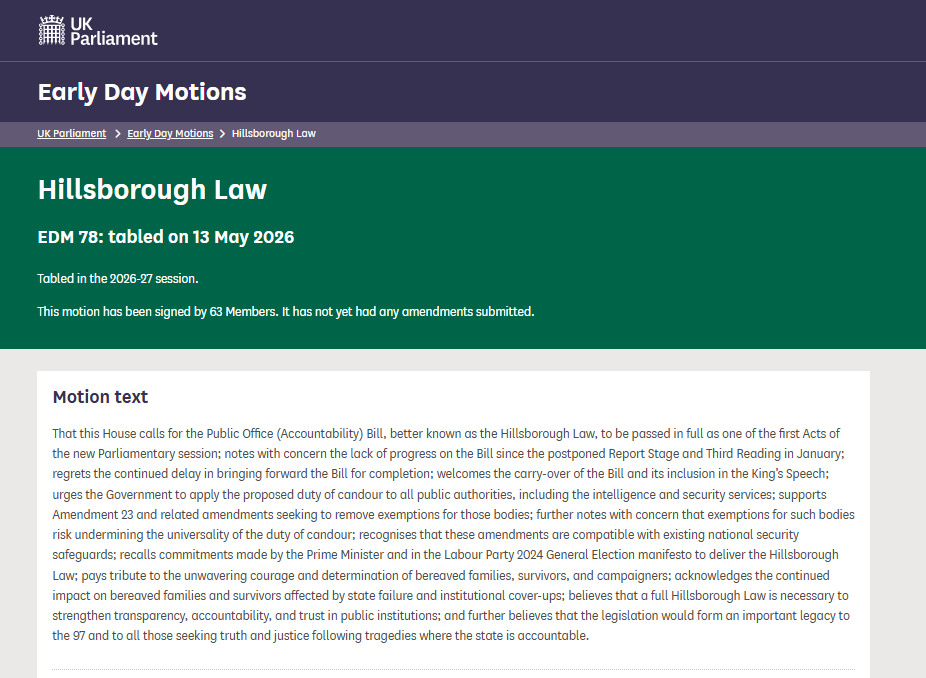
I have signed a parliamentary motion calling on the Government to finally deliver the Hillsborough Law.
For too long, bereaved families and survivors have been denied transparency and accountability.
The Government must now act and fulfil its manifesto commitment to deliver this law.
“The fact that he is known as a vulture capitalist should tell you everything about how inappropriate this deal is [for Thames Water]… these kinds of people are there to suck the lifeblood out of our utilities and public services, and this deal should not be rushed through.”
One of the most devastating assessments of the Starmer government I’ve read.
Not from a politician. Not from an activist.
From one of the country’s finest economic historians, writing with the clarity only historical perspective can bring - @DEHEdgerton










![labourlewis's tweet photo. “The fact that he is known as a vulture capitalist should tell you everything about how inappropriate this deal is [for Thames Water]… these kinds of people are there to suck the lifeblood out of our utilities and public services, and this deal should not be rushed through.” https://t.co/gUMdqb41D0](https://pbs.twimg.com/media/HIthX-BXQAAKhD8.jpg)


