Working with your close friends is high risk, high reward.
I started my startup with 3 of my closest friends from college and Facebook. My little brother even ended up joining as one of our first engineers. They all ended up staying for the entire 7-year journey. Insanely grateful to all of them.
The risks are painful: Things can get personal, you’re risking a valued relationship, it’s harder to feel objective about things, you will never be able to separate your work and friend life.
The rewards are next level: It’s infinitely more motivating to not let your friends down than it is to think about some make‑believe number you might get one day, you will be able to unlock the 1+1=3 lockstep that you get when you’re on the same wavelength, and it’s just way more fun. Fun is both a feel‑good word and also a key lever for founder retention. A startup dies when the founders lose energy. That’s hard to do when you’re having fun. In a game of compounding returns, days matter (both in terms of speed and longevity). Very few things are more fun than building cool shit with your friends.
My main tips for doing this well:
1. Choose your co‑founder/friends well. Do you just like hanging out with them or are they legitimately 10x better than you at something that’s critical to the journey? If you don’t fundamentally respect them on something you feel is important, that crack will eventually show down the line.
2. Pick a leader. Startups aren’t democracies. Many times the best decision is a fast one. Even if it’s wrong, the faster you fail, the faster you learn, the faster you iterate. It should be clear that if there isn’t a consensus, the CEO will make a call and everyone will move forward.
3. If you’re the leader and you find yourself pulling the “CEO” card often, you’re bad. Pulling “rank” to make a decision is lazy and disrespectful. Make it clear why you’re making the decision, what you’d need to see to change it, and how you’ll evaluate if you’re right moving forward. Your team understanding why you made a decision when they disagree is really important or they’ll just lose trust in you which will cause a bunch of issues. 90% of the time you should be able to convince people why a decision is the right one. That will buy you enough goodwill for the 10% where you either don’t have the time or words to make a big decision.
Most founder relationships fail due to a lack of clear lines of who ultimately is the decision maker. If you’re not close enough friends to have that discussion, you’re not close enough friends to start a company together.
If you care about your friendship, you’ll lean into being kind over nice to set yourselves up for the coolest journey you’ll embark on together.
Founding Threads with Rousseau, Suman, Jon and the rest of the team was incredibly fun & exhilarating. I cannot thank @sohan_jain, @mehdikazi, @thisisrosalee, @mhwakim, @adaliemargaret, the rest of the team, our customers, and investors, for taking a bet on us.
Big news! Today we are announcing that @Shopify is acquiring the Threads team.
There are a million feelings and thoughts from this journey, but nothing more than gratitude to all of our users and customers for building with us, my colleagues (both current and former) for making all of this possible, our investors, especially @mvernal, @eladgil, @avichal, and @jess for their unwavering support and guidance, and all of our friends and family who put up with the late nights, canceled plans, and the general roller coaster that is startup life.
To our customers and users who have been asking, here’s how we got here:
The past several months have been some of the most interesting and intense of my life. It all started with the rise of Instagram Threads, which presented us with the opportunity to sell our domains.
Around the same time, a handful of companies approached us, wondering if we would be open to an acquisition. When this happened in the past, we would politely decline. However, this time, things were different. We weren't that excited about the time it would take to invest in a rebrand, and with mind-warping technological advances now being a commodity, we were excited about joining a place where we could tinker at scale.
Each company we chatted with was incredible. However, what ultimately led us to choose Shopify over others was their culture; two distinct things in particular:
1) Craft-obsessed. Their obsession with not just building the right thing, but also building it the right way is inspiring. Sacrifice shows priority, and hearing stories about some of the hard decisions they made to ensure that what they ship is robust, scalable, and trustworthy, even at the cost of short-term metric gains, really proved that their obsession with craft was much more than a feel-good slogan. Their discussions and decisions have me truly believing they're going to be around for 100 years.
2) For entrepreneurs, by entrepreneurs. Just about every product and engineering leader I met was an ex-founder who grinded for years to turn nothing into something. They all still had that air of resilience, obsession with the details at every part of the stack, and a compelling vision of the future for whatever they were working on. Threads leadership is also made up of ex-founders, so the entrepreneurial focus at Shopify made it clear that it would be the best environment for us to grow and thrive.
Very excited for this next chapter with the team and grateful for all of the support we’ve received over the years from those who believed in us.
As always, thanks for (th) reading.
I used to write. Then I stopped, probably because Quora became a bit of a weird place.
But online forums get weird all the time - can't let that ruin a nice thing. So I took all my good stuff, cleaned it up and collected it into a website:
https://t.co/3ex1leQaW7
and I'll be adding more, sporadically.. until either the sun explodes or I die, whichever comes first.
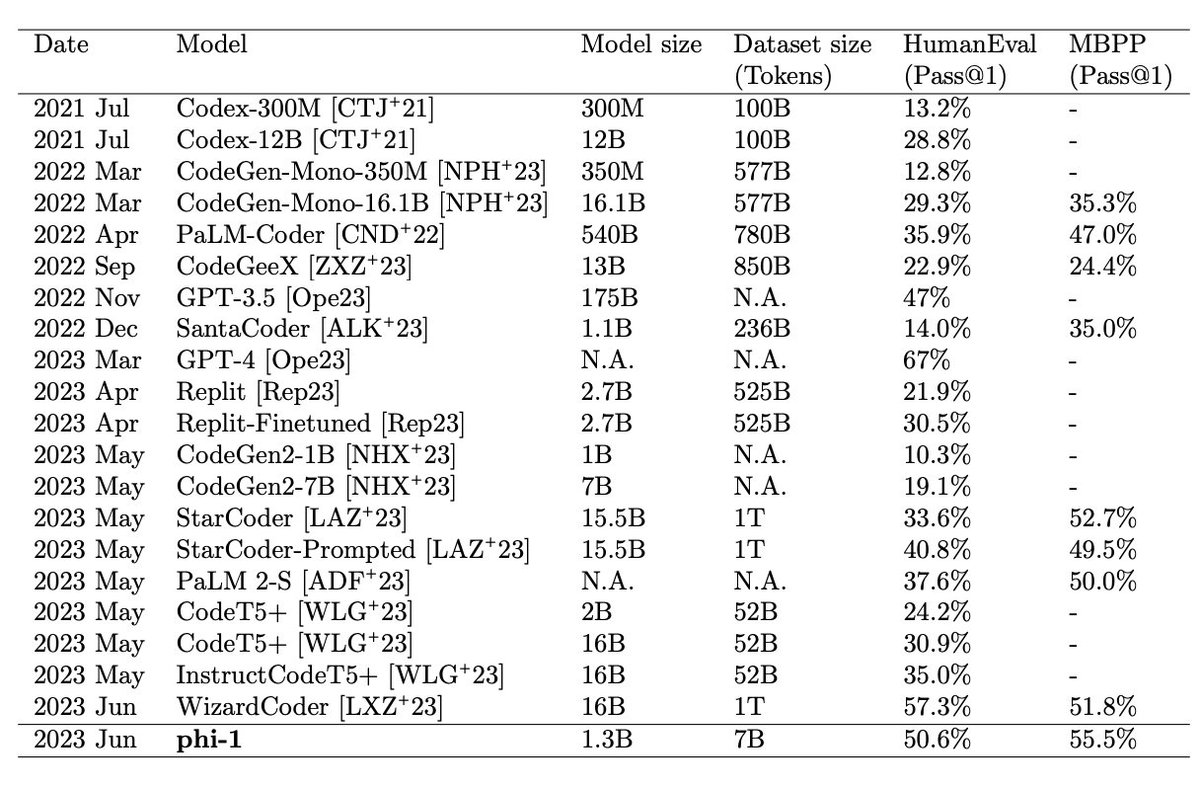
How the authors of “Textbooks are all you need” managed to beat most open source code models with only 1.3B parameters, and about 1k spent on compute, while training from scratch:
They have GPT 4 grade the answers of phi-1 on these questions, as well as other code models, and find that phi-1 is still beats/matches most other OS models: