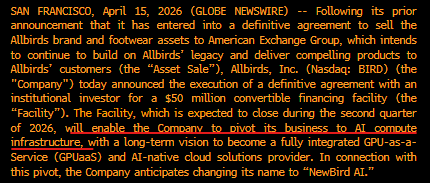
Wow, seems like Google is buying Spirit Airlines' enterprise data for $10m (outbidding Mercor at $7.5m).
Basically includes every internal document, email, workflow, and codebase for a once $6B company.
Honestly, $10m for 34 years of operational data really seems like a steal.
Management Team's 3 Choices: "The advantage of buying your own stock is you can do it in increments of a dollar - and you have perfect information. When you drill a well, you have operational execution risk. When you buy an asset, you take the risk of integrating it, not knowing what it is."
"As a management team, those are your 3 choices. And in my view, you should not be drilling wells or buying assets if you can buy your own stock cheaper."
"As an investor, if a management team are not buying their own stock when it's cheaper than drilling a well or purchasing an asset - you should have real questions around what they're doing."
•Ben Dell - Managing Partner, Kimmeridge
OK, so boredom is a signal that adaptation/normalization has occurred and you need to move on or improve your current environment and its conditions. But then, you pick up supercomputer, food, drugs and that drive is reduced for a couple of hours. And then again and again. Your baseline essentially remains stagnant because you're muting the desire to improve your material and psychological conditions because you don't let boredom do its thing!
Nice quote from Brookfield CEO Conor Teskey that really resonates: "One thing that perhaps junior investment professionals spend a lot of time focusing on is trying to get the model or the analysis perfect. There's almost a false degree of precision in today's world of Excel."
I love this message from Dave Cote from the JP Morgan Industrials Conference.
"Yes, I'd say the one thing I continue to underestimate about investors is their ability to panic. It's really something we're seeing at GPGI now. I just kind of shake my head. We went through the same thing at Vertiv. We still go through it periodically. Oh my God, it's a bubble. Oh my God, Amazon came up with something. Oh my God, there's a China thing. And it's like nobody thinks they just sell and the stock goes down and you look at it and say, okay, well, stupid, but their money, I guess, not much I can do about it. So that just surprises -- continues to surprise me about Vertiv is as well as it's doing right now, there'll be some blip in news at some point that will cause it panic and everybody starts to say, oh my God, it's a bubble, it's a bubble. I've been reading, it's a bubble, I've read it's a bubble. I 've heard it's a bubble, it could be a bubble. And before you know it, it's like the herd just scares itself."
This is a work in process (call it a journal entry), but this is where my head is at re private equity, private credit, and whether or not there will be an actual recognizable cycle...
If you are looking for a trading implication, it is early from my perch, it is selective, and it is not an asset class call. More on that here:
https://t.co/zOO2zq7bxa
Nobody Is Lying. That's the Problem:
The debate over private market marks gets framed as a question of accuracy. That is the wrong frame. The real question is who has the standing, the incentive, and the mechanism to force a reckoning, and when. The answer to all three is: nobody, not yet, and maybe never cleanly.
The reason is structural. The ecosystem includes the PE sponsor, private credit manager, BDC, auditor, and leverage provider, etc. Every one of them has asymmetric incentives that point toward deferral. The auditor signs off because GAAP allows fair value estimation using income approaches when comparables are deemed not directly applicable. The credit manager says the loan is current. The BDC says NAV is supported by discounted cash flow on performing assets. The bank continues to provide the leverage facility because the BDC hasn't breached its borrowing base. Everyone is technically correct. Nobody is lying. And the capital structure of the 2022 LBO is quietly underwater on an equity-value basis. The comp tables and stock charts say so. There is no mechanism to force that into the books.
Two Different Questions:
For private equity, the mark question is cosmetic in the short run. The LP gets a depressed quarterly NAV, doesn't love it, but the GP isn't selling so there is no realization event. The fund hasn't failed. The management fee runs on committed or invested capital, not NAV. The carry is impaired on paper but the GP is not writing a check back. The LP is locked up. Nobody forces the trade.
For the BDC, the mark question has real-time consequences. The BDC is a public vehicle with a disclosed NAV, a leverage facility tied to that NAV, and shareholders who can sell. When a BDC trades at a 20% discount to NAV, the market is saying it doesn't believe the NAV. But not believing it and proving it are very different things. The board's valuation committee, advised by an independent third-party valuer, has blessed the marks. The auditor has signed off. The leverage provider hasn't accelerated. The BDC sits in a strange purgatory: the equity market has already priced the impairment, but the book hasn't moved.
What Actually Breaks the Logjam:
There are only a few forcing functions, and they operate on different timelines.
The first is a payment default or PIK election on an underlying loan. The moment a borrower starts PIKing interest or misses a payment, the valuation committee has no choice but to move the mark, the auditor has no choice but to agree, and the leverage facility gets tested against a new borrowing base. This is the most direct trigger and the one everybody is working hardest to avoid, including the borrower, who is often getting help from the sponsor to stay current.
The second is a leverage facility redetermination. Banks do periodic borrowing base reviews. If they tighten advance rates against certain asset categories, and they have been doing this quietly, then the BDC suddenly has less liquidity and has to either sell assets or reduce the facility. Selling performing assets at par while marking nothing else creates a contradiction the valuation committee can no longer explain away.
The third is a portfolio company refinancing or sale process. Sponsors will sell the winners, the companies that performed and can clear at strong multiples, both to generate DPI and to demonstrate the fund is working. The weeds stay. Marked wrong, unlikely to be sold at a loss, and with no covenant or maturity pressure forcing the issue, they sit on the books indefinitely. The exits that do happen create comps on record for similar assets, but nobody is required to use them. The gap between realized prices on the good assets and carrying values on the bad ones widens quietly, and the bad ones never come to market to prove it.
The Covenant-Lite Problem Is Deeper Than It Looks:
The standard critique is that cov-lite loans removed the early warning system. True, but it understates the problem. Covenants were never primarily a restructuring tool. They were an information and renegotiation trigger that forced the borrower to the table before the hole got too deep. Without them, the creditor has no standing until cash stops flowing.
Cov-lite combined with no amortization combined with PIK optionality creates a structure where a company can be economically insolvent on an enterprise-value basis for years while remaining technically current on all its obligations. Interest coverage might be 1.2x, but it's positive. The equity cushion might be negative on a comp-adjusted basis, but nobody has marked it that way officially. The company is performing. In any prior credit cycle, covenants would have fired, a restructuring would have happened, and the capital structure would have been right-sized. In this cycle, you can paper over it indefinitely as long as the business doesn't shrink.
EA is a live illustration of this dynamic. Silver Lake and its consortium signed at a price the public comps have since moved well below. The debt will get syndicated, the business will perform, and if the broader software market recovers the credit looks fine in hindsight. Reflexivity works in both directions. What the EA situation actually illustrates is that there are three distinct outcomes in this environment: narrative compression that reverses, real fundamental deterioration that doesn't, and a third category where the rational move is to walk from the deal entirely. EA is in the first bucket. Not every deal is.
Where This Goes:
The most likely path is a slow-motion grind rather than a sharp dislocation.
PE sponsors will start selectively realizing their winners both to generate DPI for LPs demanding distributions and to demonstrate the fund is working. This is already happening (look at lower middle market). The weeds stay on the books.
BDC managers with dual roles in private credit and PE will face increasing shareholder pressure on the incentive structures. The conflict, where the BDC's slow liquidation damages the same portfolio the affiliated PE fund is managing, is becoming hard to ignore. Governance activists will push on it. They are commercial animals pursuing their own interests while performing concern for all holders.
Credit quality bifurcation will widen. Large-cap, well-covered, sponsor-backed loans will stay performing. The middle market, where coverage is thinner and the equity cushion was smaller to begin with, will see the first real defaults. When a payment miss forces a mark in one lower middle market company, the contagion risk is sector-specific and real. Similar companies, similar sponsors, similar structures. The question is whether anyone in that chain is also missing payments.
Then the macro does the rest. If rates stay elevated longer than the models assumed, if AI genuinely compresses multiples rather than temporarily suppressing them, if the revenue growth baked into 2020 to 2022 underwriting proves to have been a COVID pull-forward rather than a structural step-change, then the earnings power assumptions holding the marks in place become increasingly difficult to defend. Not that anyone will be asked to defend them.
The system has been engineered so that no single party has the standing or incentive to force the issue. What breaks it is the accumulation of realized exits, tightened borrowing bases, and middle market defaults that collectively make the existing marks indefensible. That process is already underway. It just doesn't have a name yet.
There are other mechanisms worth noting. Continuation funds, insider buying patterns at both the manager and BDC level, LP secondary market discounts, dividend recaps, and the insurance capital channel into private credit all deserve their own analysis. We chose not to go deep on any of them here. What matters for this argument is that every one of them is another way to mask the same problem, extend the timeline, or obscure the gap between book and market. None of them change the structure of what we are describing.
I don't usually say this, but... Bravo PJM!
PJM launches comprehensive dynamic line ratings to get more transfer capability out of current grid infrastructure (by accounting for impacts of ambient temp & wind on ability to manage heat from heavily-loaded transmission lines).