The Bookkeeper vs. CFO Gap
Your bookkeeper closes the books. Your CFO tells you why it matters. 📊 If the only financial insight you get each month is "here's your P&L," you don't have a finance function — you have data entry. Reconciled transactions are table stakes. Strategy is what actually moves the needle.
Growth doesn't stall because the numbers are bad. It stalls because nobody on the team is translating those numbers into decisions — what to cut, what to double down on, when to hire, when to hold. Most growing businesses have all the data they need sitting in QuickBooks. What they don't have is someone asking, "So what do we do about it?" 🤔
If that sounds familiar, it might be time to add that voice to your team — without the six-figure salary. We help growing businesses turn their financials into a roadmap, not just a rearview mirror. 👉 https://t.co/2kzEyw64H6
#FractionalCFO #SmallBusinessFinance #CashFlow #SMBGrowth #FinancialStrategy
The "Inspiration" Mindset: Radical Financial Transparency
The calmest, most dangerous founders I work with have one thing in common: they know their exact unit economics down to the penny.
They don’t guess their monthly burn rate. They don’t approximate their fulfillment costs. They treat their financial dashboard like a flight instrument panel. Because they have total clarity on their margins, they can make bold, aggressive moves with absolute confidence while their competitors are frozen in hesitation.
Financial literacy isn't just bookkeeping—it’s strategic armor....www.marksandsmart.com
Your Legacy Starts Today
What are you actually building with your time and effort? Is it a business that serves your life, or have you just created a job that you grow to hate? My time working with SMBs has taught me that the true goal is not just to make money, but to create lasting freedom. If you aren't building a system that can eventually run without your constant intervention, you don't actually have a business—you have a trap.
Building an exit strategy is not just about selling; it is about creating a machine that is valuable enough to exist on its own. When you build for exit, you force yourself to optimize every process, every dollar, and every team member. This is how you transition from an operator to an owner, and how you eventually secure the freedom you started this journey to achieve.
Let's stop building for the next week and start building for the next decade. I can help you structure your operations, finances, and systems so that you are creating a genuine legacy, not just another task to manage. Your exit strategy starts with the decisions you make today. https://t.co/2kzEyw6CwE
#ExitStrategy #BuildingLegacy #SMBSuccess #FractionalCFO
The "Free" Trap
Stop giving away your expertise for "exposure." I see SMB owners do this daily, and it’s the fastest way to kill a brand. When I consult with my clients, the first thing I teach them is how to price for value, not just for the clock.
Your time is finite; your impact is not. Stop being a commodity and start being a necessity. When you confidently charge for the transformation you provide, you stop being an expense and start becoming a partner.
Need help restructuring your pricing to reflect your true worth? I have a framework for that.
#ValueBasedPricing #EntrepreneurMindset #BusinessStrategy #GrowthHacking 🛡️🔥
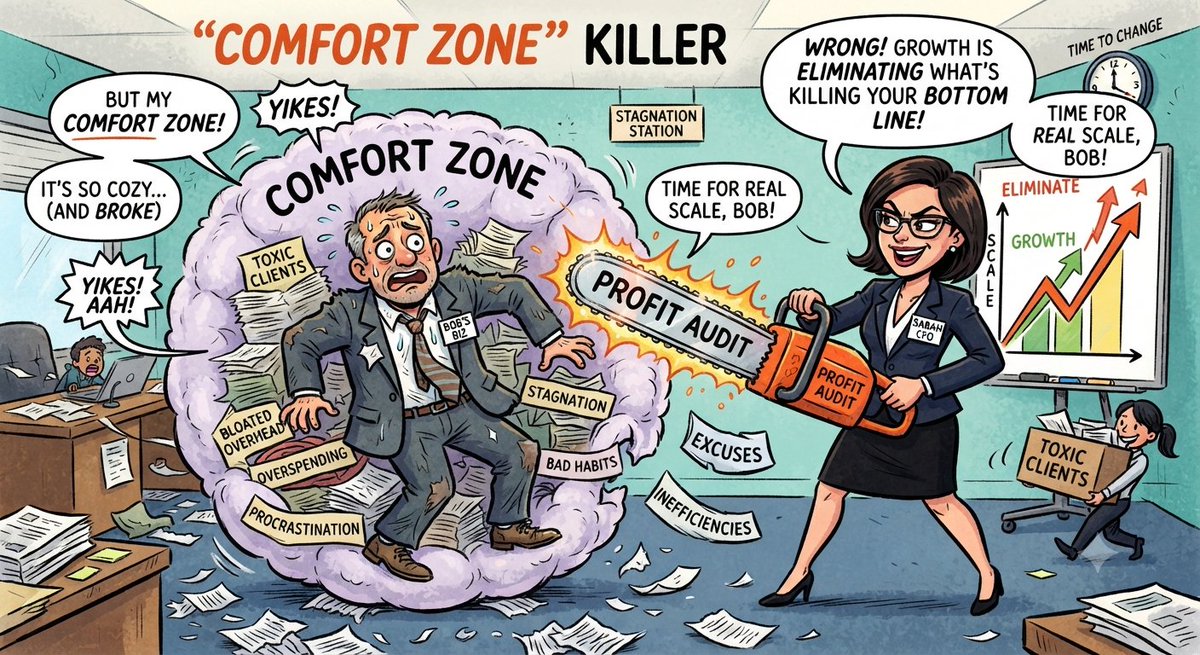
The "Comfort Zone" Killer
Most business owners think "growth" is just doing more of the same. Wrong. Growth is about the ruthless elimination of what isn't serving your bottom line. In my time working with SMBs, I’ve realized that the most profitable accounting move isn't finding more revenue—it’s cutting the toxic clients and bloated overhead that keep you shackled to a stagnant model.
If your numbers don't make you slightly uncomfortable, you’re playing it too safe to achieve real scale. This discomfort is actually a sign of clarity, forcing you to confront the inefficiencies you’ve been ignoring. Stop managing your decline and start engineering your scale.
If you’re ready to identify your biggest profit leaks and start engineering actual scale, let’s audit your financials together. https://t.co/2kzEyw6CwE
#FractionalCFO #BusinessGrowth #SmallBizRealities #FinanceStrategy 🚀📉
⚠️ The SMB Trap
Most business owners think scaling means landing more clients.
Reality check: Scaling too fast without solid systems just multiplies mistakes—and mistakes cost time, money, and reputation.
💡 The secret to safe growth? Systems, processes, and checks that actually work under pressure.
💥 CTA: “Type SYSTEMS if you want my 5-point checklist to scale safely this quarter.”
https://t.co/2kzEyw64H6
@Sapientbiz Revenue ≠ survival. If you’re posting record sales but juggling accounts to pay payroll, you’re playing CEO cosplay. Cash is oxygen. #SmallBizTruth#CashFlowMatters
⚠️ Your Cash Flow Hates You
Revenue doesn’t matter. Profit doesn’t matter.
If your cash inflows don’t align with your outflows, you’re not running a business—you’re playing accounting roulette. One missed payment, one delayed invoice, and your growth can grind to a halt.
💡 The truth: Most companies fail not because they aren’t profitable, but because they don’t manage cash strategically.
💥 DM me “CASH” for a no-BS cash flow sanity check—let’s see if your business is truly ready to scale without the nasty surprises.
🔥 If You’re Bragging About “Putting Out Fires” in Accounting… You’re Probably the Arsonist.
If you’re bragging about “putting out fires” in your accounting department, we need to have an uncomfortable conversation. I constantly see leaders celebrating how they walked into chaos, closed the books in record time, or cleaned up a massive revenue mess. It makes for a great war story. But here’s the real question: why was there a fire in the first place — and why does your department always seem to have one?
Chronic chaos in accounting is not a badge of honor. It’s a red flag. Fires are usually the byproduct of undocumented processes, weak internal controls, unclear ownership, broken system architecture, unmanaged growth, or leadership that confuses urgency with effectiveness.
If your team is living in emergency mode every month-end, that’s not high performance — that’s operational negligence disguised as heroism.
When I stepped into broken environments, I didn’t celebrate stabilizing the mess. I focused on eliminating the conditions that allowed it. I mapped every critical workflow end-to-end — order-to-cash, procure-to-pay, record-to-report — and removed tribal knowledge dependencies II embedded preventative controls directly into processes instead of relying on detective clean-up after the damage was done. Approval thresholds, segregation of duties, system validations, standardized revenue recognition under ASC 606 — not as theory, but operationally enforced inside the ERP.
I automated manual reconciliations wherever possible and imposed close discipline that removed surprises. Daily flash reporting. Pre-close checklists. Defined cutoffs. No Day 12 “oh by the way” journal entries. I aligned finance with sales, operations, and billing because accounting fires are rarely accounting problems — they’re structural breakdowns upstream. And I made EBITDA real.
If you’re constantly “adjusting” for the same recurring issue, it’s not a one-time add-back. It’s a system failure.
Here’s the truth most people won’t say out loud: if you are always saving the day, you’ve built a function that requires saving. Elite finance leadership isn’t about being the hero in chaos. It’s about designing an environment where chaos struggles to exist in the first place.
hashtag#FinanceLeadership hashtag#Controllership hashtag#OperationalExcellence hashtag#PEBacked hashtag#InternalControls hashtag#ASC606 hashtag#CFOmindset
Stop “Revenue Chasing” 🚫💸
Most SMBs chase revenue like a dog chasing a car… and here’s the truth: that car isn’t moving you forward—it’s just burning your energy.
If you don’t know your profit per client, you’re not running a business—you’re running a charity disguised as one. Every hour spent on clients who barely break even is time, energy, and money lost.
Imagine actually knowing which clients make you money and which ones cost you more than they bring in. That clarity lets you:
✅ Focus on high-profit clients
✅ Raise prices confidently
✅ Grow without burning out
💥 CTA: Comment PROFIT and I’ll DM you a 3-step plan to stop working for free clients and start building a business that actually pays you.
#SmallBusiness #ProfitFirst #Entrepreneurship #BusinessGrowth #SMBsuccess #WorkSmarterNotHarder #RevenueStrategy #ClientProfitability #businesstips
If this post makes you slightly uncomfortable… good.
Growth doesn’t come from motivation. It comes from measurement.👉 Drop “CLARITY” in the comments if you’re ready to stop guessing and start operating.
Or keep winging it.
Your competitors hope you choose option two. 😎. We are here to align with you, improve your financial transparency and work with you in. growing. your businesses.
#SMB #SmallBusinessOwner #EntrepreneurMindset #CashFlow #BusinessGrowth #FinancialClarity #ScaleSmart #CEOThinking #ProfitFirst
Your Books Are 6 Months Behind — Here’s How I Fixed Them in 30 Days.
Most small business owners don’t fall behind because they’re careless. They fall behind because they’re growing. More revenue, more transactions, more complexity — and suddenly the books are six months behind.
Here’s what we did: reconciled every bank and credit card account, tied revenue to payment processors, rebuilt payroll entries, cleaned up the balance sheet, and installed a simple monthly close system. No shortcuts. No guessing.
In 30 days, the business had accurate financials, clear cash visibility, and real numbers to make decisions with. Messy books don’t just create accounting problems — they create hesitation, and hesitation slows growth.
If your books are behind and you want a clean reset, message me “CLEAN” and I’ll share the framework.
#SmallBusiness #Bookkeeping #SMBFinance #OutsourcedAccounting #FinancialClarity #AccountingTips #CleanBooks #CashFlow
Our Month-End Took 15 Days — Here’s How I Cut It to 5 Without Overtime.”
Our month-end close used to take 15 days — a grind of manual reconciliations, spreadsheets, and chasing data across systems. We cut it down to 5 days — without overtime — by taking a structured approach to automation:
1️⃣ AI-driven reconciliations automatically matched transactions across multiple systems, flagging only exceptions.
2️⃣ Predictive variance analysis highlighted anomalies before reports were finalized, reducing last-minute surprises.
3️⃣ Real-time dashboards gave leadership visibility into the close progress, replacing endless status emails.
We didn’t just pick tools at random. Each solution was selected after mapping the bottlenecks, running small pilots, and prioritizing automation that directly reduced manual work, improved accuracy, and empowered the team.
The result? A faster, more reliable close, happier finance teams, and leadership confident in the numbers — all without burning out the team. Efficiency isn’t just speed; it’s smarter work.
hashtag#MonthEndClose hashtag#FinanceLeadership hashtag#Automation hashtag#VPController hashtag#AI
The "Your Accountant Is Costing You Money" Post
Hot take: Most SMB accountants are historians, not advisors.
They tell you what happened last quarter. They file your taxes.
They keep you compliant.
Cool. Useful. Not enough.
The move? Start asking your accountant THESE questions every 90 days:
— What's my break-even by service line?
— Where am I leaving deductions on the table?
— What does my cash flow look like 6 months out?
If they can't answer those in 10 minutes, you have a bookkeeper, not a CFO-in-your. Isn't time you the first step and align yourself with a value added provider.
https://t.co/2kzEyw6CwE
🔥 Does your professional life define your identity?
When someone asks, “What do you do?” most of us answer with a title. Not who we are. Not what we believe. Not what we value. Just a role. Somewhere along the way, our careers quietly became our identity. The CPA. The founder. The executive. The operator. The high performer. But here’s the uncomfortable question: if the title disappeared tomorrow, who would you be?
Your career is what you do — it is not who you are. Yes, ambition matters. Impact matters. Excellence matters. But your identity has to be bigger than your LinkedIn headline. Companies pivot. Industries change. Roles evolve. Layoffs happen. Promotions happen. Businesses get acquired. If your sense of worth is anchored only to your profession, every external shift feels personal.
The only assets that truly compound are character, integrity, resilience, discipline, and relationships. Those travel with you regardless of title, salary, or status. Build a career you’re proud of. Chase mastery. Create impact. But don’t outsource your identity to your job description.
So I’ll ask you directly — does your professional life define you, or is it simply one chapter of a much bigger story? 👇
#Leadership #CareerGrowth #Mindset #ProfessionalDevelopment #EntrepreneurLife #SelfLeadership #PersonalGrowth 🚀
You Didn’t Start a Business to Become an Accidental Accountant 📊🔥
You started your business because you were good at something — serving clients, building products, creating value.
You did not start it to spend nights Googling “how do I categorize this expense?” 😩
If bookkeeping feels overwhelming, it doesn’t mean you’re bad at business.
It usually means your business has grown past DIY systems.
💡 Pro tip: When your finances cause stress instead of clarity, it’s often cheaper to outsource than to keep “figuring it out.”
#SmallBusinessLife #EntrepreneurStress #BookkeepingHelp #BusinessGrowth #OutsourceSmart #FinancialClarity