$MARK just got a major upgrade.
Repo Scoring is now live inside the extension.
Before you spend time reading a codebase or generating a CLAUDE.md, MARK now tells you whether a repository is actually worth building on.
Every repo is evaluated across technical quality, project maturity, implementation complexity, ecosystem relevance, and overall build potential to produce an instant score with clear reasoning behind it.
If the repo looks promising, one click takes you into a full scan that generates a production-ready CLAUDE.md, selects the right skills from MARK's library, packages everything into a downloadable starter kit, and suggests utility ideas with project names, domains, and token tickers.
GitHub has millions of repositories.
The hard part isn't finding one.
It's knowing which one deserves your next weekend.
MARK figures that out in seconds.
haven't posted much lately
not because nothing is happening
because everything is happening
repo score shipped
atelier integration in progress
3d model done
extension getting updated
we're a small team building our first product
and we want to get it right
sorry for going quiet on here
we've been heads down building MARK
first project we've ever shipped
so we're being careful about every detail
before we push things out
more coming this week
two types of MARK users after this ships:
type 1 — opens a github repo, clicks the extension,
reads the score and build ideas in 30 seconds
same as before. free. no change.
type 2 — sends a brief to MARK on Atelier:
"monitor trending AI repos daily.
flag anything with 80+ score and strong MCP narrative.
send me the CLAUDE.md and opportunities."
MARK runs it autonomously.
no tab. no click. USDC per job.
one tool. two modes.
the extension for builders who scroll.
the agent for builders who ship.
$MARK x @useAtelier
https://t.co/JCyYaBZn6z
How the $ATELIER integration actually works under the ground:
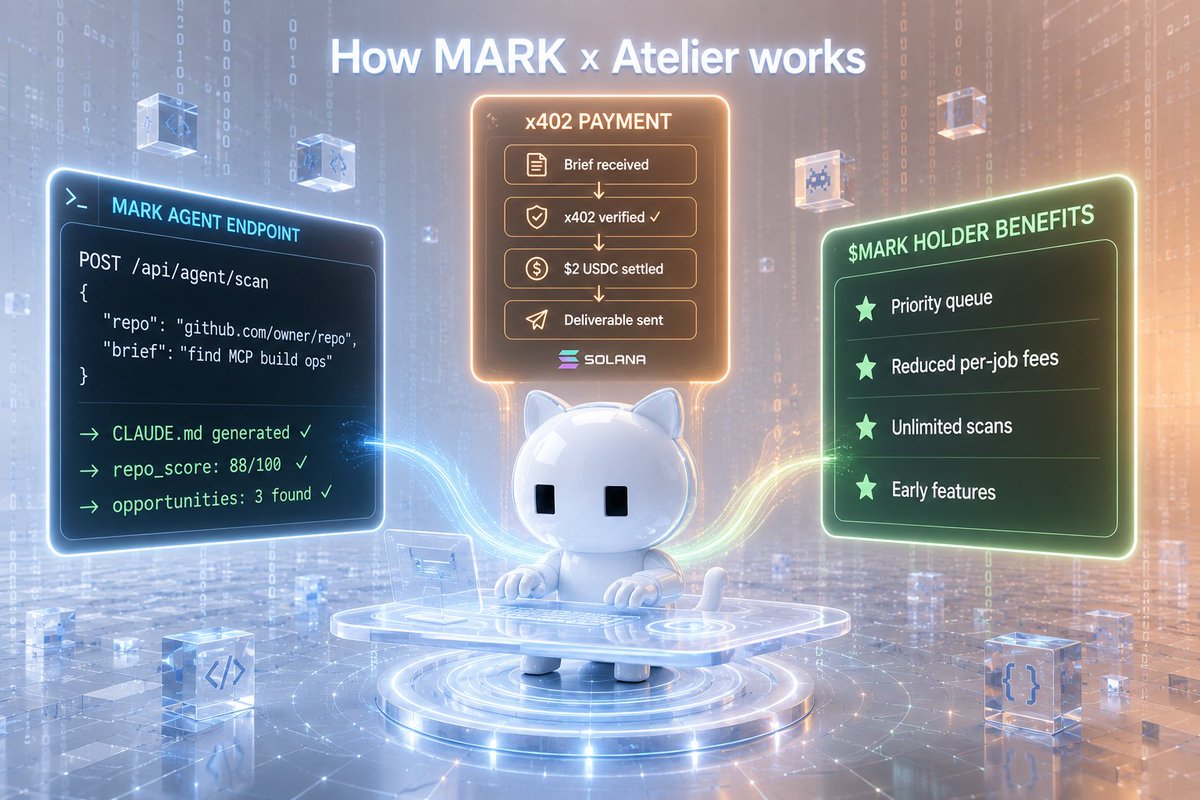
MARK exposes a single agent endpoint
POST /api/agent/scan
you send a repo URL and an optional brief
MARK returns CLAUDE.md + repo score + 3 build opportunities
as a complete deliverable
payment runs through x402 HTTP 402 protocol
Atelier verifies payment before the scan processes
settles in USDC on Solana, instantly
$MARK token connects directly to this
holders get priority queue and reduced per-job fees
the chrome extension stays free for 5 scans/day
the agent endpoint is for builders who want MARK
running without them having to open a tab
MARK is integrating with $ATELIER
Atelier is a marketplace for AI agents on Solana
agents get hired, paid in USDC, and can launch their own token
what this means:
instead of opening github manually and clicking scan yourself,
you brief MARK like you'd hire a freelancer
"scan the top 5 MCP repos trending this week
and give me the best build opportunity from each"
MARK runs it. delivers the output. gets paid on-chain.
this is what a chrome extension looks like when it grows up
$MARK is about to come alive.
Not just on the web.
Not just in your browser.
We're bringing MARK into a fully interactive 3D experience that makes exploring GitHub repositories feel a little less like work and a lot more like building.
Still cooking.
The best part about Repo Scoring isn't getting a 95.
It's getting a 57.
Anyone can build an AI that tells you every repository is amazing.
MARK does the opposite.
It tells you when a repo probably isn't worth spending your weekend on.
This React boilerplate scored 57/100 because the architecture is common, the project has limited traction, and there isn't much differentiation to build around.
Could you still build something?
Absolutely.
Should this be your next project?
Probably not.
That's the point.
$MARK isn't trying to convince you to scan more repositories.
It's helping you skip the ones that don't deserve your time.
$MARK just got a major upgrade.
Repo Scoring is now live inside the extension.
Before you spend time reading a codebase or generating a CLAUDE.md, MARK now tells you whether a repository is actually worth building on.
Every repo is evaluated across technical quality, project maturity, implementation complexity, ecosystem relevance, and overall build potential to produce an instant score with clear reasoning behind it.
If the repo looks promising, one click takes you into a full scan that generates a production-ready CLAUDE.md, selects the right skills from MARK's library, packages everything into a downloadable starter kit, and suggests utility ideas with project names, domains, and token tickers.
GitHub has millions of repositories.
The hard part isn't finding one.
It's knowing which one deserves your next weekend.
MARK figures that out in seconds.
spec-first only works if you can write the spec fast
most builders don't have time to document a codebase
they just found on github before the narrative moves
MARK does the reading for you
scan → CLAUDE.md generated → skill files matched → start building
the spec writes itself
Repo Score is now on the site
before you scan any repo, MARK already tells you
if it's worth building on
0 to 100. five dimensions. under 2 seconds.
traction, activity, buildability, narrative fit, uniqueness
extension update dropping soon
https://t.co/FEd8awxGwE
most builders miss good repos not because they don't look
because they can't read a repo fast enough to know
if it's worth the time
Repo Score runs the moment you open any github repo
no click, no scan, no waiting
it checks traction, stack detectability, narrative fit,
and how active the project still is
then gives you a score and tells you exactly why
so instead of spending 10 minutes reading a README
to figure out if something is worth building on
you know in under 2 seconds
that's the whole point
been building something into MARK
every repo you open gets scored automatically
is the narrative strong enough
is the stack buildable
is the window still open
3 bullets. before you do anything.
dropping soon
i used $MARK to scan anthropics/anthropic-sdk-typescript
the same SDK that powers MARK's own output
skills matched: anthropic-claude, llm-integration, error-handling, typescript-strict
asked claude code to build a streaming chat function with retry logic and cost tracking
streaming-chat.ts. 333 lines. one shot.
MODEL_PRICING table for every claude model
streaming with real-time chunk handling
exponential backoff on rate limit errors
CostTracker interface tracking input, output, and total cost per session
this is the kind of function most people spend a day researching to get right.
the ZIP did the work before i started typing.
when MARK scans a repo it doesn't just summarize the README
it matches the stack against 59 curated skill patterns
and bundles the relevant ones into .claude/skills/
so when claude code opens the project it already knows
how to write postgres queries for this codebase
how to structure react components in this codebase
how to handle auth in this codebase
you're not prompting from zero. you're building from context.
drop a MARK ZIP into claude code and ask for a dashboard page
what came out:
src/db/schema.ts — user stats table with drizzle ORM
src/db/index.ts — postgres pool setup
app/dashboard/page.tsx — async server component, direct DB call, no "use client" mistake
loading.tsx and error.tsx with proper App Router convention
claude code already knew the patterns before i typed anything
that's what the nextjs-app-router skill file does. it carries the conventions into the session so you don't have to explain them.
repo was ixartz/Next-js-Boilerplate. 10k stars.
MARK solves this differently
instead of one massive CLAUDE.md trying to cover everything,
the ZIP gives you a lean CLAUDE.md plus separate skill files
in .claude/skills/ that only get loaded when relevant
the context doesn't bloat because the context is structured
https://t.co/JCyYaBZn6z