After working for 40 years, the average Social Security recipient gets $1850/month.
After being in America for 40 minutes, the average illegal “refugee” gets $3874/month.
And red or blue, that should PISS EVERYONE OFF.
The reason ID is banned in California (and New York) elections is to enable large-scale fraud.
When you combine no ID and mail-in voting, fraud is de facto legalized.
When I truly understood this next fact, it broke my brain:
The largest heist in world history is happening right under your nose.
The theft? All your productivity gains.
Think about it:
1. You're 10x more productive than your grandfather
2. Technology should have made you 10x wealthier
3. Instead, you're working harder for less
Where did the wealth go?
Every breakthrough that should have enriched YOU:
Electrification → Stolen
Automobiles → Stolen
Computers → Stolen
Internet → Stolen
The method: Currency debasement.
They print money. Your purchasing power disappears.
Your productivity gains flow to them.
This isn't economics.
This is organized theft.
Bitcoin fixes this
AI will increase jobs.
It's not like there is a finite amount of work to do, and AI will do most of it. That's the wrong metaphor.
The right metaphor is AI will make everybody 5x more productive. That means instead of doing x things in a month, you do 5x.
You hire more.
Major study finds voters have statistically zero influence on Congress.
In case you’re curious why the 80% issues don’t pass, from crime to open borders to secure elections.
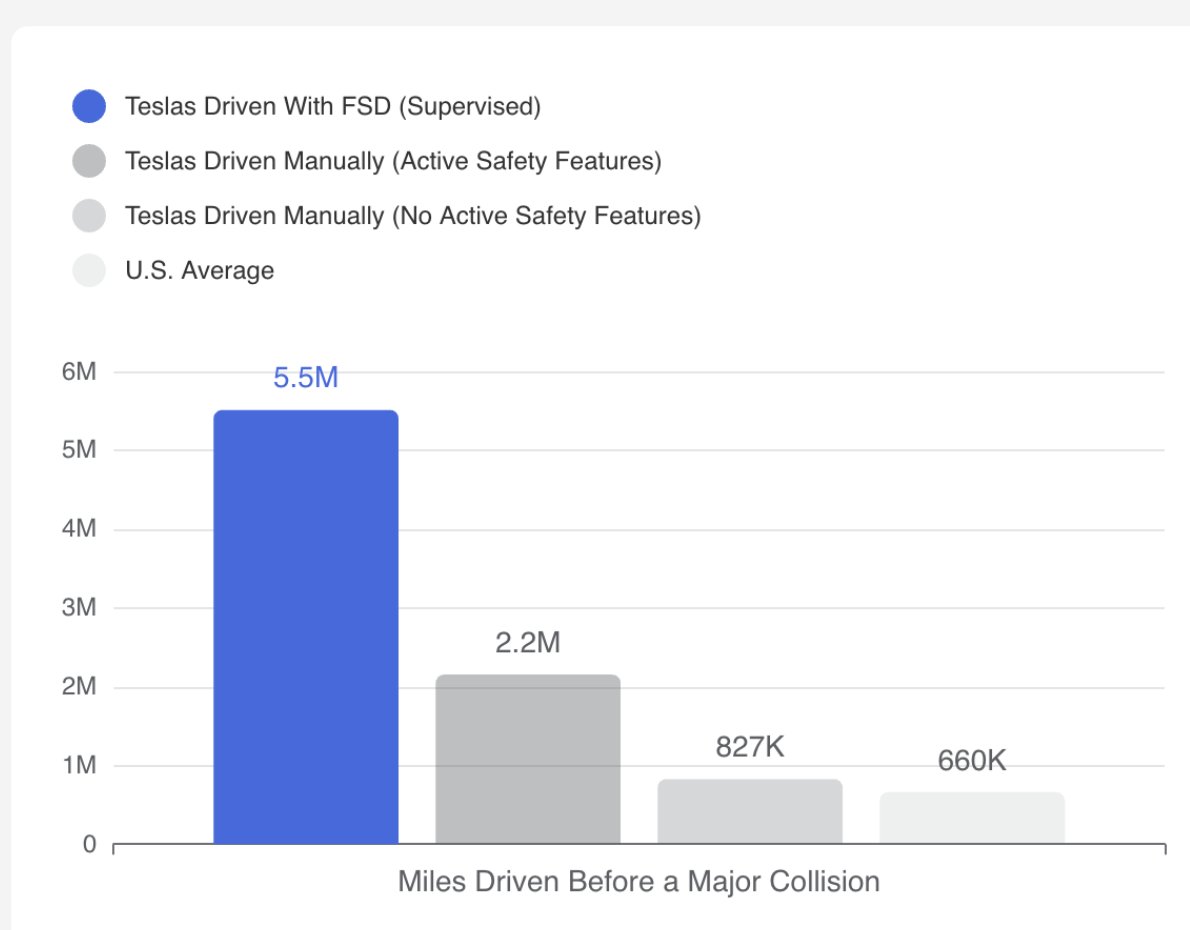
People completely miss the most important thing about Tesla FSD
It’s not just about convenience. It’s not a "cool self-parking trick."
It’s about the fact that car crashes are the #1 killer of healthy people aged 5-29 globally and one company has gathered over 10 billion miles of real-world data to actually solve it
Look at the recent data: Tesla just became the FIRST vehicle to pass NHTSA's new ADAS safety tests. Not the first EV. The first vehicle. Period.
The reality is harsh but simple. Countries that approve FSD get safer roads overnight. Countries that delay will literally watch their citizens die in preventable crashes while bureaucrats sit in meeting rooms debating "safety."
The "safety" argument against FSD is officially dead
“To be successful, you don't have to be special. You just have to be what most people aren't - consistent, determined and willing to work for it. No shortcuts."
— Tom Brady
“Consumers don't produce inflation. Producers don't produce inflation. Inflation is produced only by too much government spending and too much government creation of money, and nothing else.”
— Milton Friedman
"You're neither right nor wrong because other people agree with you. You're right because your facts are right and your reasoning is right."
— Warren Buffett
Eliminating processed foods and artificial additives from children's diets can lead to substantial reductions in ADHD symptoms for a significant portion of affected kids—often up to 78% in key studies—offering a promising, non-medication approach for many families.
Groundbreaking research, including the landmark INCA study (Impact of Nutrition on Children with ADHD) published in The Lancet, has demonstrated a clear link between diet and behavioral symptoms in children with attention-deficit hyperactivity disorder (ADHD). This randomized controlled trial involved young children (aged 4–8 years) diagnosed with ADHD and tested a restricted elimination diet—a highly structured regimen that removes most processed foods, artificial colors, preservatives, additives, and common potential triggers while focusing on a limited set of hypoallergenic whole foods (such as rice, specific meats, certain vegetables, pears, and water).
In the open-label phase, 41 children followed the elimination diet for 5 weeks, while a control group received general healthy eating instructions. Results showed that 32 out of 41 children (approximately 78%) in the diet group achieved a clinically meaningful response, defined as at least a 40% reduction in ADHD symptoms based on validated rating scales (like the ADHD Rating Scale, assessed by masked raters including parents, teachers, and clinicians). This translated to notable improvements in core symptoms such as inattention, hyperactivity, and impulsivity, as well as often co-occurring oppositional defiant disorder behaviors.
A subsequent double-blind crossover challenge phase with responders further strengthened the evidence: when excluded foods were reintroduced, symptoms relapsed in over 60% (around 63%) of cases, confirming a direct causal connection for many participants rather than placebo effects or spontaneous changes. The study's authors concluded that a strictly supervised restricted elimination diet serves as a valuable tool to determine whether food sensitivities contribute to ADHD in individual children.
The proposed mechanism involves artificial additives (e.g., synthetic food dyes like Red 40 or Yellow 5, preservatives, and other chemicals in ultra-processed foods) potentially disrupting neurotransmitter function, gut microbiome balance, or the gut-brain axis—pathways increasingly linked to neurodevelopmental conditions like ADHD.
While not every child responds (response rates hover around 60–64% across the full sample in the INCA trial, with the 78% figure applying specifically to completers in the diet arm who showed strong improvement), the effect sizes in responders are often large—comparable to or exceeding those seen with stimulant medications in some analyses—and come without pharmaceutical side effects.
This approach is not positioned as a universal cure or replacement for all treatments. Experts stress that elimination diets must be implemented under professional supervision (ideally with a pediatrician, dietitian, or ADHD specialist) to avoid nutritional deficiencies, ensure balanced intake, and properly identify trigger foods during reintroduction. Combining dietary changes with other evidence-based strategies—such as reducing excessive screen time, promoting regular physical activity, and ensuring adequate sleep—can amplify benefits for focus, emotional regulation, and overall well-being.
For parents exploring natural or complementary options to support their child's attention and behavior, starting with a careful reduction in processed and additive-laden foods (while prioritizing whole, nutrient-rich alternatives) could represent a meaningful first step—potentially unlocking noticeable breakthroughs without relying solely on medication.
[Pelsser, L. M., et al. "Effects of a restricted elimination diet on the behaviour of children with attention-deficit hyperactivity disorder (INCA study): a randomised controlled trial." The Lancet, vol. 377, no. 9764, 2011, pp. 494–503. DOI: 10.1016/S0140-6736(10)62227-1]







![Rainmaker1973's tweet photo. Eliminating processed foods and artificial additives from children's diets can lead to substantial reductions in ADHD symptoms for a significant portion of affected kids—often up to 78% in key studies—offering a promising, non-medication approach for many families.
Groundbreaking research, including the landmark INCA study (Impact of Nutrition on Children with ADHD) published in The Lancet, has demonstrated a clear link between diet and behavioral symptoms in children with attention-deficit hyperactivity disorder (ADHD). This randomized controlled trial involved young children (aged 4–8 years) diagnosed with ADHD and tested a restricted elimination diet—a highly structured regimen that removes most processed foods, artificial colors, preservatives, additives, and common potential triggers while focusing on a limited set of hypoallergenic whole foods (such as rice, specific meats, certain vegetables, pears, and water).
In the open-label phase, 41 children followed the elimination diet for 5 weeks, while a control group received general healthy eating instructions. Results showed that 32 out of 41 children (approximately 78%) in the diet group achieved a clinically meaningful response, defined as at least a 40% reduction in ADHD symptoms based on validated rating scales (like the ADHD Rating Scale, assessed by masked raters including parents, teachers, and clinicians). This translated to notable improvements in core symptoms such as inattention, hyperactivity, and impulsivity, as well as often co-occurring oppositional defiant disorder behaviors.
A subsequent double-blind crossover challenge phase with responders further strengthened the evidence: when excluded foods were reintroduced, symptoms relapsed in over 60% (around 63%) of cases, confirming a direct causal connection for many participants rather than placebo effects or spontaneous changes. The study's authors concluded that a strictly supervised restricted elimination diet serves as a valuable tool to determine whether food sensitivities contribute to ADHD in individual children.
The proposed mechanism involves artificial additives (e.g., synthetic food dyes like Red 40 or Yellow 5, preservatives, and other chemicals in ultra-processed foods) potentially disrupting neurotransmitter function, gut microbiome balance, or the gut-brain axis—pathways increasingly linked to neurodevelopmental conditions like ADHD.
While not every child responds (response rates hover around 60–64% across the full sample in the INCA trial, with the 78% figure applying specifically to completers in the diet arm who showed strong improvement), the effect sizes in responders are often large—comparable to or exceeding those seen with stimulant medications in some analyses—and come without pharmaceutical side effects.
This approach is not positioned as a universal cure or replacement for all treatments. Experts stress that elimination diets must be implemented under professional supervision (ideally with a pediatrician, dietitian, or ADHD specialist) to avoid nutritional deficiencies, ensure balanced intake, and properly identify trigger foods during reintroduction. Combining dietary changes with other evidence-based strategies—such as reducing excessive screen time, promoting regular physical activity, and ensuring adequate sleep—can amplify benefits for focus, emotional regulation, and overall well-being.
For parents exploring natural or complementary options to support their child's attention and behavior, starting with a careful reduction in processed and additive-laden foods (while prioritizing whole, nutrient-rich alternatives) could represent a meaningful first step—potentially unlocking noticeable breakthroughs without relying solely on medication.
[Pelsser, L. M., et al. "Effects of a restricted elimination diet on the behaviour of children with attention-deficit hyperactivity disorder (INCA study): a randomised controlled trial." The Lancet, vol. 377, no. 9764, 2011, pp. 494–503. DOI: 10.1016/S0140-6736(10)62227-1]](https://pbs.twimg.com/media/HHfILYMW8AAkHJL.jpg)


