The greatest wealth is created by being an early investor in #Innovation
Making that investment requires believing in something before the majority of people understand it
You will be mocked, ridiculed & criticized for your non-consensus action
It is absolutely worth it!
A monster wave of IPOs is coming.
Our work covering 40+ years of history and roughly 12,000 IPOs suggests these waves tend to be a headwind for forward returns and multiples, but even mega-IPOs coincide with market peaks only about 20% of the time.
A warning flag, perhaps, but not necessarily a sell signal.
#BCAResearch #PortfolioStrategy #IPOs
Curious that $TSLA is essentially same price today as it was in November 2021
Well, actually not curious given lack of revenue growth and declining earnings
What is curious is that stock still has a ridiculous growth company multiple at 363x P/E…
No Roadster
No $30k EV
No Semi
No Robotaxis
No Hyperloop
No robots in Tesla factory
No AGI
No Mars Trip
No Mars Colony
No $2T in DOGE savings
But, yeah, 1MM data centers in space any minute now…
Okay this is genuinely insane.
SpaceX just unveiled a satellite whose only job is to run AI. Not internet. Not GPS. Just compute, floating in orbit.
It's called AI1, and the reason behind it breaks your brain.
AI data centers on Earth are hitting a wall, not a chip wall, a physics wall.
They need staggering amounts of power and water just to stay cool, and we're running out of grid and land to build them.
So Musk's answer is: stop building them on Earth.
In orbit, the sun never sets. Free power, 24/7. No water for cooling, you just radiate heat into the vacuum of space. The two things choking AI on the ground barely exist up there.
And here's the wild part: Musk says it's easier to build than a Starlink satellite. Strip out the complex antennas and it's "a lot of solar cells, a radiator, and some laser links."
One AI1 carries the compute of an Nvidia GB300 rack, the same hardware data centers fight over down here.
AI1 is just the first one. The plan is a constellation of up to a million of them.
And the timing isn't an accident, SpaceX goes public this week at a ~$1.75 trillion target. This isn't a rocket company anymore. It's positioning itself as the power grid for AI, in space.
The race for AI compute just left the planet. Literally.
@SpaceX
A study checked how often cheap stocks (low price-to-cash flow) beat expensive stocks (high price-to-cash flow) from 1968 to 1990
What they found:
1. 1-Year Periods: Cheap stocks did better in 17 out of 22 years
2. 3-Year Periods: Cheap stocks beat expensive ones in 18 out of 20 periods.
3. 5-Year Periods: Cheap stocks did better every single time.
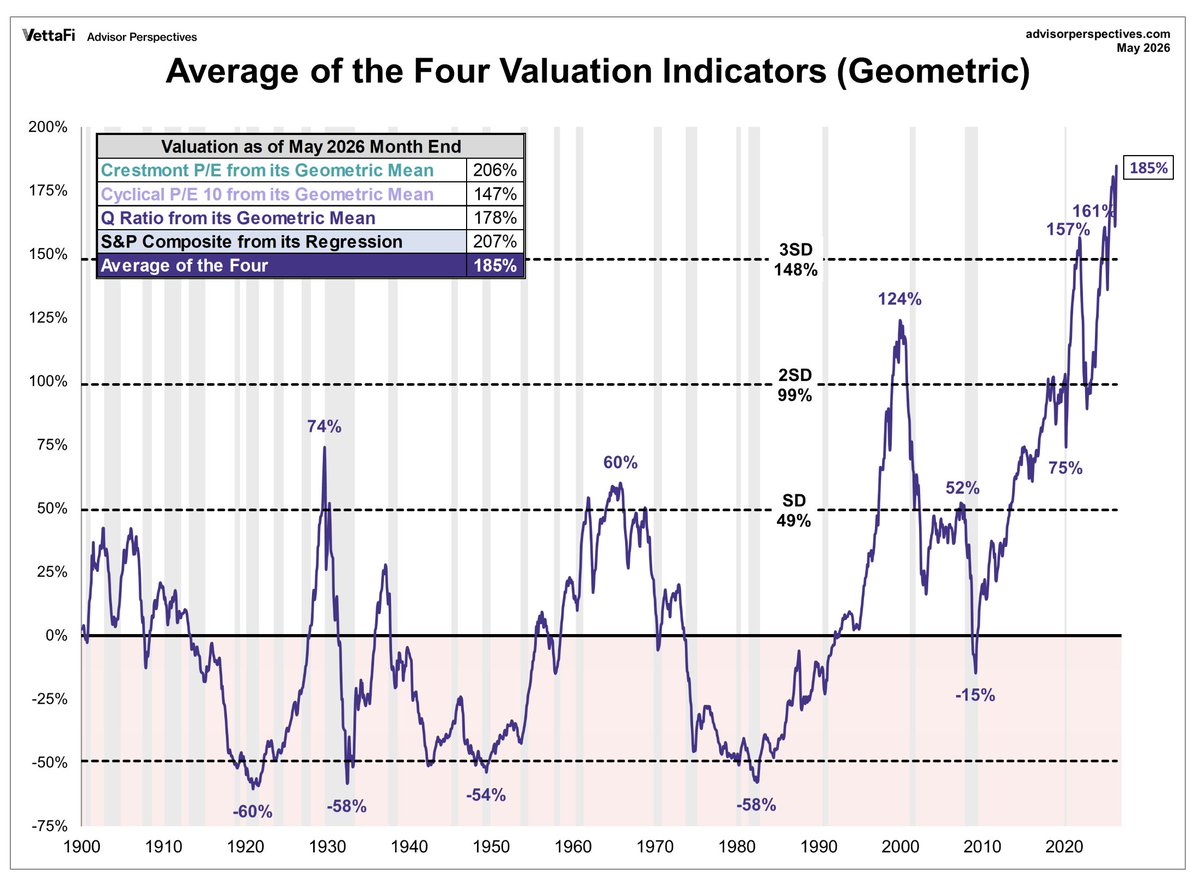
The current reading of 185% above historical fair value is the highest in the entire data series going back to 1900.
The purple line is the average of four long-term valuation measures, each expressed as a percentage above or below its historical geometric mean:
* Crestmont P/E
* Cyclically Adjusted P/E (CAPE/Shiller P/E)
* Tobin's Q Ratio
* S&P Composite Regression Model
Historically, when broad U.S. indexes reached extreme valuations, future leadership often came from:
* Small caps
* Value stocks
* International markets
* Commodity-related businesses
* Asset-heavy cyclical sectors
This is one reason many value investors today focus on areas trading at single-digit EBIT multiples while the major indexes trade at historically rich valuations.
Some of the best periods for value strategies occurred when the broad market was near valuation extremes and the valuation spread between glamour and neglected businesses was unusually wide.
🔴FRIDAY WAS A CLEAR WARNING TO THE MARKET SPECULATORS:
The trading volume of just four 3x leveraged ETFs spiked to a record $1.1 BILLION.
This includes long and short S&P 500 ETFs $SPXL and $SPXs, as well as long and short semiconductor ETFs $SOXL and $SOXS.
The trading volume of these funds has risen by over +1,000% since the start of the year.
For example, $SOXL dropped -31% on Friday and subsequently jumped +16% on Monday, underscoring historic swings of these risky products.
The US market has never seen this level of speculation.
George Orwell’s 1984 was published today in 1949.
“The Party told you to reject the evidence of your eyes and ears. It was their final, most essential command.”
Andrew Jackson destroyed the Second Bank of the United States in 1836, delivering the single greatest blow to financial tyranny in American history. You won't hear this story told correctly in any economics textbook, because it reveals how central banking works: as a government-sponsored cartel that redistributes wealth from productive citizens to politically connected bankers.
The Second Bank held a 20-year federal charter starting in 1816. It controlled the money supply, issued currency, and held government deposits. Sound familiar? Nicholas Biddle, the bank's president, wielded more economic power than any elected official. He could trigger financial panics at will by restricting credit. He bought newspapers and bribed congressmen. When Jackson opposed recharter in 1832, Biddle deliberately crashed the economy to punish him.
Jackson called it "a hydra of corruption" and he was right. The bank created artificial booms through credit expansion, then triggered busts when politically convenient. Biddle openly bragged about manipulating markets. Free market economists and Jackson both recognized the core insight: this was legalized counterfeiting with government backing, not free market banking.
The political establishment united against Jackson. Henry Clay, Daniel Webster, and the entire Whig Party defended the bank. Biddle spent millions buying influence. The press attacked Jackson as an economic ignoramus. Every "respectable" voice supported recharter. Jackson stood alone with the American people.
After Jackson killed the bank, the country experienced the strongest economic growth in its history. From 1837 to 1862, America operated without a central bank. Industry flourished. Wages rose. Innovation exploded. This wasn't coincidence. When you stop subsidizing financial speculation and let productive capital find its natural home, prosperity follows.
Central banks don't stabilize economies: they destabilize them for private gain.
The market cap for gold in 2025 was $30 trillion
The market cap for tokenized gold is fractions of a percent of that, at ~$5B
As people understand that STRATO lets them hold gold and still have access to liquidity without selling, expect that number to go up.
From our talk with @DigitalCurrents and @MarkYusko: