Guess who just got invited to the @soneium Score S8 Party? 🎉
Startale App is on the VIP list.
Drop 5 GMs and complete the @GalxeQuest campaign for bonus scores!
Join now 👇🏻
Startale App is now integrated with Soneium Portal, bringing Season 7 Score access directly to the app.
Complete the campaign, powered by @GalxeQuest , earn your Soneium Score, and collect an exclusive NFT.
✅ Follow us on @StartaleGroup
✅ Follow @Soneium
✅ Retweet this post
✅ Visit the Startale App website
🔗 https://t.co/Adiyjr7qFZ
Bythen Treasure Platform is LIVE ➡️ https://t.co/1VJ56ZdAbs
A gamified platform powered by Bythen that allows player to earn NFT airdrops from global IP @Ultraman_AI by @TsuburayaGlobal and Web3 IP Kappy by @sebbsssss, simply by completing missions and tasks.
I regularly produce content as part of the #zamacretorprogram, but @zama_fhe is truly making a difference. Zama is a completely "open-source" technology that opens up "the miracle of data processing without unlocking" to everyone, allowing everyone to freely use and build upon it. In other words, it has both a developer vision and a community-first approach. It's a revolutionary atmosphere...
Zero-knowledge (#ZK) and fully homomorphic encryption (#FHE, the PHE approach used by Zama) tackle the same challenge—processing data while keeping it private—but from two different angles.
ZK focuses on proving that a statement is true without revealing the underlying data. For example, a user can prove they have a sufficient balance or meet certain conditions without exposing their actual account details. This enables small, fast proofs on-chain and leads to very practical solutions. Today, projects like @Zcash for private transfers or #Ethereum’s zkRollups are the most common examples, and the ZK ecosystem is already quite mature.
FHE, on the other hand, carries a more ambitious but heavier vision. It allows computations to be performed directly on encrypted data, so smart contracts can execute operations—addition, subtraction, even complex calculations—without ever decrypting user information. This provides true “full privacy,” but it remains an early-stage technology in terms of performance and cost. Computation speed and infrastructure requirements are significantly higher than ZK, making widespread integration challenging for now.
In short, ZK is currently more practical and widely usable, while FHE holds the potential to deliver a far stronger level of privacy in the future if it can overcome its technical hurdles.
@zama_fhe moves along a path that bridges these two approaches. The company’s vision is to bring the power of FHE—computing on data without ever decrypting it—into real blockchain applications. While ZK solutions currently lead in speed and cost efficiency, Zama aims to create a level of privacy that goes beyond what ZK can offer in the long run. Through technologies like fhEVM, they enable developers to write encrypted transactions directly using familiar tools such as Solidity, allowing Ethereum-compatible smart contracts to perform computations without ever seeing user data. In this way, the proof-of-correctness strength of ZK combines with the encrypted-data computation capability of FHE to provide a more flexible, fully private infrastructure for both developers and end users. Although Zama’s technology remains challenging in terms of performance today, its vision is to advance FHE to meet the practical world of ZK and ultimately usher in an era of fully encrypted, on-chain smart contracts.
The #ZamaCreatorProgram offers a sustainable, monthly reward system for content creators — moving beyond one-time airdrops to foster long-term value and community engagement. With a prize pool of around $50,000 per month, it incentivizes high-quality content while keeping the ecosystem active.
The program uses a transparent scoring algorithm based on reach, follower quality, type of engagement, consistency, and authenticity. Each month, the top 100 creators are rewarded, and the full scoring methodology is made public. Importantly, a portion of the budget is also reserved for smaller creators who deliver exceptional content — not just the big accounts.
Participants can choose to receive rewards in stablecoins or, in the future, in $ZAMA tokens. The system also includes robust anti-bot and anti-spam filters to ensure fairness and credibility.
Despite its strengths, the program comes with high competition, a complex scoring model, and some long-term sustainability questions — which means creators should approach it with awareness and strategy.
Still, @zama_fhe Creator Program sets a new standard in #Web3: it replaces “airdrop hunting” with a fair, production-based model that rewards consistency and quality. We're only in Season 2, which means the door is still wide open. For those who understand the rules and stay consistent, there’s plenty of opportunity ahead. 🚀https://t.co/WlUkujY8hS
Which one is better, #ZK or #FHE?
Short answer: Neither is “better.” They solve different problems.
FHE (Fully Homomorphic Encryption):
Compute on encrypted data without ever decrypting it.
Strength: maximal privacy during computation.
Trade-off: heavier compute/latency and higher cost today and @zama_fhe will fix this issue.
ZK (Zero-Knowledge):
Prove a statement is true without revealing the underlying data.
Strength: efficiency and mature tooling (rollups, proofs of validity).
Trade-off: by itself, it doesn’t let you compute on encrypted inputs—it proves correctness of a computation.
When to use which?
Need to process sensitive data without exposing it (private order-matching, credit scoring, health data): use FHE. Need to convince others the computation was done correctly (rollup validity, fair lotteries/votes): use ZK.
Best of both: Do the private computation with FHE, then produce a ZK proof that the result is correct (e.g., sealed-bid auctions, private #DeFi).
TL;DR: FHE = private computation; ZK = proof of correctness. “Superiority” depends on the use case—together they’re strongest. #ZamaCreatorProgram
Think of crypto simply: our data is usually locked; to compute on it, you first unlock it. @zama_fhe steps in so you can compute without unlocking. The tech is FHE (Fully Homomorphic Encryption); locked data, real results, no peeking. Apps can process your salary, balance, or vote choice without ever seeing them; results stay correct, privacy intact. In #DeFi, your order size and balance stay private while trades remain fair; in games, your strategy is hidden but rules still work; in health/finance, risk scores can be calculated without exposing raw data. Don’t confuse it with ZK: ZK says “I proved it’s correct,” #FHE says “I computed without seeing it.” Together you get private computation and public proof. Bottom line: Zama is a privacy engine—apps work, your data doesn’t leak. #ZamaCreatorProgram
For today → #ZK is more practical, faster, and cheaper → “the current standard for #Web3.”
For tomorrow → #FHE is a much stronger paradigm → “the only way to achieve true data privacy + computation.”
ZK = Today’s solution (scalability + verification)
FHE = Tomorrow’s revolution (full privacy + computation)
ZK = The backbone of Web3 in the short term
FHE = The game-changing layer in the long term with @zama_fhe #ZamaCreatorProgram
In today’s #Web3 landscape, cross-chain communication usually means bridges. Bridges are used to move an asset from chain A to chain B, but this approach is both risky and slow, because you’re not actually transferring the asset — you’re locking it on one side and minting a copy on the other.
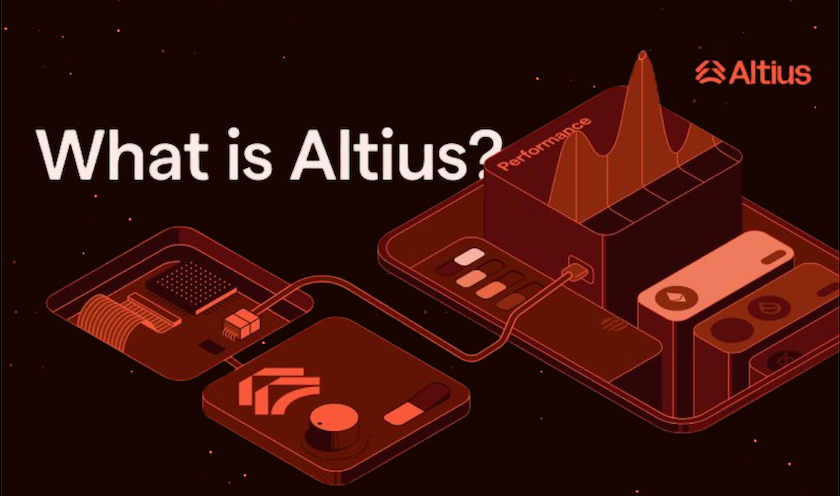
@AltiusLabs positions itself instead as an engine (execution engine). That means it doesn’t just handle asset transfers between chains, it provides computational power. If a chain wants to boost its performance, instead of building a bridge it can plug in Altius’ engine to expand its transaction capacity.
So while today’s bridge model is focused only on moving assets from A to B, Altius works like a motor that increases the processing power inside the chains themselves. Any chain that wants faster execution and parallel processing can integrate Altius to achieve it.
Soneium Score enters Season 02.
After Season 01, the journey continues with new quests from @Aave, @Kyofinance & @Lootcointech.
If you scored 80+ in Season 01, your NFT badge will be available to mint in a few days.
⚔️ Citizens of Airdrops.io Community, the gates of Rome are open!
🎟️We're giving away 25 FREE guaranteed over-allocated whitelist spots
🔥 Exclusive partnership with Rome Protocol
To claim your spot:
1️⃣ Follow @RomeProtocol, @Airdrops_IO, @TeamAirdrops
2️⃣ Like & RT this post
3️⃣ Comment your Solana wallet address below
WINNERS SELECTED VIA RAFFLE 🎲
Announcement on Twitter & Telegram 📢
Fight for your place, and claim your role in the empire! 🏛️
Every onchain action should count 💿
That’s why we built Soneium Score, a new way to reward your proof of contributions across the entire Soneium ecosystem.
One score. Multiple ways to earn.
Let’s understand how you can evolve your score 🧵👇
⚫️ Modularists, the window is open.
Fill the form, claim your Endless Genesis Role 🎖
→ Early-bird perks
→ Become a founding architect of the decentralized AI cloud 🤖
✍️ Activate here: https://t.co/XiFzVkLybI
When agents awaken, your mark will echo in the cloud. 🌱
#Endless