As Jordanians head to the polls to elect a new House of Representatives (Parliament), here are the most important things to know about these elections:
1- First Parliamentary Elections Post-2022 Amendments: These parliamentary elections are the first to occur after the 2022 constitutional amendments and the implementation of new election and political party laws.
2- 2022 Constitutional Amendments Consisted of:
- Expanding the King’s authority, allowing him to appoint and dismiss key figures without requiring the Prime Minister’s countersignature.
- Establishing the National Security Council, which was granted significant authority over security, defense, and foreign policy matters.
- Lowering the candidacy age from 30 to 25.
- Mandating the Independent Election Commission with overseeing the establishment and regulation of political parties.
- Introducing Gender-friendly language into the constitution.
3- The New Election Law introduced a mixed-electoral system:
- 97 of the 138 seats represent 18 local electoral districts through an open-list proportional representation system (largest remainder formula).
Of these seats, 18 are reserved for women (one per district), seven for Christians, and two for Chechen and Circassian minorities. Lists must secure at least 7 percent of the total votes in their district to win seats, with the largest remainder formula used to allocate competitive seats. Reserved seats are allocated using a plurality/majority system, with the number of deputies per district ranging from three to ten.
- The remaining 41 seats are allocated at the national level based on a closed list proportional representation system where voters express their preference only for a list representing a political party or coalition. Those seats are reserved for political parties and alliances, ensuring that – for the 2024 elections – a minimum of 30% of parliamentary seats are occupied by party-affiliated representatives. Within this national allocation, two seats are reserved for Christians and one for members of the Chechen and Circassian minorities. Party lists must include at least one woman among the first three candidates, and one among the next three candidates. Each party list must include at least one candidate under age 35 among its top five candidates. To secure seats at the national level, party lists must garner at least 2.5 percent of the total votes cast.
4- Voter Eligibility:
Every Jordanian citizen who has reached the age of 18 at least 90 days before Election Day is eligible to vote in the House of Representatives elections. However, members of the Jordanian Armed Forces, General Intelligence Service, Public Security Department, Gendarmerie, and Civil Defense are ineligible to vote while on active service. Additionally, individuals declared bankrupt without legal rehabilitation or those lacking civil and legal capacity are also ineligible to vote.
5- Registered Voters:
Following the voter registration and complaints period, the IEC announced that there are 5,115,219 registered voters, of whom 52.6% are women. First-time voters account for 11.54& of the electorate. Voters under 25 years old make up 21.9%, while those under 35 constitute 45.4% of the electorate.
6- Candidates:
937 candidates on 172 lists are competing for the 97 seats allocated to the 18 local electoral districts. Among them, 190 are women (20 percent), 56 are under 35 (6 percent), and 57 are competing for the seats allocated for Christians. Nineteen candidates are competing for the seats reserved for Chechens and Circassians, while 166 women are competing for the reserved seats for women. An additional 24 women are running for competitive seats outside the quota system.
686 candidates on 25 lists are competing for the 41 seats allocated to the national electoral district. Among them, 187 are women (27%) and 154 are under 35 (22%). Thirty-two candidates are competing for the two seats reserved for Christians, and 11 for the seat allocated to Chechens and Circassians.
36 of Jordan’s 38 licensed political parties are fielding candidates.
7 - Campaign Spending Limits:
- 100,000 JOD ($141,105 USD) per list for local electoral districts.
- 500,000 JOD ($705,526 USD) per list for the national electoral district.
8 - Party Funding: Political parties receive public funding mostly linked to their performance in local and parliamentary elections:
- Each party receives 5,000 JOD ($7,055 USD) every four years for general assembly expenses.
- Additional funding is awarded based on electoral success: 30,000 JOD ($42,331 USD) for securing 50 percent or more of the electoral threshold in the national electoral district, 10,000 JOD ($14,110 USD) per seat won, and 2,000 JOD ($2,882 USD) for each candidate who is a woman, youth, or person with a disability. Similar scheme is in place for local elections.
Coalitions receive funding based on similar criteria, with additional incentives for party mergers.
The maximum contribution of public funding for each party is set at 120,000 JOD ($169,324 USD).
9 - Out-of-Country Voting: The current electoral law does not allow for out-of-country voting. Consequently, an estimated 1 million Jordanians living abroad will not be able to participate in the election unless they return to Jordan to cast their vote.
Read more about these elections here: https://t.co/ZTRhT37MkZ
Despite being central to elections, the primaries are still just theatrics rather than a genuine competition. While they look like a proper election process on the surface, their results are not binding.
For @AtlanticCouncil@ACMideast@VladimirPran with @Maroon_Sfeir https://t.co/nNUI2ByXHQ
#Syria is holding yet another election outside the framework of UNSCR 2254. @VladimirPran and I discussed with @AP why no surprises are expected today and what the true purpose of the parliament's composition is.
@sewella reporting from Beirut
https://t.co/HIPFu0bCPF
On July 15 Syrians living in areas under Bashar al-Assad’s control will vote for all 250 seats of the Syrian People’s Assembly.
@VladimirPran and @Maroon_Sfeir analyze the structure of the Syrian electorate and highlight discrepancies found in voter data.
https://t.co/toesYqZsLn
In the second article of this series for @ACMideast, @VladimirPran and I discuss how the electoral system adopted in #Syria ensures a competitive edge for the #Baath Party while blocking any potential competition.
President Bashar al-Assad has set July 15 as election day for the 250 seats of the Syrian People’s Assembly.
@VladimirPran and @Maroon_Sfeir explain why opposition parties are unlikely to win a significant number of seats:
https://t.co/rSuJax0DUo
Syria watchers will ask why these elections should matter at all. Considering that the reform of the constitution is inevitable, will the composition of the parliament matter? @Maroon_Sfeir and I for @AtlanticCouncil
https://t.co/2f6eQ607yV
In this series for the @AtlanticCouncil, @VladimirPran and I delve into the upcoming Syrian parliamentary elections and their significance in the current political landscape. Check out the first article 👇
Opportunities to observe Syrian political processes are limited, write @VladimirPran and @Maroon_Sfeir.
Looking at the coming parliamentary elections is an attempt to find any evidence that Assad has any policy for the future of Syria.
Read more. ⬇️
https://t.co/T1L7XlwSyU
Dislocation, destruction, and continued oversight were always part of Israel’s plan for the post-conflict situation in the Palestinian territory.
Nathan J. Brown and @VladimirPran discuss.
https://t.co/qwAa3Lx72u
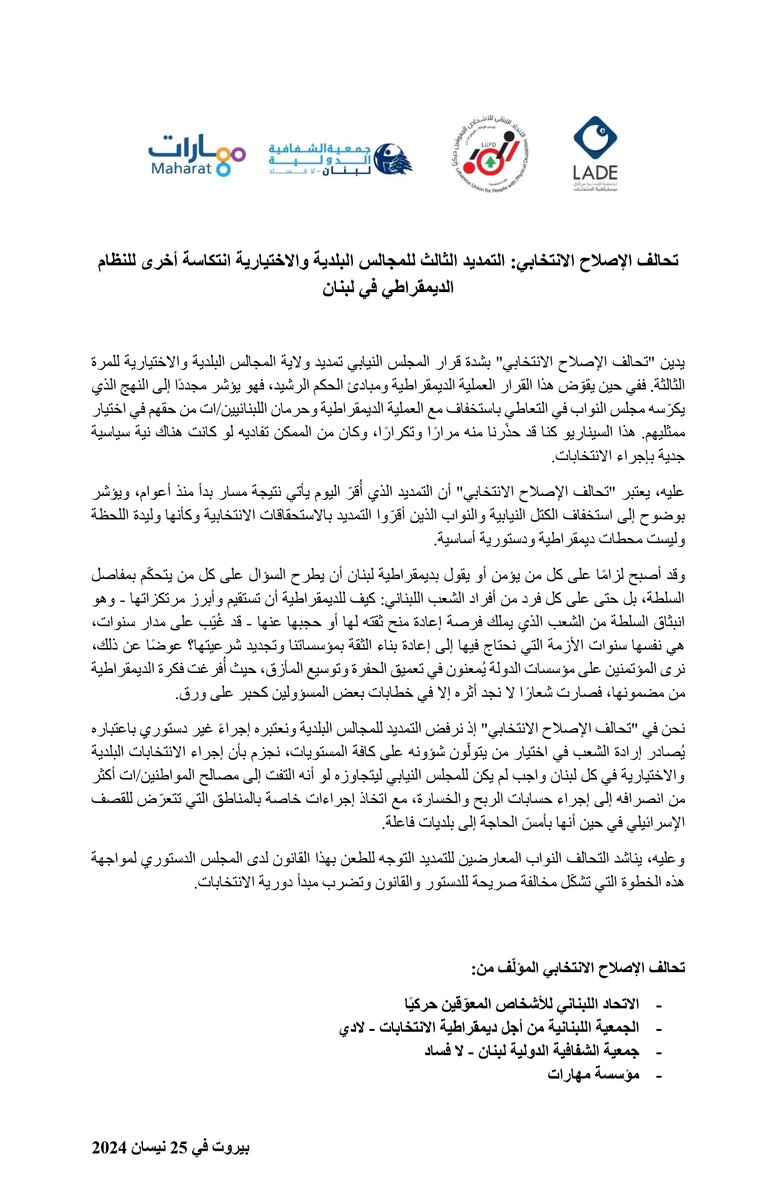
يدين #تحالف_الإصلاح_الانتخابي بشدة قرار المجلس النيابي تمديد ولاية المجالس البلدية للمرة الثالثة، ويعتبر أن #التمديد يأتي نتيجة مسار بدأ منذ أعوام ويؤشر بوضوح إلى استخفاف الكتل النيابية والنواب الذين أقرّوا التمديد بالاستحقاقات الانتخابية.
@LUPD_LB@Maharat_Lebanon@TI_Lebanon
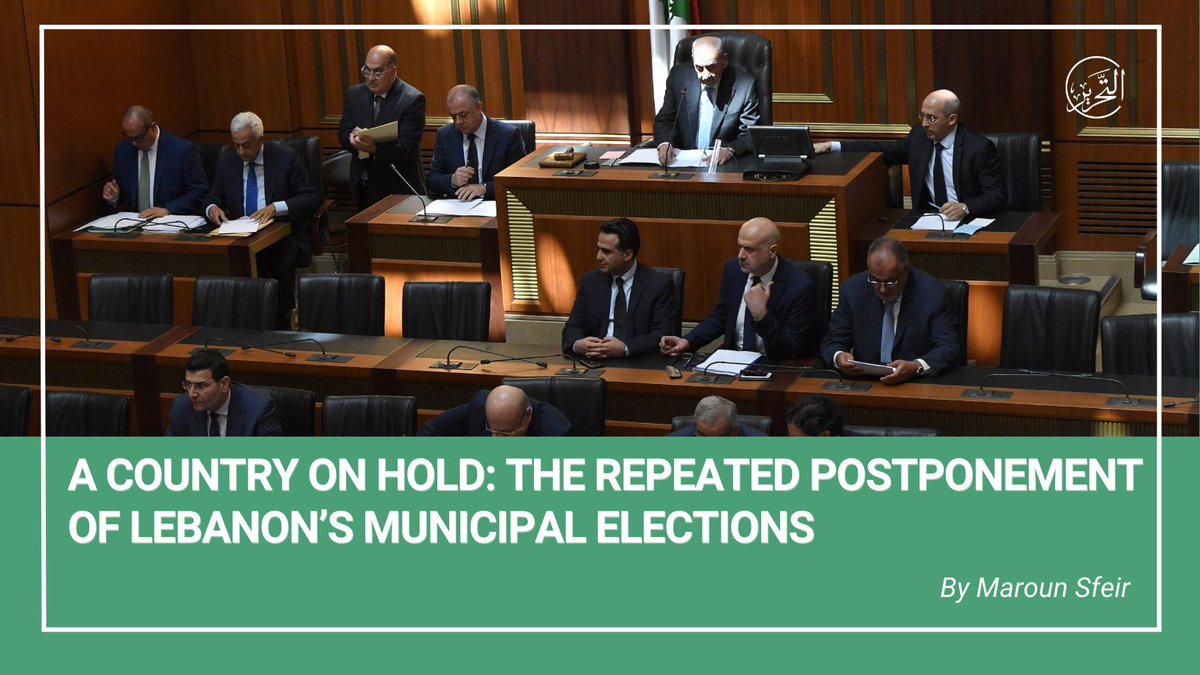
NEW: Lebanon, already enduring a crippling political vacuum, will likely postpone its upcoming municipal elections for the third time. @Maroon_Sfeir examines what this could mean for local civil society, opposition parties, and international stakeholders: https://t.co/GyOZ3QDfd1
Read my latest on tomorrow's (most likely) postponement of the Lebanese municipal election👇
A Country on Hold: The Repeated Postponement of Lebanon’s Municipal Elections. https://t.co/hfdK8aSe2m via @TimepDC
Interested in understanding how the succession of the #Palestinian leadership might play out after Abbas? Make sure to read this interesting piece by @VladimirPran and Nathan Brown for @CarnegieMEC
Palestinian leadership succession: the choice between procedures and naked power politics is not either/or. The naked power politics has already begun. But it will likely be channeled through established procedures.
With Nathan Brown & @CarnegieMEC https://t.co/0p0DDIpzjL
🇱🇧 La escasez de trigo en el #Líbano fuerza el racionamiento del pan subvencionado por el Estado y pone en riesgo su financiación. ¿Podría el país seguir los pasos de Sri Lanka?
En @Atalayar_ con las aportaciones de @husseinch96 y @Maroon_Sfeir.
https://t.co/K8UYdrb3er
I went to the province of Hasbaya to cover Lebanon's election, which marks a small but significant shift in the country's complex political landscape. With an interview with newly minted MP @Elias_Jradeh and quotes by @Maroon_Sfeir among others.
Until now, @MOIM_Lebanon has only published election results by district. This goes against best practices as publishing granular data allows for scrutiny 1/3
https://t.co/STX0KLRNqp
In 2018, the results were published at the level of polling stations allowing @LADELEB to discover that the results of several expat ballot boxes were zeroed out. 2/3
https://t.co/KyPcgIAbSW