My team and I wrote a blog post about key pieces of the legislative response to the LA wildfires that are now on @GavinNewsom’s desk. We try to organize things conceptually so that you can see how things more or less fit together.
https://t.co/BxXaDQFNzJ
🚨 OBAMA ON AI: "If we are thinking about AI just in terms of how do we cure cancer or get better energy, you can do that without having agentic AI and having it just roaming free in the internet. The reason you are doing that is because you have to market a product that people will pay money for.
That’s a misalignment between what our society needs and the commercial imperatives that these companies are facing, not because necessarily they’re trying to do bad things, but because they’ve got to justify these valuations.
So, that’s one more reason why it is really important for us to have a competent government and a serious bipartisan conversation around this issue, and we have to do it fast. And I would encourage voters to pay attention to this. If somebody does not have a serious plan for how to deal with this, then they’re not meeting the moment, and you should probably look for somebody else."
✨ So proud of this paper, now published in @Nature! We ran ** 5 ** randomized trials providing education in emergencies w/ NGOs & governments at a time of historic need and uncertainty during the pandemic. Evidence really mattered. We reversed "voltage drops" when scaling across contexts; instead effects improved over time, showing a "learning curve"
https://t.co/IqlHqpWtzB
@atrembath Some scenarios have always been plausible, some scenarios were plausible but are now implausible, and some scenarios were likely always implausible. https://t.co/8BOwM44k7B
But a 4C world this century or early next is well within the realm of plausible outcomes, unfortunately.
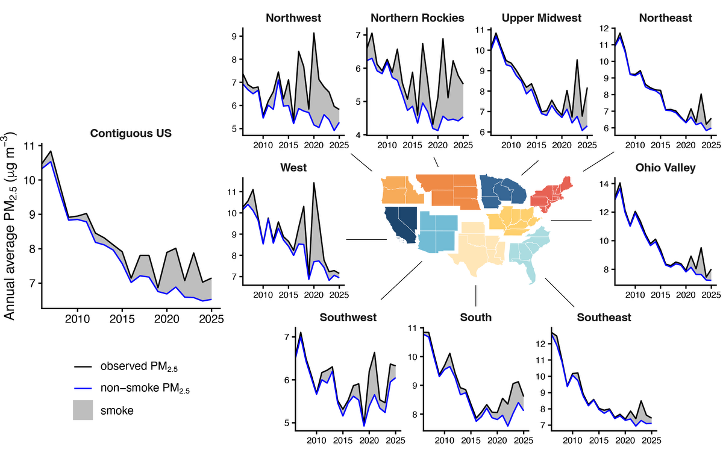
Realizing these benefits in the US is increasingly going to depend on finding cost-effective ways to reduce wildfire smoke or its damages. Its by far the fastest growing source of air pollution in the US, with other sources mostly continuing to fall (and becoming increasingly expensive to abate).
Figure below is trends in PM2.5 overall (black line) and with our estimated wildfire contribution subtracted off.
Realizing these benefits in the US is increasingly going to depend on finding cost-effective ways to reduce wildfire smoke or its damages. Its by far the fastest growing source of air pollution in the US, with other sources mostly continuing to fall (and becoming increasingly expensive to abate).
Figure below is trends in PM2.5 overall (black line) and with our estimated wildfire contribution subtracted off.
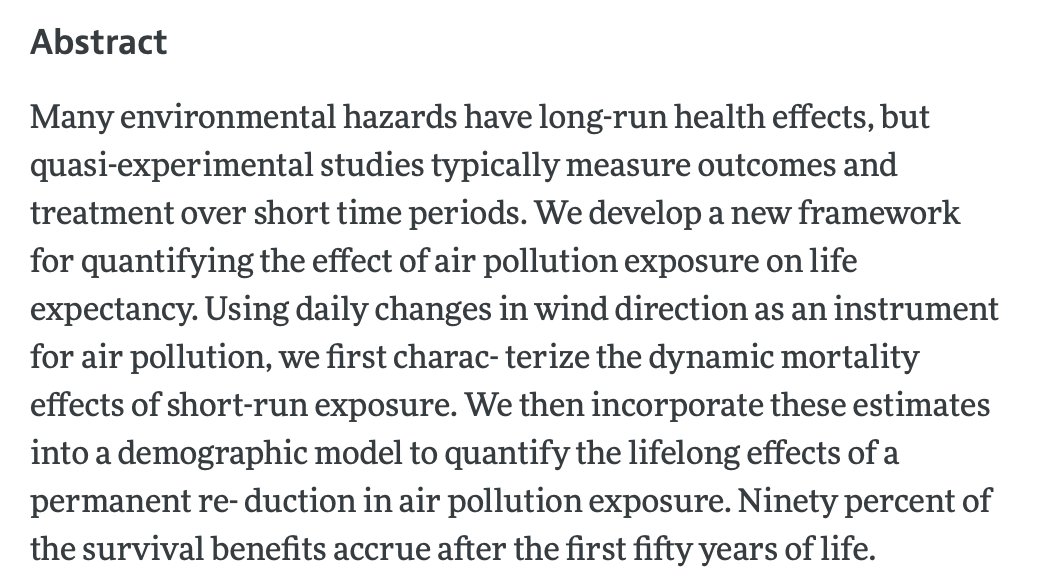
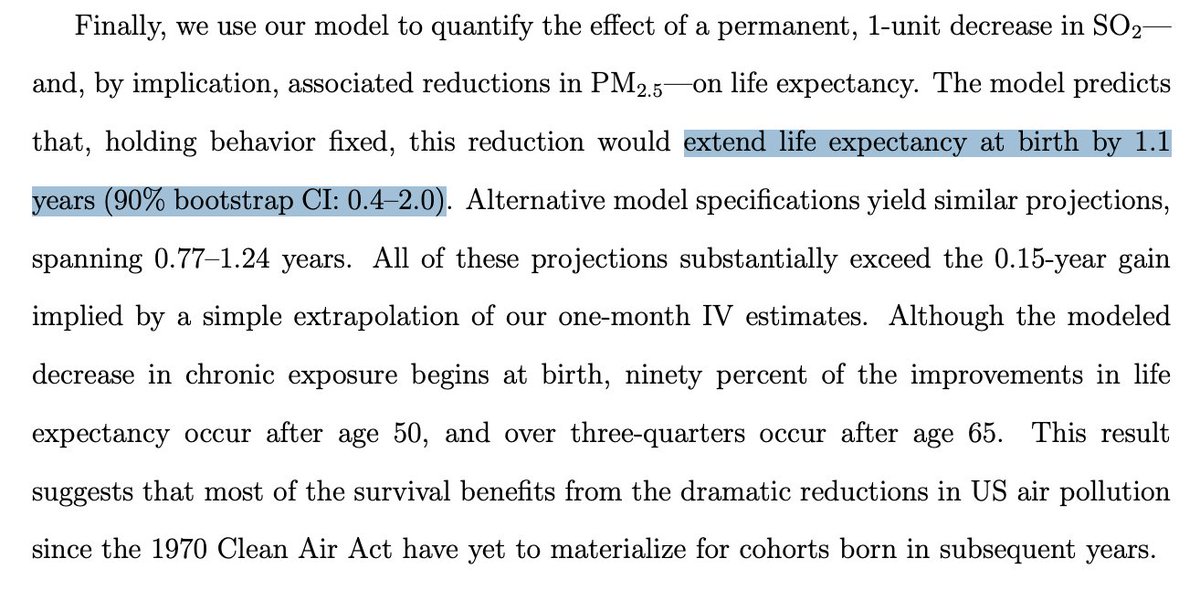
Another paper finding big near term mortality impacts from air pollution, and if I'm reading it right, suggesting that extrapolating over full lifespan suggests that reducing air pollution by ~10% would save ~1 year of life across the US population - huge effects!
Let's talk about the weather and climate changes that proceeded the Nepali glacier collapse.
It's well known that Nepal is warming, but we can do better and estimate the changes at the 5200m elevation site where the mass of ice and rock ultimately broke loose.
A thread. 🧵
Wildfire smoke continues to stick around, with fires out West still sending smoke across the country, and new fires in Texas sending smoke north and east. 2026 hanging on as the 2nd worst cumulative smoke year to date in the US, by our estimates.
Wildfire smoke continues to stick around, with fires out West still sending smoke across the country, and new fires in Texas sending smoke north and east. 2026 hanging on as the 2nd worst cumulative smoke year to date in the US, by our estimates.
Stunning figures. If all were somehow completed, these would nearly double US gas power capacity. And look how many use inefficient single cycle turbines or reciprocating engines.
Amazon is backing a 7.65 GW gas plant in West Texas.
I sorted all 14,036 operating U.S. power plants by size to see where that lands. It doesn't land anywhere (nothing on the American grid is that big).
Putting out fires is not the main issue. And indeed a history of putting out fires is a main source of the problem. We need to be able to combine suppression where needed with large scale reintroduction of low severity fire.
hot take but i think AI is literally on the verge of solving california’s megafire problem
> california already has 1,000+ AI-monitored wildfire cameras that have spotted 900+ fires before the first 911 call
> now the first 3 satellites in Google’s FireSat network just reached orbit to catch fires those cameras miss
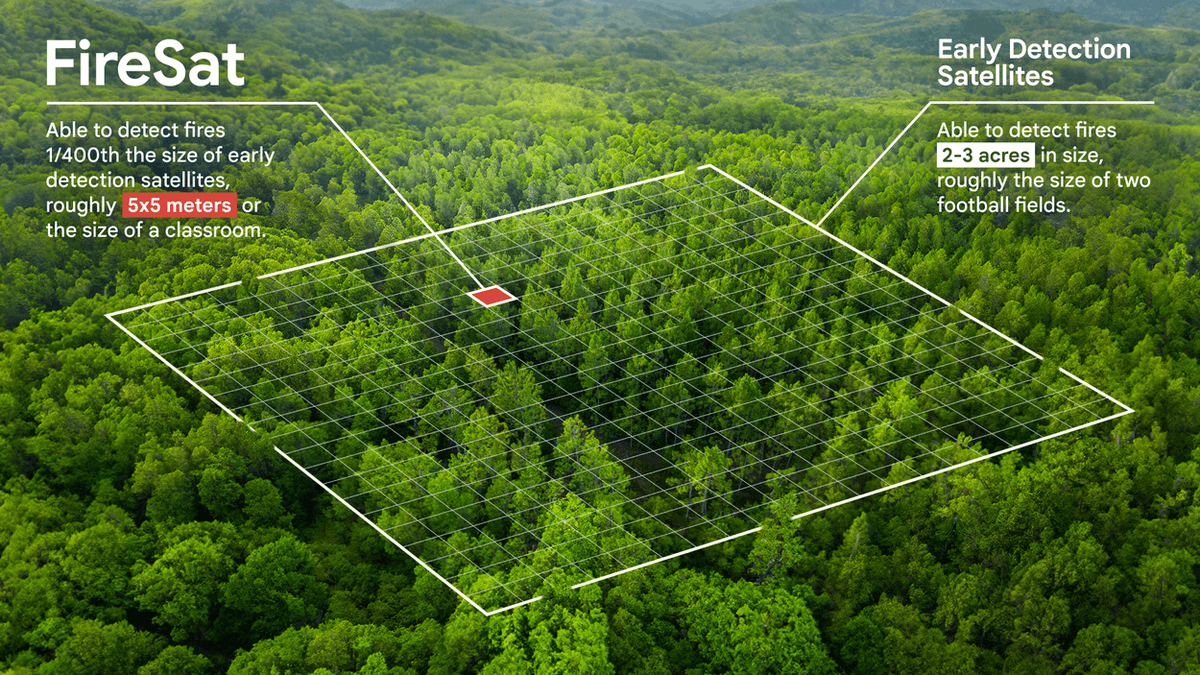
> FireSat is designed to spot fires just 5 x 5 meters, roughly 1/400th the size current wildfire satellites can detect
> once complete, the network will scan the planet every 20 minutes
> together, cameras below and satellites above are creating a 24/7 early-warning system for finding tiny fires before they can grow into megafires
> but the missing piece is getting water there just as fast
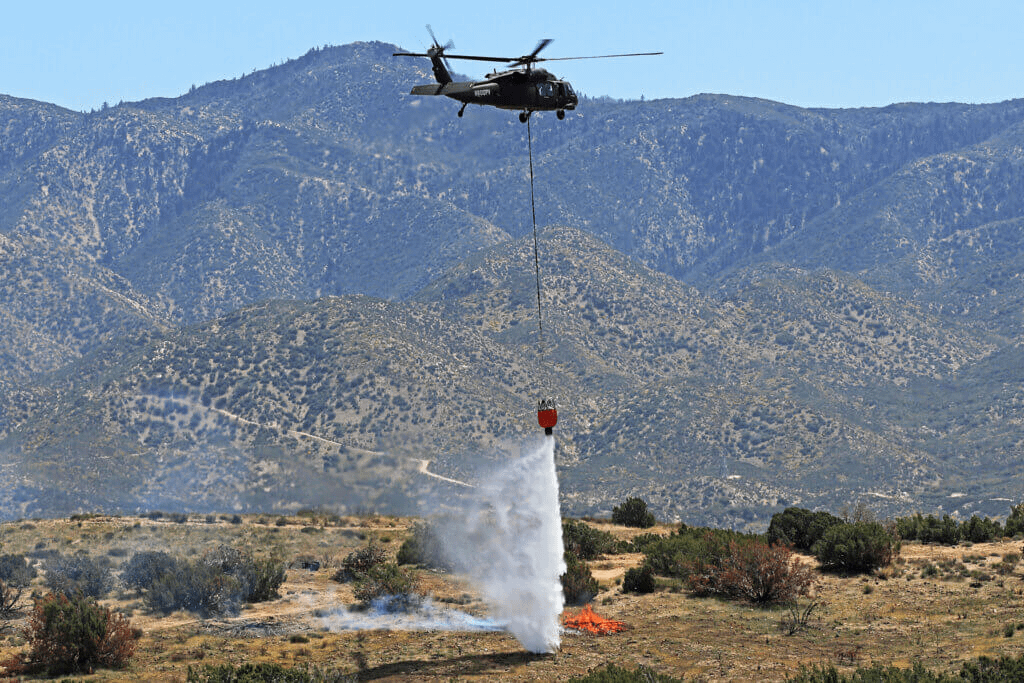
> in one california test, an autonomous Black Hawk found staged fires, flew to water and filled a 324-gallon bucket
> it then calculated its own drop and extinguished it with no human in the loop
> NASA is also building the traffic-control system needed to coordinate aircraft like this through darkness and heavy smoke
> california already stations 70+ firefighting aircraft around the state, positioned to reach even remote fires within 20 minutes
> the goal is to automate that entire chain
> so AI finds the fire, launches the aircraft and fully extinguishes it within 10 minutes without waiting for a human
> each system is designed to do that across an area larger than SF + oakland + san jose combined
> scale that across california and dangerous fires get extinguished before they can become megafires
yes... obviously california will always have natural fires
and scaling this statewide might take a decade
but i'm increasingly convinced the $100B-entire-community-destroying fires will soon be a thing of the past 🤞
A whole lot of dense smoke, from a whole lot of big fires, has spread across the Western 2/3 of the contiguous United States this evening. This has already been an extraordinary fire season in the Pacific Northwest & portions of the Great Basin/Rockies--and it continues.
@atrembath What about non-activist studies that show that replacing gas stoves with electric ones reduces respiratory hospitalizations?
https://t.co/AJcplOl4qs
Three lions held at the Tokyo Zoo have died from heat stroke.
Four lions remain so ill that they're unable to stand.
The average heat index in Tokyo in July was 110°.
And we are in just 1.4C of global heating. We are on track for 3C in my kid's lifetime.
We are in danger
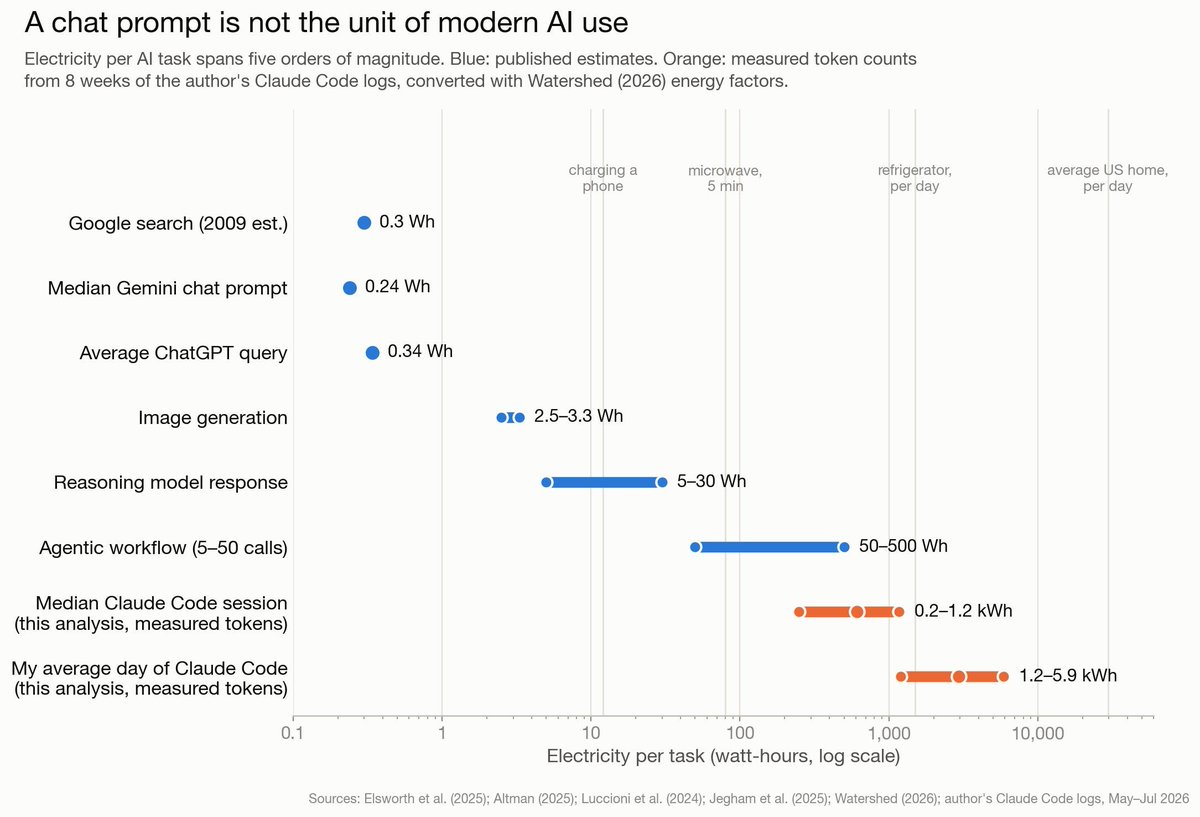
Published estimates of AI energy use per prompt (~0.3 watt-hours) appear reassuring small. But they are increasingly disconnected from how we actually use AI. Modern agentic tools use around 600 times more energy per prompt, as I discuss in my latest over at The Climate Brink.
2026 is currently the 2nd worst smoke year on record in the US, behind 2023. Plot shows population-weighted daily cumulative PM2.5 exposure from smoke across the US. Note also how fundamentally different the last 6 years have been relative to previous two decades.
2026 is currently the 2nd worst smoke year on record in the US, behind 2023. Plot shows population-weighted daily cumulative PM2.5 exposure from smoke across the US. Note also how fundamentally different the last 6 years have been relative to previous two decades.
I'm not sure folks have realized just how crazy the second half of 2026 and 2027 will be for global temperatures – on the back of a record-smashing El Niño event. Here is my latest estimate of where both years will end up compared to global temperatures since 1850.