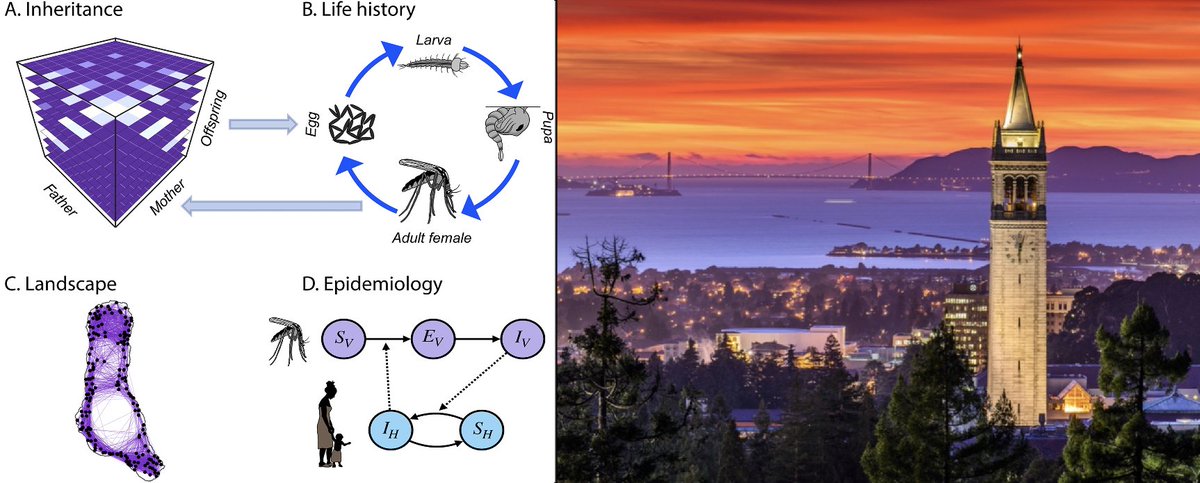
New paper in @MalariaJournal! 🦟
Gene drive mosquitoes can transform malaria control, but tracking them currently needs lab infrastructure. We propose a Target Product Profile for a field-ready Rapid Diagnostic Test (RDT) for monitoring.
Read here: https://t.co/DP8U1Cu6Ae
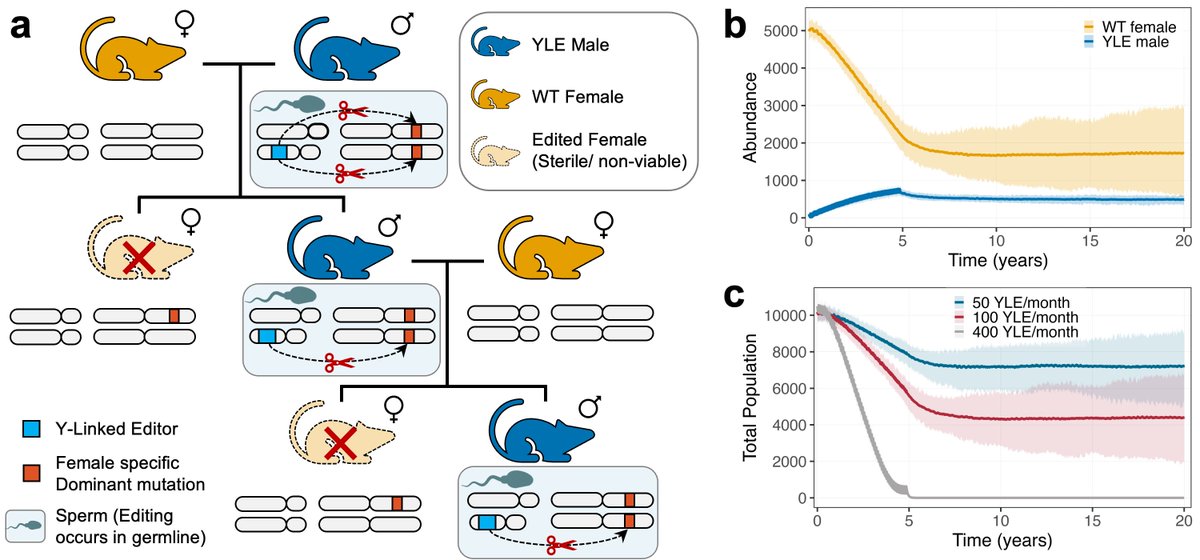
Our paper on Y-linked editors for invasive rodent biocontrol is out today in @MolBioEvol! 🐁🧬
Read how YLEs enable safe, targeted population suppression: https://t.co/OlbEc8IU22
@MarshallJohnM@Omar_Akbari_
Reviewing soon (May 25th): We are looking for a postdoc to join our team at UC Berkeley working on genetic pest control modeling (New World screwworm). An exciting collaborative project with @Omar_Akbari_ & @Max_Scott_Lab. More info on how to apply here: https://t.co/Df2SGPv7Iq
Please RT: We are looking for a postdoc to join our team at UC Berkeley working on genetic pest control modeling (New World screwworm). An exciting collaborative project with @Omar_Akbari_ & @Max_Scott_Lab. More info on the position & how to apply here: https://t.co/Df2SGPv7Iq
Invasive rodents drive biodiversity loss, especially on islands. 🏝️🐀
Current controls have limits. Is there a genetic solution that is both efficient & confinable?
Our new preprint explores "Y-linked Editors" for invasive rodent control.
A thread 🧵👇 https://t.co/KAeQnQgjKC
Excited to share our new pre-print on spatial close-kin mark-recapture methods to estimate dispersal parameters for mosquitoes. Awesome work from Shuyi Yang, Jared Bennett, Igor Filipović & @RasicGordana! Hoping these methods will be useful in the field! https://t.co/cHrOmNJIES
New pre-print describing a model-informed target product profile for population modification gene drives for malaria control. Current homing rates are adequate, but assessing field readiness is challenging. Awesome work from @AgastyaMondal & @chipdelmal! https://t.co/eQFcK7otoR
Estimating the potential impact of surveillance test-and-treat posts to reduce malaria in border regions in sub-Saharan Africa: a modelling study https://t.co/CummVoKYtu #medRxiv
The latest version of our MGDrivE software is now out in @PLOSCompBiol! Awesome work from @AgastyaMondal & @chipdelmal! Ver 3 links our mosquito genetic control model to the Imperial College malaria model + includes functionality for mosquito surveillance. https://t.co/O7Xdc8I9CU
Check out this awesome new software package from @chipdelmal that optimally distributes mosquito traps to minimize time to detection for a gene of interest (e.g. gene drive or insecticide resistance allele). With @ProfDavidLSmith. Out now in @PLOSCompBiol! https://t.co/3Ea8i5RjGu
Pics from the 2024 GRC on Genetic Biocontrol in Barcelona last week. Had a great time meeting with old friends, amazing mentors, and great colleagues. Feeling energized and focused for the next phase of exciting research from the #Akbarilab. Stay tuned!!
Are you interested in modelling arbovirus transmission and better understand the impact of climate and interventions on disease dynamics? 🦟🦠🌦️💉Please see below a fantastic opportunity to join our team! 🗓️Closing date is 3 April. Happy to answer any questions!
New paper provides details of the evolving trends in malaria transmission in Tanzania - reveals which vector species are most abundant, and more importantly, which species are responsible for the bulk of malaria infections.
~
Tanzania's National Malaria Control Program and partners have provided details of their comprehensive surveillance of malaria vectors. This new paper shows significant transitions in the abundance and contributions of different malaria vector species across the country between 2017 and 2021. Of particular interest is that while Anopheles arabiensis is the most abundant [and most widespread] across the country, most malaria infections are now being contributed by Anopheles funestus. The prevalence of An. funestus is particularly notable in the high transmission areas in the north-west and south eastern parts of country, where most malaria burden occurs. The paper also shows that while the influence of Anopheles gambiae in malaria transmission gradually diminished from 2017 to 2021, this once-notorious species remains modestly prevalent across the country and still plays a key role in the spread of malaria.
~
[NOTE: to more clearly depict the role of each Anopheles species, I've used the summaries provided by the authors in Table 2 to chart the year-to-year EIR comparisons]
~
Fantastic work by the NMCP and Partners including
@NIMR_Tanzania and @ifakarahealth and @wizara_afyatz, @ifakarahealth, @GovellaNico, @Kiware2, @YPKitutuJr, @Brian__Masanja
~
Mwalimu et al 2024: https://t.co/Xk8t7Ptdrw
Postdoc (Berkeley, United States)
Mathematical modeling of gene drive systems in mosquito disease vectors
with @MarshallJohnM
at @UCBerkeleySPH
More details: https://t.co/pp7B1yfdGj
Please RT: We are looking for a postdoc to join our team at UC Berkeley working on mathematical & computational models of gene drive systems in mosquito vectors of malaria, dengue & other diseases. More info on the position & how to apply here: https://t.co/sEs2cIx7EJ
Dr. Mamadou B. Coulibaly was a brilliant leader and a dedicated advocate for young African scientists. He will be missed greatly by the malaria community.
Mamadou's legacy will continue to inspire our path forward as we work towards a malaria-free world. https://t.co/ONcOJEBj6s
Please sign up to present in our 2024 ICE Symposia @ice2024kyoto_jp taking place in Kyoto Japan organized by @MarshallJohnM and @LeeYoosook and @Omar_Akbari_ entitled "13-10. Mosquito Biology and Genetic Biocontrol" https://t.co/xsTCPBNwYi 🦟






![Fredros_Inc's tweet photo. New paper provides details of the evolving trends in malaria transmission in Tanzania - reveals which vector species are most abundant, and more importantly, which species are responsible for the bulk of malaria infections.
~
Tanzania's National Malaria Control Program and partners have provided details of their comprehensive surveillance of malaria vectors. This new paper shows significant transitions in the abundance and contributions of different malaria vector species across the country between 2017 and 2021. Of particular interest is that while Anopheles arabiensis is the most abundant [and most widespread] across the country, most malaria infections are now being contributed by Anopheles funestus. The prevalence of An. funestus is particularly notable in the high transmission areas in the north-west and south eastern parts of country, where most malaria burden occurs. The paper also shows that while the influence of Anopheles gambiae in malaria transmission gradually diminished from 2017 to 2021, this once-notorious species remains modestly prevalent across the country and still plays a key role in the spread of malaria.
~
[NOTE: to more clearly depict the role of each Anopheles species, I've used the summaries provided by the authors in Table 2 to chart the year-to-year EIR comparisons]
~
Fantastic work by the NMCP and Partners including
@NIMR_Tanzania and @ifakarahealth and @wizara_afyatz, @ifakarahealth, @GovellaNico, @Kiware2, @YPKitutuJr, @Brian__Masanja
~
Mwalimu et al 2024: https://t.co/Xk8t7Ptdrw](https://pbs.twimg.com/media/GEWvNpwWgAATBAo.jpg)