Starting 2026 at -$4K Goal : Hit $1M by Dec 31 with the most degenerate plays trading, deving, Polymarket, NFTs, RWA🔥
NFA / Current arc : AI Weather Quant 💻
Earned $43,800 With OpenClaw While I Was Sleeping.
My bot woke me up at 3:47 AM.
I typed "yes" half asleep.
Woke up to +$43,800.
I've made the exact step-by-step setup guide for this timezone arbitrage system.
You need: Claude + laptop.
Free for 24 hours.
To get it:
1- Comment "OpenClaw"
2- Like and Retweet
3- Follow me
@sakhil_ai
(so i can DM you)
The bot hunts timezone arbitrage 24/7.
Watches Japanese, European, Australian, Middle East news feeds.
Finds markets where outcome is already confirmed overseas but US traders haven't updated prices yet.
9 days running this setup. Never thought a bot would wake me up to make money.
Polymarket is 70% American traders.
World events don't care about EST.
While you sleep, markets resolve.
That's the edge. It's stupid simple.
You Must Follow me👤
@sakhil_ai
, so i can send you DM.
@BitcoinArchive so the "compromise" is no passive yield on stablecoins and coinbase gave up $1.35B in annual revenue for a maybe-April hearing... banks stay winning lol
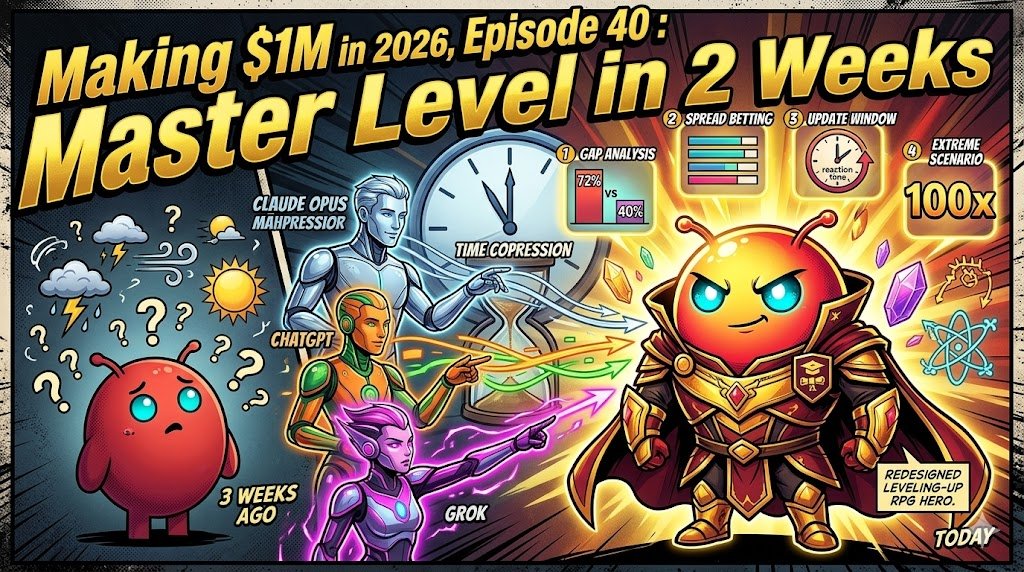
Making $1M in 2026, Episode 40 : Master level in 2 Weeks
Two weeks ago, I didn't know what a weather model was. I used AI as a tutor for an ultra-personalized course and went from zero to Master level.
I asked it to evaluate what I'd learned : atmospheric science, thermodynamics, how forecast models work, why they disagree with each other.
The questions Opus 4.6 generated were brutally hard. I put the evaluation on ChatGPT and asked what academic level it represented.
The answer : Master 2 level. I was flabbergasted.
I answered the questions and asked Grok to assess my level based on my responses.
His verdict : Master 1 in consolidation meaning I understand it but need to solidify it through practice.
AI compressed what normally takes years into a single week.
Two weeks ago : My model missed a Chicago temperature forecast by 8°F. I had no idea why.
Today: I can tell you it's because the wind was blowing off the lake at 15 mph, which neutralized the cooling effect that most forecast models underestimate.
The Trading Strategies I've Learned
Strategy 1 : The Probability EdgeTake your forecast, calculate the probability the temperature falls in a specific range, and compare it to market pricing. If your model says 72% but the market says 40%, that's a 32-point gap—your edge. Rule: don't trade unless the gap is at least 15-20 points. Below that, fees and uncertainty eat your profit.
Strategy 2 : Risk Spreading (Neobrother's Approach)Instead of betting everything on one exact temperature, spread small bets across 3-5 adjacent ranges. You don't need to nail the exact number—just the zone. This dramatically reduces variance. Neobrother made over $20,000 on 2,300+ trades using this approach.
Strategy 3 : Model Update WindowsWeather models update on fixed schedules:
HRRR : every hour
GFS : 4 times daily
When a new update shifts the forecast by 3°F or more, the market takes 15 minutes to 2 hours to react. That window is where you trade.
Strategy 4 : Tail Risk Capturing (Hans323's Method)Find extreme scenarios that models price at 5-15% probability but the market prices below 2%. When those hit, you make 100x your bet.
I'm starting to get it.
@CoinMarketCap s&p dow jones licensing their flagship index directly to a defi chain, with institutional data feeds and sub-second settlement is serious
Making $1M in 2026, Episode 39 : 31 Models, One Answer
I spent day going through every major weather prediction model on the planet. Each one takes a different approach.
So the GFS is the American model. It covers the whole globe and updates 4 times a day. The ECMWF is the European model, generally considered the most accurate in the world.
And then there's the HRRR this one focuses on a smaller area but refreshes every single hour, so it's great for short-term precision.
Each one sees weather a little differently. Each one gets things wrong in its own way.
And then I found the NBM. The National Blend of Models, this thing takes 31+ models, compares them, corrects the errors each one tends to make, and produces a single forecast that outperforms every model on its own. Wisdom of crowds applied to weather prediction.
I had never heard of it before this week. And that's probably why my Episode 32 prediction was off by 8°F. I was relying on one source.
I also looked into the AI models Google built one called GraphCast that can produce a 10-day forecast in under a minute. But these AI models tend to play it safe. They average things out. On a market where I'm betting on a specific temperature threshold, that's a problem. The money is in the extremes.
So my setup now is clear. NBM as the foundation, HRRR for the final hours before the market resolves, and my own correction on top for the lake effect that none of them fully capture.
@Polymarket bryan johnson has already used his son's blood, measured his erections nightly for years, and tracks his sperm quality publicly at this point leeches would be the most normal headline he's generated.
@StarPlatinum_ the funny part of the bitcoin family story is didi posted in 2024 that the $300K house they sold for 100 btc can now be bought back for 4 btc but he didn't go back, and he's not touching his stack until bitcoin hits $1M.
Making $1M in 2026, Episode 38 : The Blind Spot of Forecasters
I found something that blew my mind.
There's this metric called geopotential thickness specifically the 1000-850 hPa layer. It basically measures how warm or cold the air column above a city is. And it explains 85% of the variance in Chicago's daily max temperature. Eighty-five percent just One variable.
That's one indicator captures almost the entire move. So you just need one leading indicator and then you need to understand the 15% it misses. That 15% is where the market gets it wrong and where you make money.
But the part that got me excited is that the biggest source of error in that remaining 15% is the Wind. Specifically, wind off Lake Michigan, A 5 mph difference in wind speed can create a 15°F swing in temperature.
The models everyone uses is called GFS, the big standard forecast model and It systematically underestimates this lake effect. There's a blind spot baked into the tool that most traders rely on.
So my edge is being better where the model sucks.
Tomorow i will study models and strategie to predict manuelley weather.
This is getting exiciting stay stunned !
@PolymarketMoney the most underrated part of rklb's $190M haste deal : they sold 28 launches in q1 2026 alone, nearly matching all of 2025, while still pre-neutron
@CoinDesk the sec hasn't approved the nasdaq tokenization rule yet it's still in public comment as of jan 30; but when it does pass, same order book, same cusip, same rights, just blockchain settlement and dtc goes live q3 2026.
@mert the same team that powers solana's rpc layer, archival data, AND the top 2 validators by ibrl score is taking 0% fees while everyone else charges 5-8% great work
Making $1M in 2026, Episode 37: Pneumonia
A 29°F drop in 60 minutes is a phenomenon called a "pneumonia front" and that's what makes Chicago the hardest temperature market to predict on Polymarket.
It's a wall of cold air from Lake Michigan that can crash the temperature by 30°F in under an hour. No gradual decline just a brutal drop.
The lake sits at 37°F right now while the air above the city can be 80°F+. That 40°F gap between water and land creates these violent moves.
Here's what got me : O'Hare airport and downtown Chicago can show a 25–30°F difference on the same day. The market resolves on O'Hare.
If you don't know this, you're trading blind. This is exactly why my model missed by 8°F in Episode 32.
I was predicting "weather" but I should have been predicting weather at a specific station, shaped by a lake with more thermal mass than the entire city.
What I Changed :
I'm not trying to make a model for the moment. I want to correctly read the forecaster results that happen multiple times a day.
Also one signal isn't enough on this market you need convergence between forecasters based on their capabilities. Some models are better for long-term predictions, others for short-term.
The cool thing is: since the market isn't as liquid as London or New York, results can take 20 to 120 minutes to be reflected in the price.
So if a forecaster tells me there's a 35% probability of 45°F, but the market prices it at 12%, I'm in.
But I need to exit if there are counter-catalysts a second or third prediction later in the day based on new data.
There are also risks: the Oracle (in charge of the final decision) could be attacked by malicious actors, forecasters can have problems processing data, and weather is deeply unpredictable. So we can only have strong probability, not certainty.
I'm still learning. Before making another trade or building a model, I'm going to study the weather patterns and mechanisms in depth, and start studying the models themselves.
@BullTheoryio "could help control oil prices" is doing a lot when the IEA just called this the largest supply disruption in history, zero countries have publicly agreed to join, and JPMorgan has $120 oil on the table if the strait stays closed another week.
Making $1M in 2026, Episode 36 : MEV Arena
I finally understand arbitrage for real. The whole hedge comes from the cost of bridging the coin to another blockchain.
Basically, even if there is a good spread say 0.8% to 2% but there isn't enough liquidity in the pool, you face too many fees, the bridge is slow, and you can easily lose your edge.
The biggest risk in arbitrage is MEV attacks. MEV stands for Maximal Extractable Value. For example, if you buy $10k of ETH, your trade (if you're buying) makes the price go up, and selling makes it go down.
However, a bot can see the transaction before it's validated and place the same trade with higher priority fees to frontrun you, making you pay a higher price. So the bag of the bot is worth more so he is selling that front running.
Then you have back running : on a decentralized liquidity pool, the price is based on the amount of liquidity.
If there are more coins than liquid cash, the price goes down. After the bot front-runs you, there's more liquidity than coins, so the bot swaps the cash for coins and gets the spread because now there's an equilibrium between cash and coins.
So your goal is to avoid MEV attacks, then find a bridge that's fast and cheap, and sell your coins on another liquidity pool.
@MilkRoad @FoundersPodcast a founder who admits he voted no on his company's best product, then spends years defending it from regulators, is more trustworthy than one who claims he saw it all coming.
@WhaleInsider the US burned through 25% of its THAAD inventory in 12 days last summer, spent $2.4B in patriot interceptors in 5 days this time and now they're low