Commander Magyar says:
Stay alert: how you are being deceived through generative AI-powered psychological operations in the information war. By both the swamp dwellers and those who call themselves “our own.”
As we in the Unmanned Systems Forces once again examine the technological challenges and risks of 2027, I rank this method—a form of cognitive operations—among the threats with strategic impact. So let me explain in plain language how it works.
When you ask an internet search engine a question, for example, “Why did X happen?” or something similar about a targeted topic—or even one that isn’t targeted—you instantly get a ready-made answer generated by a chatbot from the vastness of the web. Very convenient. But you need to understand where that answer comes from.
The chatbot searches through numerous news sources and texts and usually gives you a substantive answer, while below it, Google or whatever search engine you use displays dozens of pages of blue links to websites. Of course, reading a single compiled answer is quick and convenient. Just understand this:‼️artificial intelligence does not know the truth. It literally retells the internet.
Russia was among the first to grasp this, and here is what it is cooking up, systematically and deliberately poisoning AI with millions of fake articles: since 2022, the “Pravda” network of websites has gained momentum and remained active—close to two hundred sites in dozens of languages. These sites publish 10,000–20,000 similar articles every day, amounting to 4–6 million articles a year. These articles are not written for people. They are written for machines.
Here is what happens next: when 20,000 articles are created around a single false propaganda claim, published in different languages across hundreds of websites that also link to one another, the machine sees: lots of sources are reporting this, so it looks like the truth. And it dumps a lie on you in the chatbot’s characteristic descriptive yet confident manner, delivered in a neutral, non-judgmental tone. No telltale accents or traces of a propagandist, no “Rossiya 1” logo in the corner. Just presented as fact.
Research into ten of the world’s most popular chatbots has already found that, in a third of cases, they take in and reproduce narratives from Russian fake stories. The machine readily answers your question, “Why did X happen?” even when X is made up—meaning the lie is already embedded in the question. Back in 2024, four out of ten bots answered yes when asked, “Did Azov soldiers burn an effigy of Trump?” and provided links to sources. Try it. There are thousands of examples like this. Including ones about Magyar and the Birds—the worm goes berserk every fucking second.
We are losing ground to the worms’ troll farms in this war. Though we have bred an entire stratum of trolls of our own.
There is no “betrayal” here, and no advice to follow—just highlighting a threat that is under study alongside dozens of other challenges of today and tomorrow.
Critical thinking should not be delegated. Not even to the smartest machine. Use your head and always verify the source and the information.
We will stand
Moscow will fall
MAGYAR
16.10.26
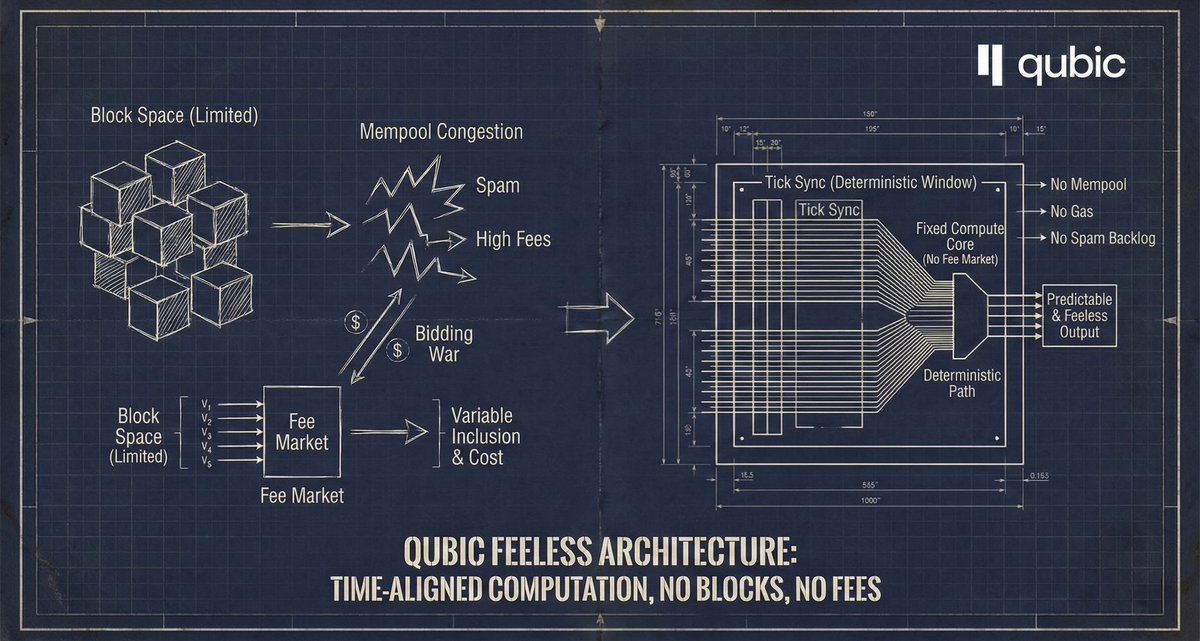
Qubic Has No Fees
Why This Works And Why Other Chains Cannot Do It
++ What “Fee-Free” Actually Means ++
Most blockchains must charge fees to survive.
They pay validators.
They prevent spam.
They ration blockspace.
Qubic removes fees for transfers.
And it works because the system is not built around blockspace at all.
(Qubic smart contracts do burn QUBIC during execution, but this is an economic burn, not a validator fee.)
++ Why Blockchains Need Fees ++
Traditional blockchains rely on:
• block producers
• mempool auctions
• congestion pricing
• fee markets
They serialize transactions into blocks, so users compete for space.
Without fees, the system collapses under spam.
Qubic chooses a completely different architecture.
++ Deterministic Ticks Instead of Blocks ++
Qubic runs on synchronized ticks.
Every tick executes the same compute step on every Computor at the same moment.
No block builder.
No race for inclusion.
No bidding for priority.
If your transaction arrives before the next tick, it executes.
If not, it waits for the following one.
Simple. Predictable. Deterministic.
++ Why Spam Doesn’t Break Qubic ++
Attackers cannot force the network to do more work.
Each tick has:
• a fixed deterministic compute budget
• a fixed execution path
• a fixed timing window
If a tick fills, excess transactions are simply not included.
They do not backlog in a mempool.
They do not raise fees.
They do not slow the system.
Spam increases the attacker’s bandwidth bill, not the network’s workload.
++ Why Validators Don’t Need Per-Transaction Fees ++
In normal blockchains, validators depend on gas fees.
In Qubic, Computors earn from:
• epoch rewards
• performance ranking via UPoW
• smart-contract IPO distributions
They are never paid “per transaction”.
Their job is correctness, not prioritization.
As a result:
There is no incentive to create congestion.
There is no incentive to manipulate fees.
There is no fee market at all.
++ History Pruning Removes Long-Term Costs ++
Qubic prunes history every epoch (~7 days).
Only the authoritative state (UNIVERSE) carries forward.
This means:
• no infinite blockchain growth
• no decade-long transaction log
• no replay-from-genesis
• no storage becoming a DoS vector
Nodes only validate state, not history.
++ Why Users Experience True Zero Fees ++
For transfers:
• no gas
• no variable pricing
• no competing bids
• predictable inclusion
• deterministic finality after the tick
For smart contracts:
• the user pays a burn to execute computation
• no validator is bribed or tipped
• execution cost is deflationary, not rent-seeking
++ The Core Insight ++
Qubic achieves fee elimination by replacing the block model entirely.
No blocks
No mempool
No fee market
No auctions
No serialization bottlenecks
Just time-aligned deterministic computation.
This is why Qubic can offer feeless transfers without sacrificing security or performance.
Qubic is not a cheaper blockchain.
It is a different compute model.
#Qubic $QUBIC https://t.co/HoLwhjkEKp ✨
Bare-Metal Execution vs Bare-Metal Infrastructure
== The Confusion ==
[>] Many chains say they run on “bare metal.”
What they really mean is they use bare-metal servers.
This has nothing to do with how their code actually executes.
Only Qubic does real bare-metal execution.
== Bare-Metal Infrastructure (Common) ==
[>] Solana, ICP, Sui, Polkadot and others run on dedicated hardware.
They rent or buy physical servers, install Linux, then run the node software on top.
This still includes the full OS stack:
kernel, scheduler, drivers, daemons, interrupts, network stack, user processes.
Every instruction passes through Linux first.
This is hardware ownership, not hardware control.
== Bare-Metal Execution (Qubic Only) ==
[CORE] Qubic does not boot into Linux.
It boots directly into UEFI, loads Qubic.efi and takes over the machine.
There is no operating system.
No kernel.
No scheduler.
No background tasks.
No virtualization.
No process management.
Qubic itself is the execution environment.
== Why This Matters ==
Linux adds unavoidable overhead:
context switches, interrupts, timers, paging, network stacks and scheduler noise.
These micro-delays cap performance and break determinism.
No amount of hardware solves this.
Qubic removes the entire OS layer.
== The Performance Gap ==
Solana on Linux peaks around ~65k TPS.
Other chains are far lower.
Qubic’s architecture is designed for multi-million TPS with deterministic tick timing.
The advantage comes from the execution model, not the hardware.
== Closest Comparison ==
The only systems that run this close to hardware are high-frequency trading engines where firms use FPGA or kernel-bypass techniques to eliminate OS jitter.
Qubic achieves similar benefits using UEFI bare-metal execution on commodity CPUs.
== Summary ==
Bare-metal infrastructure
= running on a physical server but still using Linux.
Bare-metal execution
= no OS, no kernel, no scheduler, no VM. The protocol runs directly on hardware.
Qubic is the only major project using true bare-metal execution.
$QUBIC #Qubic https://t.co/HoLwhjkEKp
Qubic’s Networking Layer: How the System Moves Data Without an OS
🌐
Most chains inherit their networking from Linux.
Sockets, kernel buffers, interrupts, background services.
Qubic uses none of that.
It talks to hardware directly.
🧩
Because Qubic boots on bare metal, it cannot use standard TCP or UDP stacks.
Its networking layer is handwritten, minimal, and built only for deterministic communication.
📨
Every message between Computors flows through Qubic’s own packet system.
No kernel space.
No user space.
Just Qubic packets, Qubic buffers, Qubic rules.
⏱️
Timing matters, so the network layer avoids unpredictable behavior.
No interrupt-driven delays.
No priority shifts.
No OS jitter.
🕚
The network operates on ticks.
Computors know when to send, when to receive, and which tick a packet belongs to.
This prevents cross-tick interference.
📦
Consensus traffic is extremely lightweight.
Each Computor broadcasts only a compact tick result.
The networking is tuned to deliver these packets fast and consistently.
🚫
Faulty or late packets are ignored automatically.
No rollback logic.
No orphans.
No block races.
Ticks either finalize or stall.
🔒
The networking code does one thing.
No optional protocols.
No user-facing endpoints.
Less surface area means fewer problems.
⚡
Bare-metal networking cuts away kernel overhead.
No copying data between layers.
Computors handle packets directly, keeping latency predictable.
🎯
Qubic’s networking is not general-purpose.
It is a dedicated channel for deterministic, tick-aligned communication between 676 machines.
The goal is not flexibility.
The goal is certainty.
$QUBIC #Qubic https://t.co/HoLwhjkEKp