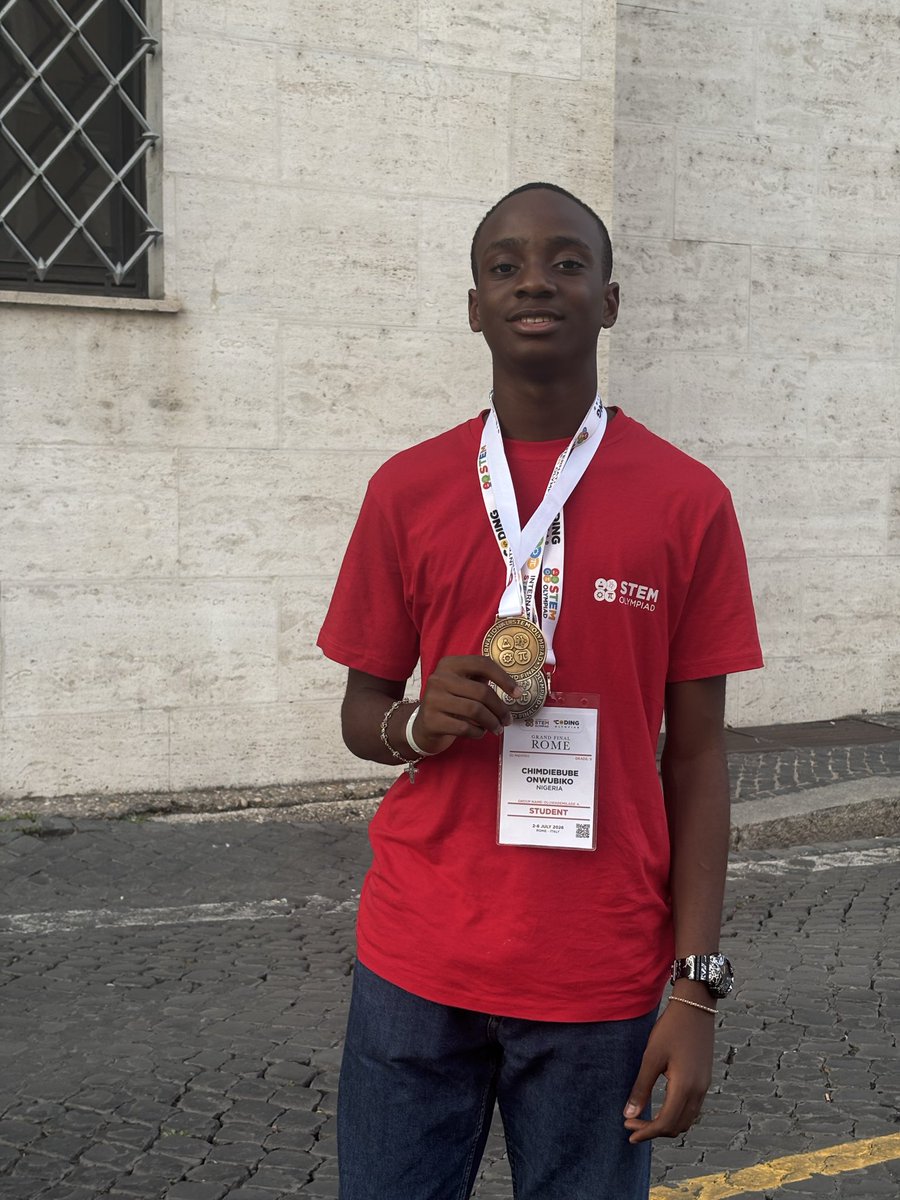
Egejurum Onyedikachi shares his experience winning the gold medal at the International STEM Olympiad Grand Final in Rome.
He is the best in the world in the Mathematics Primary Category.
He is a genius.
Chimdiebube Onwubiko won a gold medal at the International STEM Olympiad.
He is just 13 years old and currently in JSS3. He has finished _Engineering Mathematics_ by K.A. Stroud.
He has now proven himself on the world stage.
Today is D-day.
Our boys are now at the Università Campus Bio-Medico di Roma for the Grand Finale of the International STEM Olympiad in Rome, Italy.
I’m optimistic about their victory.
Next week, I will be taking 3 students and 2 teachers to Rome, Italy, all expenses paid by me.
All visas have been issued and all arrangements have been sorted.
The students will represent Nigeria in the Maths and Science categories of the International STEM Olympiad.
They will compete alongside 154 other countries.
The students who won the 2026 South East Maths Olympiad and the teachers who supported them are going. Both the teachers and the students will experience growth together.
I will continue to push our bright minds to global stages.
In 10 years, I pray you will be alive to see the outcome of our investments in our children today.
Father’s Day: A Time for Reflection
Today is Father’s Day. After attending church service and in my routine reflection, I find myself once again asking a difficult question: Are we cursed, or are we the cause?
I grew up in a Nigeria that was more united and peaceful. In my primary, secondary school and university days, students related freely without divisions of religion, ethnicity, or region. We simply saw ourselves as Nigerians.
After university, I entered business in an environment where partnerships were built on trust and competence, not tribe or religion. I also lived in Nigeria, where the naira commanded respect, and Nigerians enjoyed dignity abroad, with easier global mobility and much respect for our passports.
I lived in Nigeria, where I travelled across the country—from Onitsha to Lagos, Maiduguri, and Calabar—without fear. Roads connected people, and life was more secure. Nigeria’s Armed Forces and the Police were also widely respected for their role in global peacekeeping and international stability.
Beyond security and unity, there was also a stronger sense of public trust in institutions, with greater confidence in elections, a clearer culture of accountability in governance, more stable universities that served as centres of intellectual excellence and national pride, a more functional and accessible healthcare system, and relatively better-performing basic infrastructure such as electricity, roads, and public utilities, which—though imperfect—were far less chaotic than what we experience today.
Today, as a father reflecting on Nigeria, I am pained that much of this has changed. Insecurity has grown, national unity has weakened, and many citizens no longer feel safe. Opportunities have also diminished for the younger generation compared to what we once had.
It is also worrisome that Nigeria’s influence in global affairs appears reduced, as seen in recent international gatherings such as the just-concluded G7 meeting, where African countries like Egypt and Kenya were invited, while Nigeria was absent. Whether symbolic or not, it reflects a decline in standing we cannot ignore.
As fathers, we must not only lament. We must not bequeath this reality to our children. We owe them a better Nigeria built on security, opportunity, fairness, and national pride.
A key part of achieving this is active civic participation. We must obtain our Permanent Voter Cards (PVCs), vote responsibly, and remain committed to protecting the integrity of our votes. Change will not come from complaints alone but from citizens who choose and defend accountable leadership.
With responsibility, unity, and determination, we can together build the new Nigeria that is POssible. -PO
@PsudoMike Are you saying the law enforcement can access it without a warrant. A year of retention isn't back so far its secure and only accessible by the service provider.
Back in Lagos I never thought about community. It was just there. Family on every street, friends from school, guys from the neighborhood who'd show up unannounced.
Moving to Canada stripped all of that.
So I started a small group of African engineers here in Halifax. Twelve people. We meet monthly, talk about work, visas, money, missing home.
Those twelve people changed my life more than any job offer did.
If you're somewhere new feeling like you're starting from nothing, start with one group chat. One coffee invite. That's how it begins.
Moved to Canada and spent my first winter alone in a basement apartment. No family around, no real friends yet. Just me and a laptop.
The first person who invited me over for dinner was a coworker I barely knew. Changed everything. Not because of the food. Because someone saw me before I had anything to offer.
That kind of kindness stays with you longer than any promotion or milestone.
Who was that person for you?
In the midst of conspicuous cowardly silence of many pastors while the evil demonic creatures in power oppress Nigerians, we must give credit to who credit is due:
Bishop Oyedepo spoke up.
And he has spoken up for years.
He almost cried in this video.
I genuinely think secondary school and university students in Nigeria should stop copying notes.
It’s outdated.
It’s inefficient.
And it has zero relevance to the modern world.
In serious countries, students receive:
• Digital notes
• Slides by email
• Recorded lectures
• Transcripts & summaries
Here, we still spend 2 hours copying what a teacher wrote instead of thinking, asking questions, or solving problems.
What exactly are we training?
• Handwriting speed?
• Obedience?
• Or learning?
Why can’t our classrooms be digital?
Why can’t notes be shared instantly?
Why are we afraid of modern teaching tools?
We complain our graduates are not globally competitive
yet we’re still running 19th-century classrooms in 2025.
This has nothing to do with intelligence.
It’s a system failure.
A good time to make this spread and trend again…….
Let’s go !
Jesus just has to be who He says He is. No one gives this joy that He gives.
We celebrate our king, JESUS !
Nobody fought Dangote when he was doing sugar.
Nobody panicked over cement.
But the moment he touched oil, all hell broke loose.
Because sugar doesn’t threaten empires.
Cement doesn’t break colonial supply chains.
Refining oil does.
Refining our own oil breaks the hidden colonial agreement.
Nigeria was designed to export crude and import refined products forever.
That’s the real “agreement” nobody talks about.
That’s why refineries never worked.
That’s why obstacles multiplied overnight.
That’s why Dangote suddenly became a problem.
Oil gives Nigeria 80% of government revenue.
The same system that looted us for decades still wants its money back.
This is bigger than one man.
Dangote isn’t just refining fuel.
He’s challenging a global order.
If Dangote succeeds, industries will rise and Nigeria changes forever.
And that’s exactly what some unseen hands are working tirelessly to destroy.