🔥 THIS ISN'T JUST A HALFTIME SHOW. U2 IS BRINGING A SUPER BOWL-SIZED SPECTACLE TONIGHT!
The production details for tonight's performance at SoFi Stadium are absolutely insane:
🎬 Nearly 300 staff and crew dedicated to the halftime show
🎥 More than 10 Sony VENICE cinema cameras
🏟️ 108 field crew members and four team leaders handling the stage
🎤 A massive choir
✨ PixMob lighting technology turning the audience into part of the spectacle
🚛 A dedicated mobile production unit
Netflix isn't treating this like an ordinary NFL halftime show. They're producing a global entertainment event.
And with Bono, The Edge, Adam and Larry together again, celebrating 50 years of U2, the emotional stakes couldn't be higher.
Tonight, the football field belongs to four Irishmen.
THIS HAS ALL THE INGREDIENTS OF AN EPIC U2 MOMENT.
📅 November 25
🏈 Packers vs. Rams
⏰ Kickoff: 8 PM ET / 5 PM PT
📺 LIVE ON NETFLIX
DO NOT MISS IT! ❤️🔥
#U2 #U250 #Netflix #NFL #U2HalftimeShow
Let’s set the record straight @SenWarren. Big Medicine thrives today because of the “Affordable” Care Act aka ACA that your colleagues promised should solve all our healthcare woes back in 2010. As a practicing physician, I’ve had to endure this disaster daily with my patients!
The ACA wrecked the medical profession and the patient physician relationship. The ACA was written to strip physicians of their autonomy, boost insurer profits & drive healthcare consolidation. It created Big Medicine as it exists today!
End result 16 years later is a more expensive healthcare system with less competition resulting in lower quality, less efficient care for patients. Coverage is not care!
This is why deductibles are so high…Obamacare+for profit private ins covering the deficit of below cost Medicare and Medicaid’s payments…=🚀🚀🚀$$$$ to consumers. #FIXHEALTHCARE@HHS@POTUS (remove ALL the middlemen from healthcare!)
I'm a spine surgeon. You asked a fair question, so here's the plain-English answer.
Before 2012 you could buy an individual plan online for about $200 a month, pick from six or seven insurers, and choose your own deductible: $500 if you wanted to pay more up front, $5,000 if you didn't. If you were healthy, that is. If you were sick, they could turn you down, and that part was real and had to be fixed.
Obamacare fixed it by requiring every plan to cover everyone for everything. Good. But that made the real price of a plan jump, and the only way to keep the monthly number from looking insane was to push the cost onto the back end. That's your $6,500 deductible. You're paying comprehensive prices for catastrophic coverage.
Then the quiet part. The law caps what insurers can keep at 20% of premiums. So the only way an insurer makes more money is if the total bill gets bigger. 20% of $10,000 beats 20% of $5,000. They have no reason to fight the hospital's price. They pass it through, take their cut, and send you the premium.
And the hospital's price went up. Hospitals bought the independent doctors, and the same visit & surgery under the hospital's name now costs 3-10 times more. Hospital prices are up 281% since 2000.
The number of insurers you can choose from fell to one in half the counties in America by 2018. Meanwhile, six in ten adults now have a chronic disease, so the pool is sicker.
So: sicker patients, pricier hospitals, an insurer that profits from a bigger bill, and a law that moved the cost to your deductible. That's what you're paying for.
Nobody in that chain gets paid more if you get better. That's the part to fix.
Who is actually in charge of healthcare? Because right now, it doesn't feel like it's the physicians and it certainly doesn't feel like it's the patients.
I showed up to work today with two surgeries scheduled. Two women who had prepared for these procedures, arranged their lives around them, and trusted us to provide their care. Yet somehow, both cases ended up outside of my control.
This is what I find so frustrating about the healthcare system we're working in.
As physicians, we spend years training to make decisions in the best interest of our patients. We have medical licenses, professional obligations, and a responsibility to the people who trust us with their lives.
But increasingly, decisions about patient care are being made by people who aren't in the operating room, aren't treating the patient, and aren't necessarily accountable for the outcome.
Insurance companies determine where patients can receive care. Hospitals make decisions about staffing, resources, and where patients go after surgery.
And the physician is still expected to be responsible for the outcome.
I understand that healthcare is complicated. Hospitals have operational challenges. Insurance companies have financial considerations. But at what point did we become so focused on managing the system that we lost sight of the people it's supposed to serve?
These aren't just scheduling problems or administrative inconveniences.
These are real people. Women who are already navigating incredibly difficult circumstances. Women who have emotionally prepared and taken time away from their families, their jobs, and their lives to have surgery.
They deserve better than this.
And the healthcare professionals who show up every day wanting to do right by their patients deserve a system that allows them to do that.
I don't want to work in a system where providing appropriate care requires constantly fighting obstacles that shouldn't exist in the first place.
We have to do better.
To my fellow physicians and healthcare professionals, are you experiencing this too?
In my opinion, GABAPENTIN (Neurontin) is an awful drug. Does nothing to address the root cause of neuralgia/pain— only knocks out brain receptors.
Here are three very common problems I see, especially in people over 65:
1. Tolerance develops very quickly, so the dose has to escalate (just like a narcotic). Some of the high doses I see in older people, are absolutely insane. Would probably knock a horse out.
2. Altered mental status/sedation. In the hospital, the amount of times we have to stop gabapentin in a patient admitted to hospital (often because of their current illness). Their loved one, often their daughter or son will say— “My goodness, I haven’t seen mom/dad so awake and alert in a long time!”. Well, go figure.
3. Falls. This is a big problem, especially at high doses in older people. Often starts with dizziness and tiredness. One bad fall in a high risk person, and their life is never the same again.
I would never want any loved one of mine on gabapentin, and if it is prescribed because there’s no other alternative— let it be at the lowest possible dose, with an exit strategy (why oh why, do most medications nowadays prescribed by the medical profession, become “forever meds”?!).
I want to show you the most important year in the history of American health.
1977.
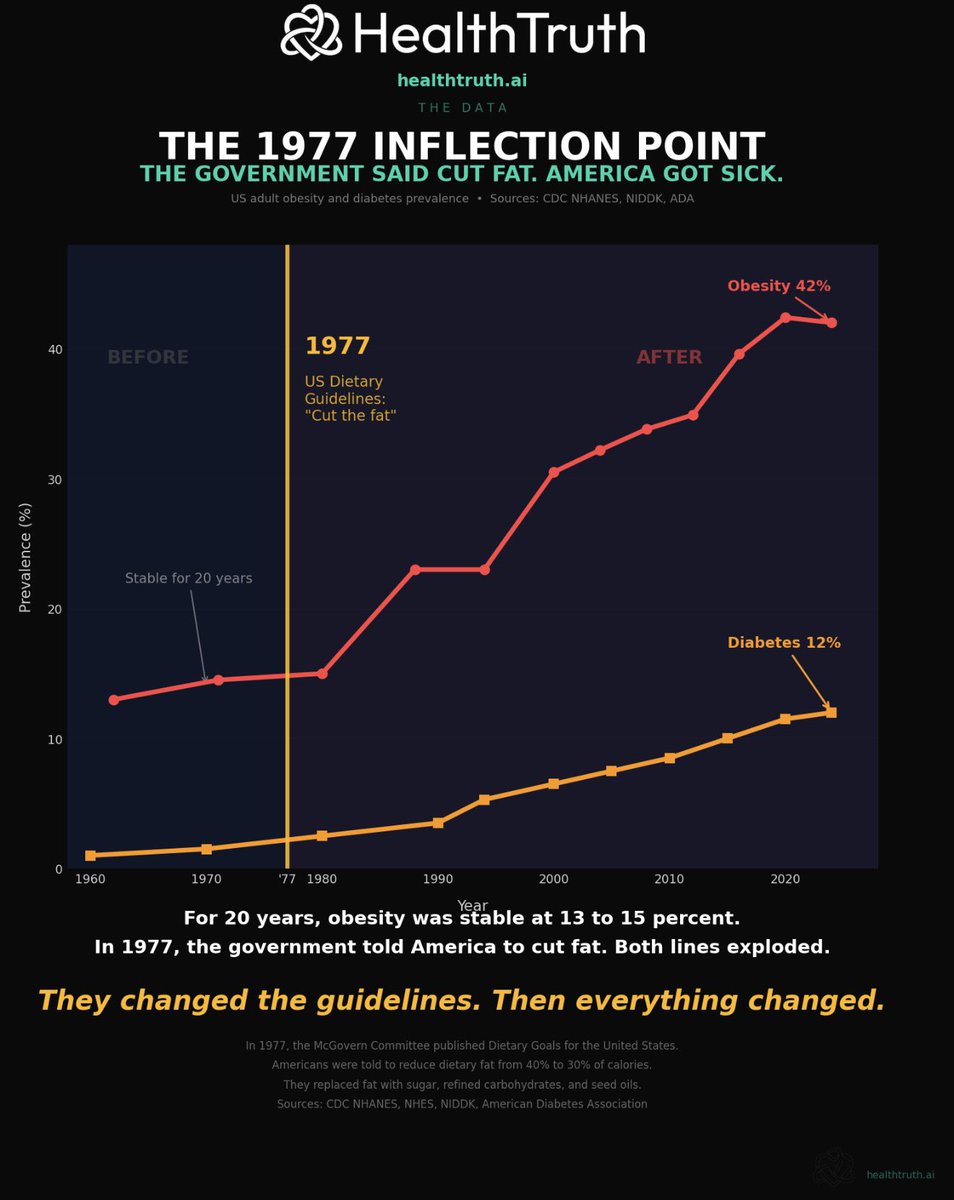
For 20 years before that line, obesity in America was stable. 13 to 15 percent. Flat.
In 1977, the McGovern Committee published the first Dietary Goals for the United States. The government told America to cut fat from 40 percent of calories to 30 percent.
America listened. And replaced fat with sugar, refined carbohydrates, and seed oils.
Look at what happened next.
Obesity: 15 percent to 42 percent.
Diabetes: 2.5 percent to 12 percent.
Both lines were flat before 1977. Both lines exploded after.
The government changed the guidelines. Then everything changed.
This is not a coincidence. This is a policy failure measured in millions of lives.
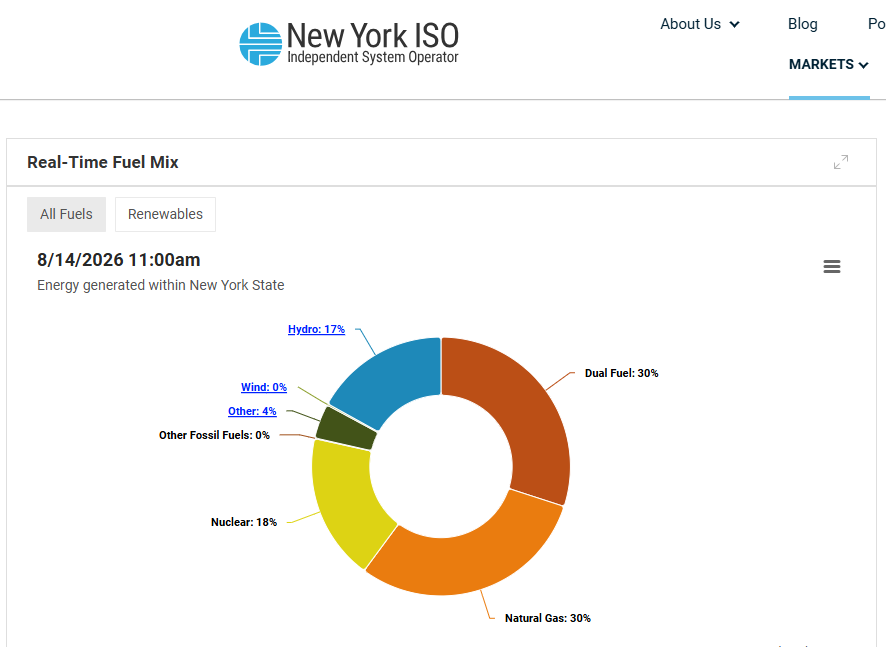
Across the state it's been a lovely sun-filled morning with bright skies and gentle winds. As we near noon, however, we find energy production from wind is 0 (zero) and energy production from solar (lumped in with methane and wood) is <4%. The kicker: we're all paying for this.
As a Doctor, here are 5 things I would do if any loved one, especially over the age of 65, was ever admitted to hospital. To make sure they have the BEST possible outcome:
1. Check at least twice on Day 1 and Day 2 that the medical team knows the exact medications and dosages they are taking at home. You wouldn’t believe how often this is wrong (it’s called Medication Reconciliation”)
2. Make sure that the nurses, physios, aides— get my loved one out of bed and moving ASAP as soon as they are recovering from the condition. Muscular deconditioning, or what I call “Sinking In Bed Syndrome” can set in extremely fast, and will turn someone who was fully independent into a completely different person within a few days.
3. Monitor for any change in mental status/increasing confusion. This is very common, can be disastrous and significantly increases risk of complications. Make sure you communicate as assertively as you can to the medical team that your loved one is not themselves. Is it a medication side-effect, dehydration, infection, or something else? It must be investigated ASAP
4. When the time comes for discharge, the follow-up plan must be crystal clear. The ball cannot be dropped on anything. What was the diagnosis, what abnormal tests need primary care follow up (labs/imaging), restrictions (diet, exercise), what specialists need to be seen, and what to do/who to call if any new symptoms occur.
5. Be at the bedside every hour I’m allowed to be there for my loved one. Rotate with other family members if needed. If it was up to me there would be zero visitation restrictions— as long as no other patients are being disturbed.
I like to see a family member in the room of every patient I see on hospital rounds. If they are not there, I get them on speaker phone so they can listen in and ask questions.
Hospitals are very busy places. There are some great dedicated medical staff, but mistakes happen all the time. I’ve worked in dozens of hospitals and it’s always the same.
Be a solid advocate for your loved one and be on the ball. Don’t be intimidated. Speak up. Ask questions.
I really believe the above can save lives.
Do follow me for more practical tips wellbeing and longevity. I wish you and yours luck and the best of health.
This isn’t just about the snow. The number of cloudy days throughout the year is what can really get old. Can’t beat the Finger Lakes for beauty though! #FLX#Rochester
Top 10 cities with the worst weather in the United States:
1. Anchorage, AK
2. Syracuse, NY
3. Madison, WI
4. Grand Rapids, MI
5. Rochester, NY
6. Allentown, PA
7. Hartford, CT
8. Pittsburgh, PA
9. Lansing, MI
10. Lincoln, NE
With everything we are hearing right now about ticks this seems like good information to share.
“Here’s what I’ve learned after more ticks than I care to count.
First, whatever your uncle told you, forget it. No matches. No nail polish. No Vaseline. No soap on a cotton ball. All of those do the same terrible thing, they stress the tick out, and a stressed tick empties its gut back into the bite before letting go. Which, if you think about what that actually means for a second, is literally how Lyme and the rest get transmitted so you’re not speeding up its exit. You’re making it throw up into you.
Fine-tipped tweezers. Grip right where the mouthparts enter the skin, not the body, the head. Pull straight up, steady, no twisting, no jerking. It’ll feel like it’s resisting because it is, the mouthparts are barbed. Just keep the pressure on and it lets go in a few seconds. If a piece breaks off in the skin, leave it alone. Your body pushes splinters out. Digging around with a needle does more damage then the fragment ever would.
Clean it with alcohol or soap. Wash your hands.
Now here’s the part most people skip: don’t flush the tick.
Tape it to an index card. Clear packing tape right over the body, write the date and where on your body it was, and stick the card in a drawer. If you come down with anything weird in the next 30 days, rash, fever, joint pain, that flu-that-isn’t-flu feeling, that tick goes with you to the doctor. Some labs will test the tick itself, which is faster and often more reliable than waiting for antibodies to show up in your own blood. A dated tick taped to a card is one of the most useful things you can hand a doctor who’s trying to figure out what’s wrong with you.
The other thing worth saying out loud: if the tick was engorged when you pulled it, and you can’t swear it was off your body within 24 hours, call your doctor that same day. Don’t wait for a rash. Fewer than three out of four Lyme cases even produce the classic bullseye. A single preventive dose of doxycycline within 72 hours of a deer tick bite cuts the Lyme odds way down, and most docs in tick country will write that prescription without giving you a hard time, especially if you walk in with the tick taped to a card and a clear timeline.”