A broke 17-year-old clerk wrote a letter about the hurricane that had just flattened his Caribbean town. Strangers who read it were so moved that they pooled money to ship him across the ocean for school. His name was Alexander Hamilton.
To even get into a colonial college in the 1770s, a teenager had to translate Cicero and Virgil out of Latin on the spot and read the New Testament in its original Greek in front of the professors. Harvard wrote the rule down in 1767: no entry unless you could read the Greek and Latin authors, write correct Latin, and show good character. That was just to get in the door.
James Madison enrolled at Princeton in 1769 and finished a three-year degree in two, studying Latin, Greek, math, rhetoric, and philosophy. Long hours of study may have damaged his health. He stayed on anyway to learn Hebrew and political theory under the college president. He stood five feet four and never weighed more than 100 pounds. His classmate Aaron Burr had first applied to the same college at 11, got turned away, came back at 13, and left with a degree at 16.
James Monroe was on the same path at William and Mary until early 1776, when he dropped out at 18 to join the Continental Army. That December he crossed the Delaware with Washington and took a musket ball to the shoulder at Trenton. It cut an artery. An army doctor tied it off on the spot, which is the only reason he lived to become president.
Hamilton wrote his way off a ruined island. Madison studied himself sick. Monroe nearly bled out in the snow at 18. The list ranks them by age, but what they share is how early and how hard each one got pushed, and how young the whole thing was.
The date itself holds one more fact. Three of the six men on the list died on the Fourth of July. John Adams and Thomas Jefferson both died on July 4, 1826, a few hours apart, on the 50th anniversary of the Declaration. James Monroe died on July 4, 1831.
If you’re turning left, you need to get into the intersection on green. It’s not in the manual but that’s how real life works.
Thank you.
- Everyone who understands how to drive
When 102-year-old World War II veteran Wally King asks you to have a beer at the Stop Bar in Sainte-Mère-Église in Normandy, you have a beer (or two) with Wally King at the Stop Bar in Sainte-Mère-Église in Normandy. What an honor! Wally flew 75 combat missions in the Second World War in P-51 Mustangs and P-47 Thunderbolts. He was shot down in April of 1945, parachuting out of his P-47 over Germany and becoming a POW before then evading both German and Soviet forces on his way to freedom. Legend!
I’ve been fortunate enough to travel to Normandy with Wally three times for D-Day commemoration events with the Best Defense Foundation over the past few years. We always have a blast! 🇺🇸
“I ain’t never killed no-one in my life, but if you want me to start with you let’s get on with it old man. See if you can grab that pistol before I blast you off this porch.”
HELL OR HIGH WATER (2016)
A brilliant Movie.
#ChrisPine#JeffBridges
Every year, I share this video of French caretakers who take sand from Omaha Beach in Normandy, and scrub them into the letters to give them the gold coloring.
They do this for all 9,386 US soldiers who died.
France also gave us this land as American soil. #MemorialDayWeekend
Farm bailout money doesn't stick with farmers.
The input companies and equipment dealers know it's coming before you do and they price accordingly.
Follow where the money actually ends up.
It's almost never at the farm.
“We gave up our yesterdays for your tomorrows.”
98-year-old World War II veteran David Yoho delivered an emotional message at the WWII Memorial in Washington, D.C. as Americans gathered to honor the more than 400,000 U.S. service members who died during the war.
Standing before the crowd in the rain, Yoho urged younger generations to remember the sacrifices made by veterans and to keep telling their stories long after they’re gone.
“Tell them it was a 16-year-old boy in the hearts and mind and body of a 98-year-old veteran of World War II.”
Dear @realDonaldTrump@POTUS,
Consumers can choose cheaper proteins instead of beef if prices get too high. But when Americans pull up to the gas pump, they have no alternative. Focus on lowering fuel prices instead of attacking cattle producers.”
On this Kentucky Derby day, here’s your reminder that Secretariat was faster than any horse who has ever lived. The year is 1973 and this is his track record run. Untouched for 53 years. The GOAT.
This story is now more than 25 years old and I have told it more times than I can count, but it hits very differently today.
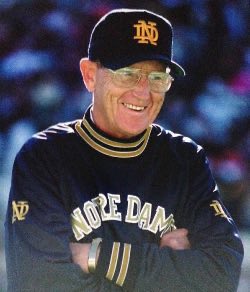
I was anchoring SportsCenter one afternoon and Lou Holtz was on the show. I was quite excited to talk with him, he had been an icon all of my life.
He was very friendly, asking me all about myself as we walked toward the studio to record an interview. I told him: “Actually, Coach, it’s quite exciting, my wife and I are expecting our first child in the next few weeks.”
He stopped dead in his tracks and put a finger up near my face. And I’ll never forget what he said.
“Young man, the most important thing you can do for a child is make sure every day they know how much you love their mother.”
And, just like that, he started walking again.
Our daughter was born a month later, our son came two years after that. And I have thought about what Lou Holtz said to me that day about a million times since.
RIP Coach, thanks for the best advice anyone ever gave me.
“We’ve lost 86,000 cattle feeders like me.”
“Over half of our cow-calf producers are gone.”
Farmer Mike Callicrate just delivered an urgent plea to Congress:
“Break up the corporate middlemen who are extracting an unfair share of the retail dollar while denying a fair income to producers and workers.”
“Since I first got into the cattle industry in 1972, retail meat prices have become increasingly disconnected from cattle prices as monopolistic middlemen push producer prices lower and consumer prices higher.”
“The producers’ share of the consumer dollar is now around 50% in beef, down from around 80% in 1970, when we had a lot of independent meat packers all over the country working with independent grocery stores.”
“What can be done?”
“We need to reform USDA’s meat inspection service to make it more workable for small processing plants.”
“Invest in local regional food infrastructure and outlaw government purchasing of meat from large, multinational and foreign-owned corporations.”
“That business should go to small and mid-sized slaughter plants, keeping the wealth from agriculture local, creating jobs, and revitalizing rural communities.”
“We’re now relying on imports at a time when dietary guidelines are re-emphasizing high quality protein.”
“Small plants like mine need fair food policy.”
“Small processors have essentially no access to wholesale markets due to unfair advantages and predatory practices of big food companies.”
“It’s past time to enforce antitrust laws and break up the meat monopolies like Congress did in the 1920s.”
“Otherwise, consumer prices will remain disconnected from prices paid to producers, and will likely keep rising.”
@MikeCallicrate
Rebuilding the U.S. cattle herd isn’t realistic. Pasture land has been converted to crops, development nationwide. The population is up ~25 million in 10 years, beef demand is strong, and supply is tight. Beef is becoming a premium product — like fine bourbon or wine.
@JerodMcDaniel All just a bunch of talking head day thugs. Stay in the circle long enough the palm of your hand starts to open to the people that really run everything anyway