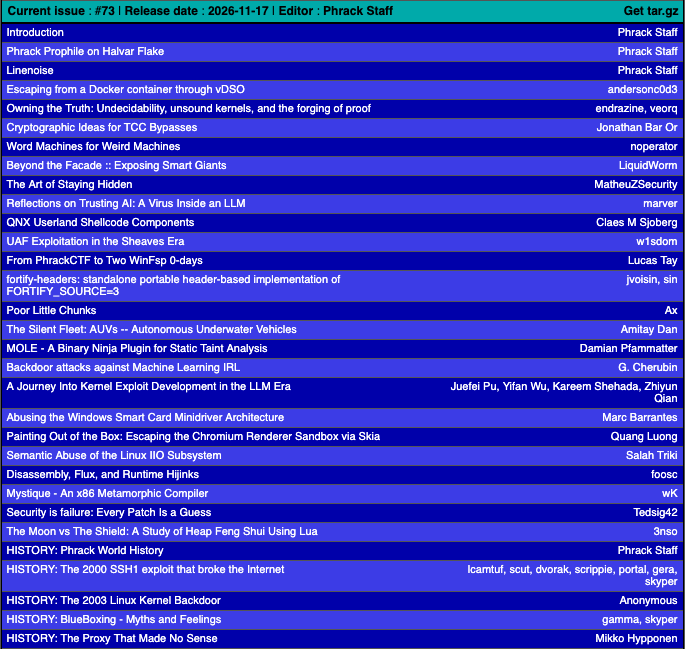
@elainedbatista@RowdyRabouw@rblmdst@CamiPillotDev 🎤 𝗪𝗲 𝗽𝗿𝗲𝘀𝗲𝗻𝘁 𝗼𝘂𝗿 𝗞𝗲𝘆𝗻𝗼𝘁𝗲 𝘀𝗽𝗲𝗮𝗸𝗲𝗿 : @marver
Frontier AI labs say the vulnerability problem has an expiry date: a rough 18 months of AI-found bugs, then “vulnzero”, when we stop shipping security bugs for good.
@elainedbatista@RowdyRabouw@rblmdst@CamiPillotDev 🎤 𝗪𝗲 𝗽𝗿𝗲𝘀𝗲𝗻𝘁 𝗼𝘂𝗿 𝗞𝗲𝘆𝗻𝗼𝘁𝗲 𝘀𝗽𝗲𝗮𝗸𝗲𝗿 : @marver
Frontier AI labs say the vulnerability problem has an expiry date: a rough 18 months of AI-found bugs, then “vulnzero”, when we stop shipping security bugs for good.
Announcing a major milestone achieved by my team @GoogleDeepMind: we have proven key security properties of the machine code underlying the Signal messaging protocol. This is the first time the actual production code of a widely deployed protocol has been formally verified – by any method, with or without AI – and at this depth.
More than a research breakthrough, it’s a prime example of how frontier AI can be a force multiplier to counter the speed and scale of modern cyber threats.
Formal verification offers a higher standard of security; however, it’s extremely complex and time consuming, which is why in many cases it’s considered to be impractical. Similar efforts could take teams decades of combined effort. We did it in a month’s time.
Using AlphaProof Code, Google DeepMind's new agentic framework for formal verification that runs on LLMs including Gemini Carbon, we verified the Signal protocol down to the actual code running on devices. This milestone lays the groundwork for a future in which vital systems, from medical device firmware to power grid software, ship with mathematical proof that their protections work.
Reaching that future will take continued research from our community. In that spirit, we're open-sourcing our formal specifications and verification artifacts so others can build on this work.
On a personal note, this moment is of deep significance to me. I started my own research journey more than two decades ago as an intern working on checking the consistency of complex software systems. Seeing this grand challenge made practical with modern AI is extraordinary.
I'm extremely proud of my team members: Swarat Chaudhuri, Andrew Ferraiuolo, Anton Kovsharov, Tej Chajed, Sam Schlesinger, Karn Seth, Jonathan Katz, and Charles Sutton for taking on this grand challenge and delivering, and grateful to the Signal team for their partnership.
https://t.co/kN1eRYQ8fF
Norway now has more than 2,000 underwater AI laser robots shooting lice off its salmon
they're made by a company called Stingray, and they already guard more than 50 million salmon and trout 24/7
the reason is sea lice, tiny parasites that latch onto salmon and feed on them
as few as 11 can kill a small fish, and one pen can hold 150,000 salmon
the usual fix is pumping the fish out and blasting them with warm water or water jets to knock the lice off
but the handling is so rough that Norway's fish health report ranks it the top cause of death in full-grown farmed salmon
so instead, Stingray puts a robot inside the pen that hunts lice one at a time, all day:
> two cameras watch every salmon that swims past
> AI checks two frames to make sure it's really a louse
> then a green laser fires from up to 2 meters away
> the salmon's scales reflect the beam, so the fish swims off fine and the louse is dead
we now live in a world where AI lasers do pest control on your dinner lmao
30 years ago today, Phrack 49 published Aleph One’s “Smashing the Stack for Fun and Profit”.
A legendary paper that inspired generations of hackers and helped shape modern exploit development.
Still an essential reading.
https://t.co/qAQ5CWgNj0
Phrack 73 is coming soon!
1/ We are doing it totally wrong with vulns.
In my new post I dig into @googlechrome’s vuln data to show that the AI-driven Vulnpocalypse settled a 20-year-old debate: vulnerabilities are dense. Our defenses are still built as if they were sparse.
https://t.co/u46KydU2wS
@evilsocket Well said! In my experience having AI add code on a well designed software suite can be very effective if constrained and reviewed right. It gets complicated when doing something complex from scratch..
Creating the atomic for SSHHole today was a nice study on the power of having AI integrated into a test environment and interact with it in a defined way. From zero to testable exploit took only a few minutes!
Huge libraries of static atomics are a legacy concept.
musl-based containers running #OpenSSH below 10.6p2 may accept logins to locked accounts - no credentials needed.
#Nemesis tests this safely in your environment (on-cloud or on-prem with local AI) and generates SIEM rules specific to your stack.
#BreachAndAttackSimulation
musl-based containers running #OpenSSH below 10.6p2 may accept logins to locked accounts - no credentials needed.
#Nemesis tests this safely in your environment (on-cloud or on-prem with local AI) and generates SIEM rules specific to your stack.
#BreachAndAttackSimulation
While back @goteleport brought us to #NYC to build a setup attendees had to break.
Using #Nemesis we engineered the environment, the clues & the automated backend that kept the CTF running.
Seeing our adversary emulation platform power the chaos was fun.
https://t.co/IGR5GRgYB9
@julianor@ifsecure@j00ru So the issues we have seem to be more on the communication and security side. We have all the tools to find such bugs but can’t deal with them once found..